Operation Kadesh
JudasOperation Kadesh, also called Operation Sinai, becomes a point of political argument between Shmuel Ash and Gershom Wald rather than a battle narrated directly. Shmuel sees it as a costly alignment with Britain and France that intensified Arab hostility; Wald challenges the idea that the operation created that hostility. Their exchange places the campaign within a larger dispute over Israel’s security, its dependence on Western powers, and whether force can do more than postpone catastrophe.
The operation as a political turning point
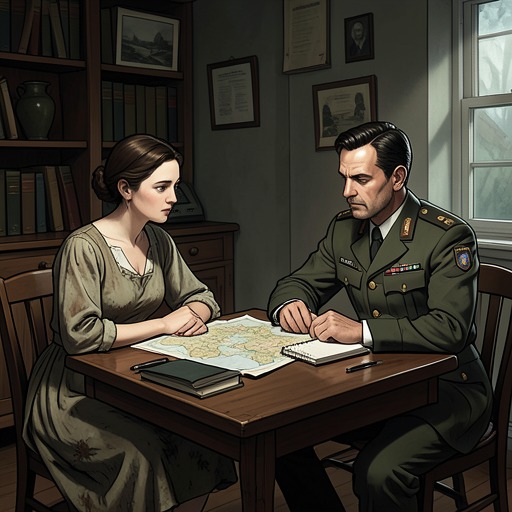
During their discussions in the library, Shmuel argues that Ben-Gurion’s government tied Israel to two colonial powers he regards as declining: France and Britain. In Shmuel’s account, Operation Kadesh deepened Arab hatred and reinforced the view that Israel was an alien presence in the region, acting as an instrument of world imperialism. He therefore presents the operation not simply as a military decision but as a political choice with consequences for how Israel was regarded by its neighbors.
Wald disputes the implied cause and effect. He responds that Arabs had little affection for Israel even before the operation, refusing to treat the campaign as the origin of the conflict. The disagreement remains unresolved: Shmuel emphasizes how the alliance confirmed Arab fears, while Wald insists that hostility was already present. Their exchange allows neither a simple claim that the operation caused enmity nor the comforting assumption that the alliance had no bearing on it.
The unresolved question of land and legitimacy
Shmuel’s criticism broadens beyond the alliance with Britain and France. He asks why Arabs should welcome newcomers who, in his account, arrived in large numbers and took land, fields, villages, cities, ancestral graves, and the inheritance of their children. He challenges the claim that Jewish return and rebuilding would naturally be welcomed, pointing to the gap between Zionist self-understanding and the experience of those already living in the country.
He also objects to the appeal to sacred books as a justification for exclusive possession of the land. The argument makes the operation part of a deeper political predicament: military alignment and security calculations cannot, by themselves, answer the question of how Jewish national claims are received by the Arab population or resolve the conflict over land and power.
Ben-Gurion and Abravanel’s opposing approaches
The argument reaches back to 1948, when Shaltiel Abravanel, Atalia’s father, tried to persuade Ben-Gurion that an agreement with the Arabs might still be possible as the British departed. Abravanel advocated a joint political arrangement for Arabs and Jews, accepting the abandonment of a Jewish state; for this position he was removed from the Zionist Executive and the leadership of the Jewish Agency. Wald admits that he supported Ben-Gurion’s uncompromising realism in that debate rather than Abravanel’s proposals.
Shmuel, by contrast, condemns what he sees as Ben-Gurion’s later transformation from a workers’ leader into the head of a nationalist state, surrounded by biblical language about restoration and fulfilled prophecy. The contrast is not simply between idealism and practicality. Abravanel’s proposals addressed Arab fears and the possibility of coexistence, while Ben-Gurion’s approach, as Wald later explains it, began from the expectation that the Arabs would not willingly share territory or power and that Jewish survival depended on securing what would not be given freely.
Abravanel’s alternative was more specific than a general hope for peace. He argued that after the British Mandate ended, a Jewish state would provoke a bloody war with the Arab world, and possibly with the wider Muslim world. He proposed an international mandate or a provisional government under American supervision, along with a pause in conspicuous demands for a Hebrew state. In his analysis, Arab opposition arose especially from fear that Jewish advantages in education, technology, ingenuity, and motivation would lead to expansion and control of the wider territory. Wald recalls these warnings as having been voiced before the events that followed, giving the later debate the force of an argument over a rejected forecast as well as over the operation itself.
Alignment, deterrence, and the limits of force
Shmuel connects Operation Kadesh to Israel’s abandonment of non-alignment. He argues that Ben-Gurion placed the country in a dependent relationship with Western powers, specifically Britain and France, whose weakness was becoming apparent. Wald’s account of the debate thus concerns not only the wisdom of a military operation but also the risks of attaching Israel’s security to powers whose position was deteriorating.
Shmuel describes the alliance as one with ships already sinking, citing the unrest in Algeria and Britain’s retreat from the remnants of its empire. His criticism is directed at the strategic judgment behind the alignment: in his view, Israel had bound itself to declining partners without overcoming the hostility that made security necessary in the first place.
At the same time, Shmuel does not argue that Israel can dispense with military power. He acknowledges that force separates the country from immediate destruction, but insists that it cannot turn an enemy into an ally, a fanatic into a tolerant person, or a vengeful person into a friend. Military power can prevent disaster for a time; it cannot repair or settle the underlying conflict. That distinction gives the argument its central tension: security may require force, yet treating force as a solution risks confusing temporary survival with reconciliation.
Narrative and historical significance
The operation is recalled through conversations in Wald’s library, where news, tea, and arguments bring present political judgments into contact with earlier choices. Wald’s memories of Abravanel and Shmuel’s reading of political history provide competing interpretations rather than a single authoritative verdict. The novel’s debate keeps Operation Kadesh linked to the unresolved consequences of 1948, the loss of Abravanel’s political standing, and the continuing disagreement over whether Israel’s security is best pursued through alignment and deterrence or through restraint and accommodation.
The exchange also exposes how political language can turn national survival into a story of destiny. Shmuel objects to biblical rhetoric when it sanctifies state power, while Wald’s defense of Ben-Gurion rests on the hard premise that good intentions and appealing words would not secure Jewish survival. Against both positions, Abravanel’s proposals remain a measure of the compromise that was considered and rejected. Operation Kadesh matters in this account because it concentrates those enduring disputes—about alliance, force, land, and the possibility of coexistence—without resolving them.