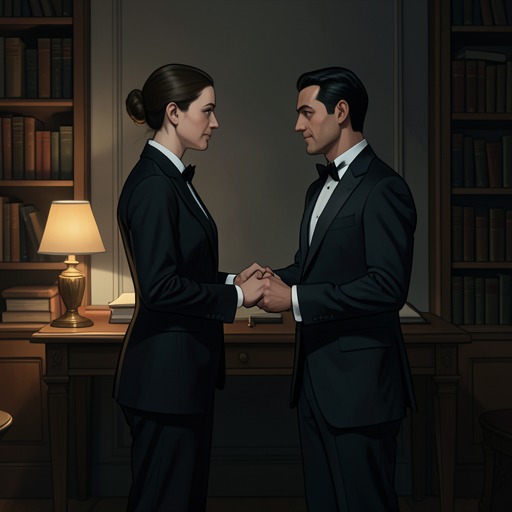
Juliette and Monsieur de Corville’s romantic relationship
JustineJuliette and Monsieur de Corville’s romantic relationship provides a brief refuge for Justine, but ends when Justine’s sudden death prompts Juliette to renounce her former life. Their final parting turns an intimate bond into a contrast between Juliette’s religious penance and Corville’s continued public service.
A Relationship Put to the Test
By the time Justine is entrusted to Corville, he and Juliette are lovers. Corville takes responsibility for Justine’s innocence and secures her release into his care while her case is clarified. When he explains what he has done, Juliette responds by kneeling before him and praising his intervention as an act of humane judgment and respect for the law. Her gratitude deepens her esteem for him: she presents the rescue not merely as a kindness to her sister, but as a new ground for their attachment.
The sisters and Corville arrive at his château, where he and Juliette together work to restore Justine’s well-being. They provide food, comfortable lodging, medicines, baths, and elegant clothing, and try to give her the freedom to make her own wishes known. Their shared care makes the relationship visible through action: the lovers turn their household into a place of shelter for someone who has repeatedly been abandoned and harmed.
Justine’s Death and Juliette’s Decision
That shelter does not last. During a storm at the country estate, Justine is struck by lightning while trying to close the windows. Juliette faints at the sight of her sister’s death, then recovers and asks Corville not to remove the body. She says that she must contemplate Justine as she considers the decision she has just made. The disaster, rather than Corville’s conduct, becomes the immediate occasion for their separation.
Juliette reads Justine’s lifelong suffering, despite her efforts to live virtuously, as a warning about her own past of libertinism and irreligion. She argues that the apparent prosperity of those who wronged Justine should not seduce anyone into abandoning virtue, and treats the lightning strike as an image of brief worldly brilliance ending in ruin. On that basis, she tells Corville that their bond no longer binds them and asks him to accept her resolve to spend her remaining years in penance.
Parting and Divergent Paths
Juliette leaves Corville’s estate at once, taking some money but leaving the rest of her property with him to be made into a charitable legacy. She asks him not to search for her. In Paris, she takes the Carmelite veil and later becomes an example to her order through her piety, judgment, and regular conduct. Her departure is therefore both a break with Corville and a renunciation of her former way of life.
Corville does not oppose her decision. He rises to high office and uses his position to bring happiness to the people, serve his ruler, and assist his friends. The former lovers’ endings are distinct but not hostile: Juliette seeks expiation through religious life, while Corville’s account concludes with a career devoted to public and personal service. Their separation gives the closing moral its human form, as Juliette’s response to Justine’s fate overturns the apparent attraction of worldly success in wrongdoing.