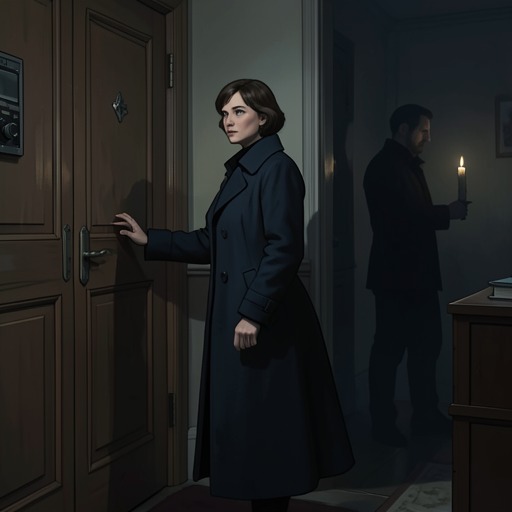
Therese and Dubois’s antagonistic relationship
JustineTherese and Dubois’s antagonistic relationship turns apparent rescue into a means of recapture, recruitment, and betrayal. At Villefranche, Dubois admits that she arranged the inn fire to seize Therese for Monseigneur; when Therese refuses to join her proposed murder, Dubois abandons her to the law under a false account of the fire and their encounter. Their conflict exposes how Dubois converts assistance into leverage, while Therese insists that neither criminal expediency nor private vengeance can make wrongdoing legitimate.
From Rescue to Recapture
After escaping Monseigneur’s estate, Therese is traveling with Madame Bertrand when they reach Villefranche. In the night, a fire breaks out at the inn. Therese attempts to rescue Bertrand’s child, but loses hold of the child while crossing a damaged beam; amid the confusion, she is seized and carried away. In the carriage, she discovers Dubois beside her, threatening her with a pistol if she speaks.
Dubois claims responsibility for the fire. She says that she had missed Therese at Lyon by two hours, reached Villefranche after her, and had the hotel set alight by men in her employ. The fire was meant either to kill Therese or to make her escape impossible. Dubois further explains that Monseigneur had been furious about Therese’s flight and had threatened her for failing to return the girl. She is bringing Therese back to his country residence, where, she says, Therese will be treated cruelly. Thus Dubois’s role as captor is not incidental to the fire: she presents the disaster as a calculated means of recovering someone she regards as a commodity for which she is paid.
An Offer of Criminal Alliance
On the journey, Dubois offers Therese a way to avoid being returned to Monseigneur: participate in the murder and robbery she is planning. She describes the country residence as isolated and says that Monseigneur lives there with a single valet when he holds his parties. Dubois proposes that she, Therese, and the driver overpower Monseigneur while her own accomplice kills the valet. She claims that more than eight hundred thousand francs are hidden in the house, making the proposed crime lucrative as well as a means of escape.
Dubois attempts to justify the plot as punishment deserved by a man who, she alleges, murders a girl every day. She argues that Therese would be helping the law by assassinating him, and threatens to accuse Therese of having devised the plan if Therese exposes it. The offer therefore combines coercion with a moral argument: Dubois presents private violence as justice while protecting herself against the consequences.
Therese rejects that reasoning. She answers that Dubois proposes the murder for her own benefit, not to punish crime, and that even a desire for vengeance would not authorize them to act in place of the law. Her refusal establishes the central ethical division between them: Dubois treats the prospect of escape and money as grounds for complicity, whereas Therese maintains that a criminal act does not become just simply because its intended victim is wicked. Her answer also leaves her more exposed to Dubois’s power, since the proposed alliance was the only protection Dubois had offered against Monseigneur.
Betrayal Before the Constables
Before the carriage reaches its destination, six constables intercept it as the party enters Dauphine. They identify Therese as the woman sought for setting fire to the principal hotel at Villefranche. Dubois, herself under arrest, responds by inventing a story that makes her appear to have been an innocent benefactor: she claims she had been staying at the inn, met Therese after the fire, believed her account of losing everything, and agreed to take her along as a servant. She portrays her decision as an act of misplaced compassion and declares that she will not protect someone guilty of the alleged crime.
Therese tries to denounce Dubois, but her accusations are dismissed as slander. The contrast between them determines how the officers receive their accounts: Dubois presents herself as a wealthy, respectable woman, while Therese is poor and unprotected. Dubois’s invented story also gives the officers an explanation for why she is traveling with Therese, turning their captor-and-captive relationship into an apparent case of a benefactor deceived by a suspect.
The accusations against Therese expand beyond the fire. Dubois invokes the loss of her possessions to allege that Therese set the blaze to rob her and exploited the child’s death to distract her. She also maligns Therese’s character and invents a history designed to make her seem criminal. These claims are not established as true: the narrative presents them as Dubois’s calumnies, which the authorities accept in place of Therese’s account.
The Brand and the Consequences
A search of the scene appears to support suspicion because the fire began in a hayloft Therese had entered while trying to find a water closet. That circumstance gives the officers grounds to treat her presence there as incriminating, although it does not establish that she started the fire. When Therese offers to be searched for the money she is accused of stealing, the officers dismiss the suggestion, assuming she must have passed the funds to accomplices.
Dubois then exploits knowledge of the brand previously inflicted on Therese by Rodin. She suggests that examining Therese’s body may reveal evidence of a criminal character. Therese recognizes the manoeuvre: Dubois knows the mark’s history but presents it as confirmation of guilt, suppressing the history that might have explained it. Therese identifies this deception to the officers, yet the brand works against her. They say that her statements and the mark condemn her, handcuff her, and take her away. Before leaving, Dubois gives the guards a few crowns, an act that completes her performance of respectability while Therese is placed in their custody.
The immediate consequence of Dubois’s betrayal is Therese’s imprisonment in Lyon. She is registered as an arsonist, a thief, a harlot, and a child-murderer, although the account makes clear that these charges arise from Dubois’s accusations and the officials’ acceptance of circumstantial appearances. Seven people died in the hotel fire; Therese herself had nearly perished while trying to save Bertrand’s child. Dubois, whom Therese identifies as the person who caused the disaster, escapes the immediate consequences and continues toward further crimes. Their antagonism is therefore not a simple contest between two equally situated opponents: Dubois can manipulate money, social standing, and a mark on Therese’s body, while Therese’s truthful protest is recast as the speech of a guilty and disreputable woman.
The Relationship’s Moral Conflict
Dubois repeatedly frames herself as Therese’s possible protector: first by offering to save her through a criminal alliance, then by telling the constables that she took her in out of pity. In both instances, the language of assistance conceals control. The proposed rescue requires Therese to accept murder and theft; the later account of kindness conceals that Dubois had arranged the fire and forcibly recaptured her. The supposed benefactor is, in both scenes, the source of the danger from which she claims to offer relief.
Therese’s resistance remains consistent across the reversal. She refuses to join Dubois in killing Monseigneur, and she attempts to expose Dubois when the constables arrive. Her appeal to lawful judgment is especially stark beside Dubois’s claim that the murder would merely assist justice: Therese refuses to let private interest masquerade as public justice, even though this principled distinction cannot protect her from a legal process already biased by wealth, appearance, and suspicion. The relationship consequently crystallizes the novel’s contrast between virtue and crime: Dubois’s deceit secures her temporary advantage, while Therese’s honesty leaves her accused and imprisoned.