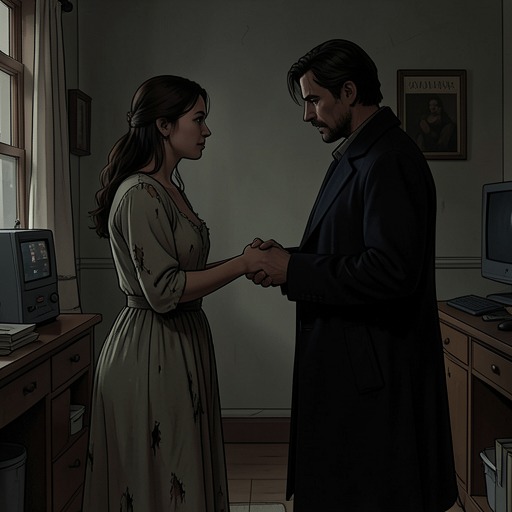
The Comte and Madame de Gernande
JustineThe relationship between the Comte and Madame de Gernande is defined by coercive control: he confines his wife, conceals her condition from her family, and subjects her to a repeated bloodletting regimen while presenting the household as orderly and well provided for. By assigning Therese to care for the Countess, he turns the newcomer into both a witness to the system and a potential accomplice; her refusal to accept its logic ultimately helps her escape.
Marriage as a System of Control
The Comte tells Therese that Madame de Gernande is his wife, but treats that status not as a bond of mutual protection but as a means of possession. He insists that passion, rather than hatred or revenge, drives his cruelty, and says that he takes pleasure in shedding her blood. He also makes clear that the violence is not an isolated episode: for three years, the Countess has been subjected to the same treatment every four days. The marriage’s private authority gives the Comte repeated access to his victim and allows him to recast abuse as a matter of personal taste.
His control extends beyond the immediate violence. He prevents the Countess from going out or receiving visitors and tells Therese that he represents her as insane. Her mother, the only living member of her family, lives six leagues away and has been convinced of the supposed derangement, so she does not dare visit. The Countess’s isolation is therefore maintained by deception as well as force: the husband who inflicts the harm also controls the account by which outsiders might recognize it.
The Regimen and Its Rationalizations
The Comte describes the bloodletting as a managed routine. Every ninety-six hours, he says, the Countess loses two bowls of blood; she then spends a day bedridden and is said to manage tolerably during the remaining three. He claims that special care and the replenishment of her blood keep her in fairly good health. That language of maintenance makes the violence sound like a domestic regimen, even as the Countess’s own efforts to inform her mother show that she wants to escape it.
According to the Comte, the Countess once tried to enlist two maids to help her communicate her situation. Their plans were discovered and the women were ruined. He says that she later repented of involving them and promised not to make confederates of the servants he hired to care for her. He uses this history to justify keeping her near only people who have themselves been impressed and therefore cannot readily expose him. The household’s care and its surveillance are inseparable: attendants provide for the Countess, but their presence also serves the Comte’s secrecy.
Therese as Witness and Attendant
The Comte assigns Therese the task of looking after the Countess and warns that he can punish her without attracting inquiry. He says that, unlike someone taken from another household, Therese has no one to whom he must account for her disappearance; in his words, she effectively no longer inhabits the world. Her position is thus made precarious from the outset: she is both a captive under threat and a designated participant in the Countess’s care.
Therese meets the Countess shortly before another scheduled bleeding. When she asks when the last one occurred, the Countess says it was three days earlier and that the next is due tomorrow. She speaks of her continuing youth and apparent strength, but also hopes that she will not have to endure the treatment much longer and places her hope in finding rest with God. Therese resolves not to leave her in the Comte’s power if she can prevent it. That decision turns their relationship from one imposed by the husband into a bond of witness and attempted protection.
The Comte’s ritual makes the limits of that protection plain. He orders Therese to undress the Countess and bring her to him; Therese emphasizes that she submits because she has no choice, not because she consents. Later, he places the Countess in restraints and directs Therese to secure them. Therese complies under coercion, while understanding that the ordeal is being inflicted on the woman she has promised herself to help. The scene makes the Comte’s authority depend not only on his own commands but on forcing those around his victims into service.
Retaliation and Escape
After Therese helps the Countess during the Comte’s ritual, he turns his anger against her. He drags and injures her, threatens to make her death more horrible, and leaves her in fear of what punishment will follow. After thirty-six hours, he returns and declares that he will bleed her three times a day as an experiment. His treatment of Therese repeats the logic of his treatment of his wife: bodily control is presented as a private prerogative, and the threat of death is used to make resistance seem futile.
The opportunity to escape comes when a servant reports that Madame de Gernande is dying and wants to speak to the Comte. Alarmed, he leaves Therese’s cell unsecured. Although weakened by fasting and blood loss, she escapes through the court and park and reaches the forest. She later travels to Lyon and learns that the Countess’s death has saved her from the immediate danger at the château. The escape does not undo the Comte’s system, but it breaks his control over Therese and shows how the crisis created by his violence can momentarily open a way out.
Narrative Significance
The Comte’s marriage to the Countess is a concentrated example of the book’s recurring contrast between apparent order and concealed violence. His claims that she is cared for, that her strength remains adequate, and that her isolation is necessary cannot erase her expressed wish for release or Therese’s testimony about what happens inside the household. The distance between the Comte’s polished rationalizations and the victims’ accounts exposes the power of private authority to manufacture a public appearance of normality.
The episode also complicates the role of the attendant. Therese is compelled to assist in the abuse, yet the narrative distinguishes coercion from willing participation and presents her care for the Countess as an ethical commitment formed under threat. Their relationship therefore joins two forms of captivity: the Countess is imprisoned within marriage and a fabricated diagnosis, while Therese is trapped in a household where helping the victim can provoke the master’s retaliation. The Comte’s control proves formidable, but not complete; the neglected door at the moment of crisis becomes the means by which Therese survives.