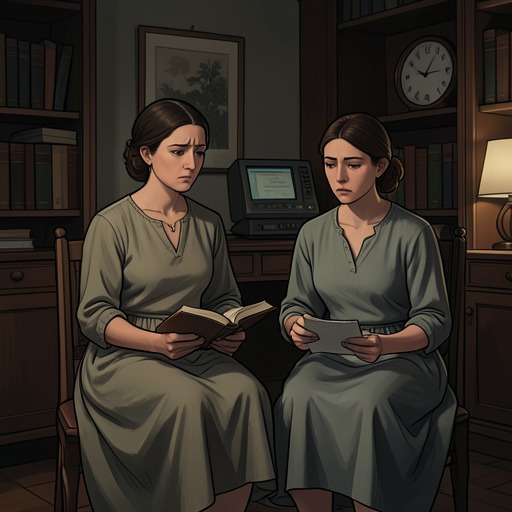
Therese and Rosalie
JustineTherese and Rosalie are friends and confidantes whose bond takes shape in Rodin’s household, where Rosalie is his daughter and Therese serves in the family. Their relationship is marked by mutual trust and care: Rosalie tells Therese what her father has concealed, while Therese seeks to protect her and restore the religious belief Rodin has tried to suppress. Their attempted escape ends in failure, making their friendship a point of resistance against Rodin’s control rather than a successful rescue.
Friendship in Rodin’s Household
Therese’s understanding of Rosalie changes when Rosalie explains that Rodin’s abuse of pupils extends to his daughter. Rosalie confides that she was still a child when he first made her a victim, and describes how he prevents religious practice and has kept her ignorant of its observances. Her disclosure gives Therese a clearer view of the danger in the household: Rosalie is not simply an unhappy daughter but someone isolated from both outside help and the beliefs that might sustain her.
The confidence between them is reciprocal. Rosalie speaks openly of what she has suffered, and Therese answers with concern for her safety and spiritual well-being. This intimacy is not founded on equal circumstances—Rosalie is Rodin’s daughter, while Therese is in his service—but on the trust they establish in the face of his authority. Rosalie’s account also links their friendship to the other young people under Rodin’s power, whose exposure to his conduct is part of the same household system.
Faith and the Hope of Escape
Therese responds to Rosalie’s disclosure by trying to lead her back toward religious belief. She sees faith and virtue as sources of consolation, but practical obstacles make their instruction difficult: Rodin refuses to allow a priest into the house, and Rosalie cannot go out unless he accompanies her. Therese therefore teaches her privately and waits for a chance for Rosalie to practise the faith they discuss. The relationship carries an ethical conflict as well as an emotional one: Therese wants to help Rosalie live by convictions Rodin has deliberately discouraged, while recognizing that open resistance could increase the danger to her friend.
That danger turns the idea of flight into a concrete objective. Therese judges that removing Rosalie from her father’s household would be safer than leaving her exposed to what might happen there. Rosalie then disappears. Rodin and the household’s servants claim she has gone to stay with a relative ten leagues away, and people in the neighborhood repeat that she left after bidding them farewell. Therese doubts this account because Rosalie has left without speaking to her and because it conflicts with what she knows of Rodin. Her concern prompts her to search the house rather than accept the explanation.
Discovery and Failed Rescue
Therese hears sounds from a cellar and finds the narrow entrance obstructed by firewood. Behind the door, Rosalie calls her by name. She explains that Rodin and his colleague Rombeau had subjected her to abuse, then arranged a false departure: an older woman escorted her through town so acquaintances would believe she had left, but brought her back after nightfall. Rodin then confined her in the cellar. The discovery overturns the story given to Therese and confirms that Rosalie’s disappearance was an act of concealment, not a visit to relatives.
When Therese learns that Rodin and Rombeau intend to kill Rosalie that evening, she hurries to the cellar and tries to force the door. A blow dislodges the key; Therese opens the door, embraces Rosalie, and urges her to flee, promising to follow. Rosalie reaches the threshold, but Rodin catches her before she can get away, while Rombeau seizes Therese. Their shared attempt thus brings them into the open as allies, but does not free either of them.
Separation and Narrative Significance
After stopping the escape, Rodin and Rombeau separate the two women’s immediate fates: Rosalie is tied to a bedpost, while Therese is punished for helping her. The friendship has exposed Rodin’s confinement and frustrated his plan for secrecy, but it cannot overcome his control of the house. Their failure underscores how Therese’s repeated efforts to assist someone more vulnerable can be met with retaliation rather than protection.
The relationship also gives the story a scene of recognition and action within Therese’s testimony. Rosalie’s call from behind the blocked cellar door transforms suspicion into knowledge; Therese answers with an attempt at rescue, and the attempt ends in the captors’ intervention. Later, in the outer narrative, Madame de Lorsange and Monsieur de Corville listen to Therese’s account with profound emotion. That response frames the narrated suffering as testimony capable of moving its listeners, even though, in the episode with Rosalie, sympathetic attachment alone cannot secure escape.