The Paris Prison Fire and Escape
JustineThe Paris Prison Fire and Escape is a turning point in Justine’s first wrongful imprisonment: after poverty and judicial prejudice make Duharpin’s false accusation decisive, Dubois’s planned prison fire rescues Justine from execution. The escape reverses her immediate fate through a crime that kills twenty-one people, but it does not resolve the conflict between survival and the religious principles she continues to uphold.
Causes and Background
Duharpin’s accusation follows Justine’s refusal to yield to his corrupt proposal. She recognizes that her refusal has made her an enemy of a man who knows she can expose him. After waiting more than a month, he enters her room with four watchmen and claims she has stolen a diamond worth a thousand crowns. The ring is found in her mattress, where Duharpin has planted it, and the supposed evidence overwhelms her protestations.
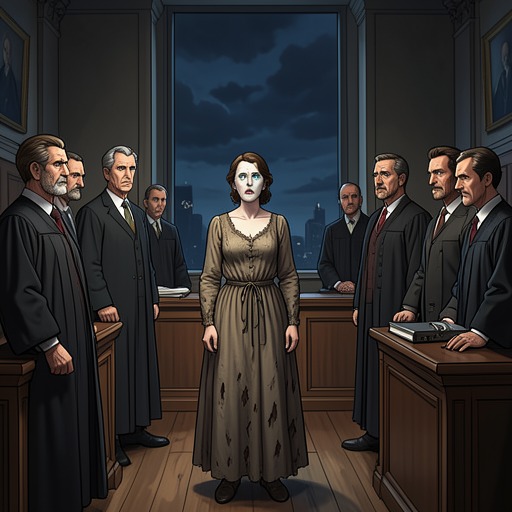
The proceedings turn the planted diamond into an apparently conclusive case. Justine has little opportunity to defend herself: her account of Duharpin’s criminal conduct is treated as a retaliatory accusation, while his reputation for integrity is accepted without scrutiny. The authorities presume her guilty because she is poor and lacks influence or protection. Transferred to the Conciergerie, she faces the prospect of a capital sentence for refusing to take part in wrongdoing.
The Fire and Escape
With execution only two days away, Dubois approaches Justine at night and tells her to remain awake beside her. She has arranged for the Conciergerie to catch fire between seven and eight, and says that four of her confederates will assist their escape. The plan is not a rescue without cost: Dubois accepts that other prisoners and people in the building may die as a consequence of the blaze.
The fire spreads, and twenty-one people are consumed. In the resulting confusion, Justine and Dubois make their escape. That same day they reach the cottage of a poacher, an intimate associate of Dubois’s band, in the Forest of Bondy. The immediate change is stark: Justine has gone from confinement and impending execution to freedom, but she has arrived there through an escape engineered by a criminal network.
Aftermath and Conflict
At the cottage, Dubois presents the escape as proof that virtue has brought Justine to the scaffold while crime has saved her. She urges the young woman to abandon virtue, offers to guide her toward fortune, and argues that success requires stopping at nothing. Her appeal makes the escape more than a change of location: it is also an attempt to recruit Justine into the life that Dubois regards as the practical answer to vulnerability.
Justine acknowledges her debt to Dubois for saving her life, but refuses to treat that debt as consent to commit crimes. She says that she would rather face death than participate in the fire, and chooses the hardships of virtue over the dangers accompanying criminal favor. Her religious principles and hope for compensation in another world remain her consolation. The escape thus frees her from prison without persuading her to exchange her moral commitments for safety or promised advancement.
Significance
The episode sharply reverses the terms of Justine’s trial. Her honest refusal helped bring about her imprisonment; an arranged fire, a deliberate crime, enables her release. The contrast exposes how little protection the legal process has offered her: Duharpin’s status makes his accusation credible, while Justine’s poverty makes her innocence difficult to recognize.
The escape also establishes a recurring tension in Justine’s story between immediate survival and moral compromise. Dubois interprets the fire as practical evidence that crime succeeds where virtue fails; Justine experiences the rescue as a deliverance whose criminal means remain unacceptable to her. Her release is real, but it begins another period of danger rather than ending her misfortunes.