Iron's Oath
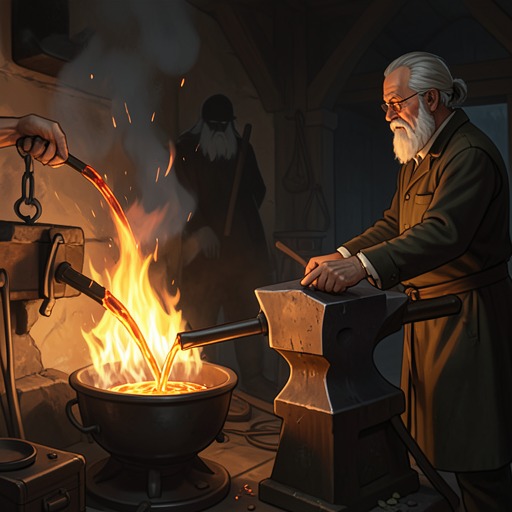
KalevalaIron's Oath is Iron’s solemn promise to use its destructive power without killing its kindred or wounding its brother. Sworn by the furnace and the tools of smithing, it draws a boundary between damage iron may do in the world and violence it must not inflict on those closest to it. The promise fails almost as soon as Iron enters the furnace: the hardened metal breaks its word and cuts its brother, turning the oath into a compact story of pledged restraint and immediate betrayal.
The Terms of the Promise
The oath follows a warning that Iron will slay the best of heroes and wound its dearest brother. Iron answers by promising that, although it will injure many trees and devour the hearts of mountains, it will not kill its nearest kindred or wound its brother. The promise does not deny Iron’s capacity for destruction. Instead, it tries to distinguish between destructive force directed at trees and mountains and violence against family.
That distinction gives the vow its particular weight. Iron is not asked to become harmless: its promised work still entails injury to trees and the imagined consumption of mountains. The limit is relational. It must not use its strength to kill kindred, slay heroes, or wound the children of its mother. In that formulation, the warning’s broad threat is met with a specific pledge about whom Iron will spare.
The Smithing Instruments and the Promise
Iron seals its promise in the language and setting of its making. It swears in the strongest accents by the furnace, the anvil, the tongs, and the hammer. These are not distant authorities named in the oath but the working instruments and place associated with smithing. Their accumulation makes the promise sound emphatic and materially bound to the process through which Iron is shaped.
The scene also places the oath within a craft relationship. Ilmarinen is identified as the master and renowned, skilful blacksmith. Iron’s pledge therefore belongs to a world in which making and danger occupy the same space: the smith’s work produces a material with great force, while Iron’s personified speech gives that force a voice and a stated limit. The oath articulates restraint before the iron is put into the furnace, at the point when the promised boundary is about to be tested.
Breach in the Furnace
When Iron is placed in the furnace, the promise does not hold. The hardened iron grows angry, breaks the vow it had taken, and cuts its brother mercilessly. The sequence makes the violation concrete: the furnace is not merely one of the objects named during the oath but the place where Iron’s pledge gives way. The words sworn by the tools of smithing are answered by violence in the smithing process itself.
The breach reverses the promise’s careful distinction. Iron had allowed for damage to trees and mountains while excluding harm to kindred; in the furnace, it injures the very brother it had pledged to protect. The failure is not presented as a forgotten or ambiguous undertaking: the narration identifies the act as breaking a vow. Iron’s oath thus becomes a measure of the ensuing action, making the cut legible not simply as damage but as the violation of a specific promise.
Significance of the Oath
The episode makes a spoken promise consequential without showing a court or formal penalty. Iron’s own words establish the limit, and the narrative’s immediate account of its breach exposes the gap between declaration and action. The instruments invoked during the oath reinforce its seriousness, but they do not prevent the violence. The result is a compact illustration of how force may be verbally restrained yet remain capable of exceeding the boundary it has declared.
Iron and Fire are treated as brothers, so the broken promise damages a kinship bond as well as breaking a pledge. The wording of the vow joins these concerns: Iron promises not to kill its nearest kindred, not to slay the best heroes, and not to wound its brother. Its failure therefore carries both a personal and a wider heroic implication. The oath gives the origin account a moral tension at the heart of smithing: Iron is shaped for powerful use, yet its own promise cannot guarantee that power will spare those nearest to it.