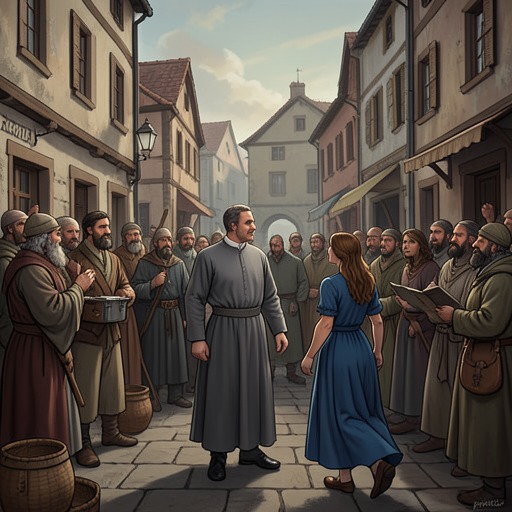
Don Aurelio secretly leaves Lago
LeilaDon Aurelio’s secret departure from Lago is an act of obedience carried out under pressure: certain that his superiors will remove him and fearing that the villagers may hold him by force, he decides to leave at night rather than wait for events to overtake him. The preparations turn a painful separation from Massimo Alberti into a test of the priest’s discipline, compassion, and trust in Providence.
Background and Decision
Don Aurelio tells Massimo that he will leave that night. Massimo reacts with a start and immediately fears that his friend is abandoning him at a moment when there may still be hope of keeping him in Lago. The priest stops him from speaking openly, placing a finger to his lips because Lúzia might hear. The secrecy is practical as well as protective: nobody knows of the plan, and Don Aurelio insists that nobody must know.
In his judgment, there is no chance that his superiors will permit him to stay. He also fears that the people of Lago, attached to him, may try to prevent his departure by force. He therefore treats leaving at once and in secret as an absolute duty. His decision is not presented as a protest against the authorities. Although he expects to be humiliated, driven from place to place, and left without secure support, he accepts the command as something he must obey.
The Planned Journey
Don Aurelio intends to walk through the night to Schio and catch the five o’clock train to Vicenza. There he will present himself to the bishop and clear himself of accusations he supposes have been made against him. Beyond that, he makes no claim to control what follows: he will entrust himself to Divine Providence. He believes the bishop may help him find a post in another diocese, perhaps among the mountain chaplaincies, in a place even more cut off from the world than Sant’Ubaldo.
That imagined destination gives the departure its bleak measure. Don Aurelio does not know where he will be sent or what conditions await him; he can only identify the next steps—walk, train, answer the accusations, and ask for another position. His confidence that the Lord will not abandon him coexists with the material uncertainty of a priest leaving with almost nothing. The passage records his departure through its decision and preparations, rather than depicting him arriving at his destination.
Farewell and the Books
Before leaving, Don Aurelio asks Massimo to help sort the books. Some belong to Donna Fedele Vayla and Marcello Trento and must be returned; the rest are Don Aurelio’s, to be sent after him wherever he may end up. He can take only his breviary, a small pocket Bible, and The Imitation of Christ. The sorting makes the cost of departure tangible: the priest’s attachment to his books is visible in his trembling hands, even though he does not complain.
One book briefly breaks through his composure. A fine edition of Saint Augustine’s Confessions recalls hours of reading and religious meditation in the shadows of Parco di Velo, beside running water. Don Aurelio cannot bring himself to say at once that it belongs to Marcello. Massimo understands, leaves the book untouched, and clasps his hand. Don Aurelio then insists that the volume be returned to Marcello, presenting the pause as a lapse of memory rather than emotion. Once the books are sorted, he does not waver again; when Massimo briefly refuses to continue and tries to change his mind, Don Aurelio rebukes him.
The Parting and Its Consequences
After the work is done, Lúzia enters on the pretext of checking that the shutters are closed. Don Aurelio sends her to bed, allowing the secret preparations to continue without her presence. He then considers how to reward her beyond the monthly wages he has already set aside. The practical thought belongs to the same scene as his impending displacement: even while preparing to leave, he remains attentive to the person who serves him.
Massimo’s own departure is interrupted by Giovanni, from the Montanina, sent by Marcello to find out whether anything has happened to him. Don Aurelio answers from the window that Massimo will come at once. Massimo, who has thrown his arms around the priest, then falls at his feet. Don Aurelio blesses him and urges him to go; they could not part without a wrenching effort. Massimo springs up, rushes out, and disappears down the stairs into the night. The scene’s visible separation is therefore between the two friends, while Don Aurelio remains behind to face his own departure.
Prayer and Moral Significance
Alone, Don Aurelio kneels before the crucifix and prays urgently for the two priests of Velo and for all the superiors who, as he sees it, intend to abase and impoverish him. Massimo had flared up in anger against those he regarded as persecutors, but Don Aurelio had silenced him and asked him to promise to pray for them. He refuses to claim knowledge of their hearts or consciences and chooses intercession over condemnation.
The departure thus joins submission to authority with a deliberate refusal of hatred. Don Aurelio’s night journey is imposed by institutional pressure and fear of being forcibly detained, yet the final movement of the episode is inward: he asks God to forgive those who believe they are serving Him. The books he leaves behind, the friend he sends away, and the prayer he offers for his opponents all make the same departure more than a change of place. It becomes a relinquishment undertaken without complaint, sustained by faith even as its practical outcome remains uncertain.