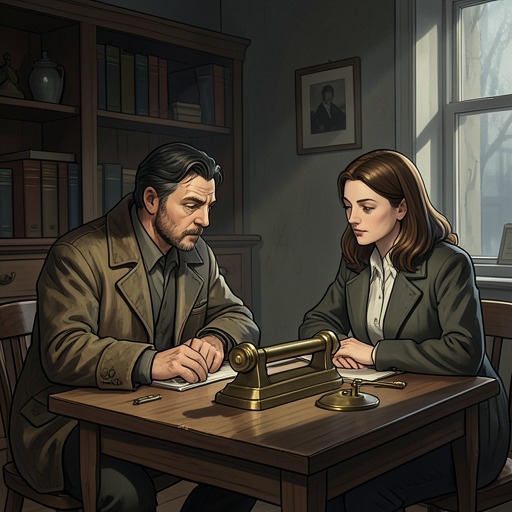
Marcello improvises at the piano late at night
LeilaMarcello improvises at the piano late at night in a scene where private mourning becomes both music and prayer. Alone in the darkened house, he opens a wallet containing his dead son Andrea’s portrait, kisses it, and plays by lamplight. The music carries him toward an imagined divine consolation, then into memories of his sins; when Lelia Camin hears him, she recognizes an emotional intensity rather than the mental disturbance Teresina fears. The episode makes sound itself a form of confession, and places Lelia beside Marcello as a witness to grief he has not spoken aloud.
A portrait and a lamp
The house has long been dark when Marcello leaves his room, carrying a closed wallet and a lamp. He passes through the study and billiard room into the salon, where he sets the lamp on the piano. Its modest, familiar light reveals his face as he opens the wallet with trembling hands. Inside is Andrea’s portrait. Marcello looks at it for a long time, his lips trembling and his eyes filling with tears; then he kisses his son’s image on the forehead, returns it reverently to the music stand, and lowers his hands to the keys.
The objects establish the scene’s intimate order: the portrait gives Marcello’s grief a visible focus, while La lucerna fiorentina di ottone makes the piano a small island of light in the sleeping house. The lamp is dearer to him than the elegant fixtures above. Its gentle illumination does not dispel the darkness so much as make the remembered face present within it. Before a note is played, the sequence of looking, kissing, and carefully putting the portrait away has turned the performance into an act of remembrance.
From sacred music to remorse
Marcello is not a technically formidable pianist, but music gives expression to the religious faith, affections, and love of beauty that converge within him. He reveres Beethoven alongside Dante and, almost, Saint John the Apostle; Haydn, Mozart, and Bach hold a place comparable to that of painters and saints. He reads the four great composers of music, as he reads the four Evangelists, and often improvises during the evening hour of memory and reverie. At the keyboard, his effort is not display: he tries to make musical language answer to what he feels within.
That night he searches for Pergolesi’s final song, and the scene’s religious register first opens toward the hope of reunion with Andrea and of entering a larger, divine love. Marcello’s earthly music strains toward a divine music he can imagine but not fully grasp. The distinction matters: the promised glory of Paradise and reunion with his son remain luminous but indistinct to him, however firm his faith and expectation of approaching death. Music can give that hope a form when ordinary thought cannot.
Then remembrance changes direction. Memories of his sins and bodily weaknesses crowd in with a frightening vividness, and his hands bend and hang motionless over the silent keys while his head sinks to his chest. The passage does not present this pause as a lasting collapse. In his humility, Marcello can yield to divine mercy without the proud resentment that would make moral failure bitter. He raises his face and hands again and turns the performance into a passionate but gentle Miserere: a prayer that imagines the washing away of guilt and receives mercy with gratitude and even joy. A melody of sorrow and love, linked in the narration to unconscious memories of Bellini, lets penitence enter the same music as mourning.
Witnesses on the stairs
Marcello plays on, unaware that anyone is listening. Teresina, who has made her bed in a ground-floor room that night, hears the piano and goes to look. Seeing her master at the keys, she hurries upstairs to wake Lelia and wonders whether he is himself or entering a morbid mental state. She helps Lelia dress quickly, still alarmed, while Lelia says nothing and resolves to see and hear for herself.
From the gallery, the women cannot see the piano through the stair opening. They cautiously descend until they can make out Marcello’s bent back in the weak light of the lamp. His posture seems to move with the music, as though the music’s passion has entered his whole figure. When Teresina starts to go down to him, Lelia catches her arm and puts a finger to her lips. As a discerning musician, Lelia hears inspiration, not delirium; Teresina understands only that she must stay still.
Marcello ends the improvisation with grave chords, closes the wallet, folds his arms, and rests his forehead on them. Teresina starts forward again, but Lelia tells her she will go instead. She descends slowly, one hand on the railing, keeping her eyes on Marcello. She does not suspect an immediate danger: she reads his emotion as the aftershock of meeting Andrea’s friend. Her intention is to persuade him to go to bed without frightening him, as Teresina might. Before she reaches halfway down, Marcello hears her and asks who is there. Lelia identifies herself as his daughter and comes quickly to his side.
The interruption and its meaning
The music does not end the encounter so much as prepare its next, more intimate movement. Marcello resumes playing, and the succeeding song makes Lelia tremble. She gently lays a hand on his shoulder and asks him to stop because he is becoming too moved and it is late. He ceases, takes the hand as it begins to withdraw, and holds it affectionately between his cold hands. The scene closes not with an explanation of his grief but with this brief exchange of touch and restraint.
The improvisation also gives the old piano a place within Marcello’s emotional life. He feels tenderness for the worn instrument, his confidant in dreams, which Lelia disdains and which seems close to an ignoble end. That contrast joins the scene’s larger pattern: what others might dismiss as old, inadequate, or alarming remains capable of carrying profound feeling. For Marcello, the piano mediates between the memory of Andrea, the shame of past wrongdoing, and trust in mercy. For Lelia, listening before intervening allows her to approach her father through the music rather than mistake his intensity for illness. The night’s performance is therefore at once an act of solitary devotion and a moment of recognition between father and daughter.