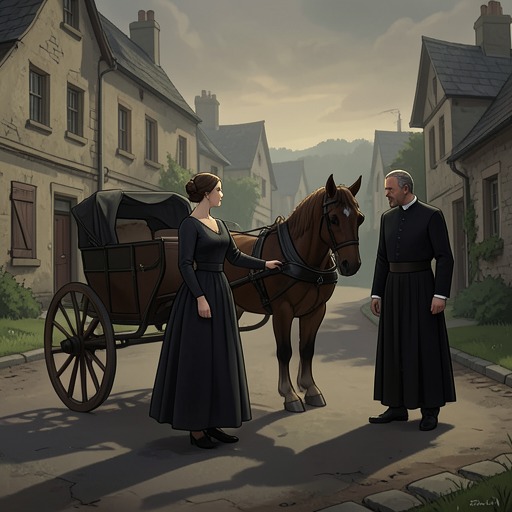
Donna Fedele entrusts Lelia with a final request
LeilaDonna Fedele entrusts Lelia with a final request during a night of fever, sleeplessness, and intimate confession. Believing that she will die soon, Donna Fedele asks Lelia to carry on her secret aid to a woman in Torino, the sister of an officer whose love she once mistakenly encouraged and then refused. Lelia’s assent is conditional: Donna Fedele must first agree to seek medical attention. Their bargain joins a plea to remember the dead with an urgent demand that the living accept care.
The confession and its setting
The request emerges from a period of close bedside care. After Lelia has gone out at night in severe agitation and returned feverish, Donna Fedele keeps watch beside her. She conceals the circumstances of Lelia’s distress from the doctor, asking him to accept the explanation of sleepwalking so that Lelia’s private feelings remain protected. As Lelia’s fever eases, Donna Fedele chooses to sleep in the adjoining bed rather than leave her alone. Her devotion is tied not only to affection for Lelia but also to the memory of Marcello Trento and the love he had continued to bear his dead son, Andrea Trento.
That night, after asking whether the light troubles Lelia and then putting out her own lamp, Donna Fedele begins a disclosure she says nobody else knows. She has been ill for more than a year, suffers physically and morally, and believes death may be near. Lelia’s silence does not stop her. At first, her response is almost imperceptible; as the account deepens, it becomes an eager, attentive silence. When Donna Fedele reaches the most painful part, Lelia’s hand searches along the bed’s edge, finds hers, and draws it close enough for Lelia to kiss it.
Two old sorrows
Donna Fedele recounts that at eighteen she fell in love with a man who was not free. She loved him with an intensity she describes as involving her whole soul and blood, but he did not return her passion; his silence asked her to renounce it. She then contemplated making her death look accidental, by taking a difficult mountain route and staging a fall, so her father would not have to bear the pain of an apparent suicide. Her mother had died when she was thirteen, and her father’s illness redirected her attention toward him. During his convalescence, his gentle talk of God, Christ, the soul, suffering, and love awakened a religious faith that her convent schooling had not given her. Donna Fedele credits him with teaching her to believe with her heart.
A second regret began after her father died, when she was twenty-seven and living with a companion who helped her move in society. A younger officer, poor but gifted and morally courageous, loved her. Donna Fedele liked him and thought she might return his feelings; she failed to hide that belief, encouraging him to hope. When he asked her to marry him, she understood too late that she could offer him a bond of the soul but not marriage, and she refused. He left without a word. Lelia asks whether he killed himself, but Donna Fedele does not answer; the conversation leaves that question unresolved rather than confirming his fate.
The request and Lelia’s answer
The officer had been an only son, with a mother and a sister. His family was left nearly destitute and hated Donna Fedele, believing she had first drawn him in and then rejected him. They would not have accepted help from her directly. His mother has since died, while his sister lives alone in Torino. Donna Fedele has secretly supported the sister, and expects that she would refuse a bequest made openly in her own name. She therefore asks to leave the money intended for the sister to Lelia, who can continue the assistance without disclosing its source.
The request is not only financial. Donna Fedele asks Lelia to visit the sister after her death and persuade her that Donna Fedele did not deliberately entice her brother: she had believed, mistakenly, that she could answer his love, and had carried the pain of that mistake to the end of her life. Donna Fedele reaches across the gap between their beds; Lelia grips her hand so tightly that no spoken answer comes. When Donna Fedele asks again, Lelia presses the back of the hand twice against her tear-wet eyes. Her gestures express a response before she can say it aloud.
A promise made in exchange
Toward dawn, acute pain makes Donna Fedele cry out. Lelia, still awake, lights the room and tends to her. Donna Fedele then asks whether Lelia will give her the consolation she requested, emphasizing her own weakened condition. Lelia makes her agreement dependent on a promise in return: Donna Fedele must allow herself to be examined and treated, in Padova or Torino. Donna Fedele asks once more whether Lelia will do what she has asked; Lelia answers decisively yes. Donna Fedele promises to seek care, and gathers Lelia into a long embrace.
The bargain briefly gives their relationship a shared direction. Feeling better later that day, Donna Fedele considers seeing a doctor and, if permitted, going to the mountains. She also writes to Lelia’s father about the young woman’s situation. Lelia resists returning to Velo and says she would go with Donna Fedele without paternal permission; Donna Fedele warns that her father might have her brought home by the carabinieri. The conversation thus makes Lelia’s promise part of a precarious practical future, not merely a sentiment exchanged at the bedside.
The request’s continuing weight
Donna Fedele’s health remains the condition that gives the promise its urgency. Later, when Lelia and Massimo are in Valsolda, Donna Fedele insists that Lelia cannot remain there and arranges for the young woman to travel with her to Torino, with the possibility of leaving her at her cousin’s home in Santhià. She intends to be examined before departing, but the doctor cannot complete the examination he considers necessary; he warns Lelia that Donna Fedele’s heart is very weak. The earlier promise has therefore not secured recovery, and the narrative does not establish here that Lelia ultimately carries out the request concerning the officer’s sister.
Donna Fedele’s condition then worsens abruptly. With a very high fever indicating a general infection, she understands that death is near, asks for a priest and viaticum, and receives the last rites. The confession and request had already made her fear of death concrete; her later decline gives the arrangement she entrusted to Lelia the character of a bequest made under pressure of time. Its emotional force lies in the exchange at its center: Donna Fedele asks Lelia to preserve a neglected woman’s memory and material support, while Lelia asks Donna Fedele not to abandon her own life without seeking help.