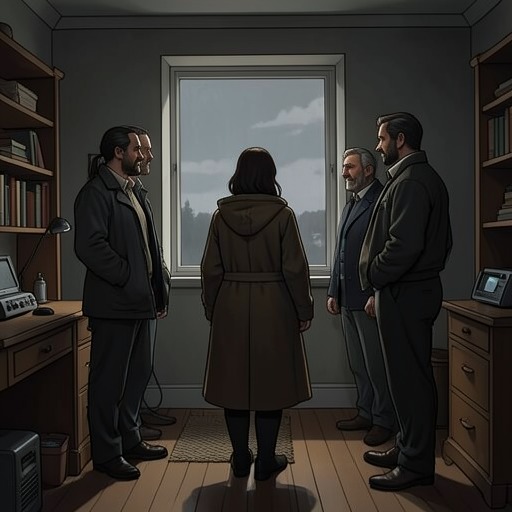
Marcello's will is opened and the heir is revealed
LeilaThe opening of the deceased master’s holographic will makes Lelia Camin the universal heir, but the revelation does not settle her future. It draws her estranged father back into her life, exposes the material interests surrounding her inheritance, and leaves the question of her home entangled with her age and her father’s authority.
The will and its terms
The will had been regularly deposited with Dr Camilli, a notary. The morning after Donna Fedele left the villa, the notary and the agent went to the Praetor of Schio, where the holographic document was opened. Donna Fedele had not stayed to await the proceedings: she did not want to seem an intruder and had said she would return if summoned. No summons came; the news reached her instead in a letter from the agent that evening.
The central provision named Lelia universal heir. Teresina, who had expected Lelia to accept the inheritance and had urged Donna Fedele to wait for news of the will, received a life-long daily bequest of five lire, exempt from tax. The two provisions establish contrasting positions in the estate: Lelia inherits the whole, while Teresina is granted a defined, modest allowance.
The father’s claim and Lelia’s age
The agent’s letter also reported a telegram from Padova, signed by Girolamo da Camin. He sent condolences, declared himself Lelia’s father, described her as a minor, and announced that he would arrive that day, possibly on the last train. The same report records that Lelia acknowledged she was his daughter and gave her age as twenty years and a few months. The deceased master, the agent added, had believed her older.
That discrepancy matters beyond the letter’s formal details. The report places Lelia’s inheritance beside a disputed or misunderstood account of her age, while her father’s declaration makes clear that the estate will not remain a private matter between Lelia and the household that raised her. Her identity as an heir and her relationship to her father become linked questions.
The heir and the returning father
When Girolamo Camin later visits the Rose Villa, the inheritance has already altered the practical stakes of their encounter. He brings Lelia a packet of ten-lire notes, saying that the money is hers and that he will account for his handling of it after the few months remaining in his period of control. Lelia receives him standing and rigidly; she lets him kiss her but offers no welcome or invitation to sit. His awkward manner does not erase the financial leverage implied by his promise to render accounts.
The narration also discloses that Girolamo has his own plans for the estate. He hopes to appropriate as much movable property as possible while he still has authority, then to secure a generous allowance from Lelia once she comes of age. His visit is therefore not only a father’s approach to a daughter: it takes place against the background of his interest in the property and his wish to preserve influence over it. The will makes Lelia the heir, but does not immediately free her from the practical power of her father.
Consequences for Lelia’s next home
The same tension continues when Lelia later seeks permission from her father to remain away from Velo. Donna Fedele expects his answer to be negative and initially insists that Lelia cannot stay in Valsolda. After hearing the contents of Lelia’s letter and learning that Massimo hopes to obtain a post as a public doctor there, Donna Fedele still concludes that Lelia must leave with her. Lelia, not yet of age, fears returning to Velo and says that only months remain before she can be her own mistress.
Donna Fedele eventually agrees that Lelia may stay with her cousin in Santhià, provided her father permits it; then she yields on the permission requirement, judging the arrangement safe and Lelia’s return to Velo intolerable to her. The will’s opening thus begins a chain of consequences rather than providing a simple resolution: Lelia inherits, her father re-enters her life as both parent and financial authority, and her immediate residence remains subject to negotiation among family ties, money, and the approaching threshold of adulthood.