Eduard Limonov's participation in the shelling of Sarajevo
LimonovEduard Limonov’s participation in the shelling of Sarajevo became a defining rupture between his former image as a provocative adventurer and his new reputation as a political militant implicated in wartime violence. The surviving footage shows him firing a machine gun in the direction of the besieged city, but does not prove that he targeted people. Its force lies in that unresolved distinction: a real act, an ambiguous image, and a public interpretation that outran what the images could establish.
From literary guest to wartime participant
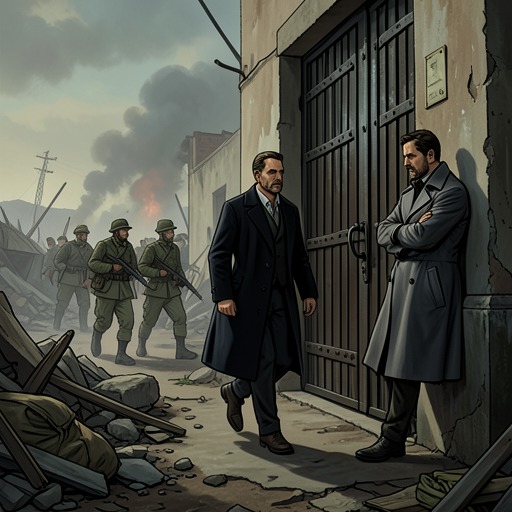
After the collapse of communism, Limonov began traveling to the Balkans for extended periods and fought on the Serbian side. His former acquaintances in Paris, who had admired his unconventionality and adventurous past, were horrified by this alignment. Their shock sharpened when a BBC documentary showed him on the heights above Sarajevo, under the eye of Radovan Karadžić, the Bosnian Serb leader and a known war criminal. What had once seemed like theatrical provocation now appeared connected to a war in which the city below was under bombardment.
The documentary, Serbian Epics, came about when its director, Pawel Pawlikowski, asked Limonov to interview Karadžić. Pawlikowski disliked offscreen interviews and visible microphones, and wanted people to speak within the film’s scenes. The resulting sequence placed Limonov and Karadžić together on the heights from which Serb batteries fired on Sarajevo. Mortar fire was nearly continuous, and soldiers surrounded them. Karadžić explained the Serb position; Limonov responded with admiration for the Serbs’ resistance to the countries opposing them. Their conversation then turned to poetry, before Karadžić left to take a call from his wife.
The machine-gun footage
Left on his own, Limonov approached a soldier greasing a machine gun. The soldier offered to let him try it. Limonov took up position behind the weapon, followed the soldier’s instructions, and, encouraged by the laughter and approving slaps of the adults around him, fired a magazine toward the besieged city. The scene presents the action as impulsive and almost childlike, but its setting makes it impossible to treat the gunfire as harmless play: Sarajevo lies in the direction of the weapon, while the surrounding war is audible and visible.
The footage does not show that Limonov shot people. Fifteen years later, asked about the scene, he said he had not aimed at anyone: he had fired toward the city, but at nothing in particular, or at the sky. A wide shot supports part of that account by establishing that the machine-gun scene takes place at a distance from Sarajevo, on the heights where the mortars fire, rather than near the streets where snipers target people. The film then cuts to a much closer view of the city, presenting the change in perspective like a reverse angle. That juxtaposition can suggest a closer connection between Limonov’s shots and people in the streets than the initial view establishes.
Rumor, image, and consequence
When the film was broadcast on French television, a rumor spread that Limonov had been shown shooting people in Sarajevo’s streets. The narrator’s close examination of the footage does not confirm that claim, and the question of whether Limonov would have been troubled by actually shooting people, or had done so in other circumstances, remains unanswered. What the episode does establish is how quickly an ambiguous image can harden into a story about what a person has done. Among Limonov’s former acquaintances, the footage displaced the charming adventurer and left in his place someone they regarded as more or less a war criminal.
The film altered the narrator’s own view as well. After obtaining a DVD from Pawel Pawlikowski, he found the sequence so disturbing that he stopped working on his book for more than a year. His reaction was not simply that the footage showed Limonov committing a crime; he acknowledged that it did not. What unsettled him was the spectacle of Limonov appearing ridiculous: a small figure playing at toughness in the midst of war. The comparison to Jean Hatzfeld’s type of fanatic drawn to war, a mickey, captures this deflation of the grand, heroic image Limonov cultivated.
The scene’s place in Limonov’s public trajectory
The Sarajevo episode preceded Limonov’s return to Russia and the creation of the National Bolshevik Party. In the narrator’s account, the change was not only biographical but political: a man once celebrated by anticonformist admirers had become the visible leader of a movement whose imagery and slogans carried far more alarming associations. The wartime footage helped make that transformation legible to people who had previously treated his provocations as part of his charm.
The episode therefore remains deliberately unsettled. It records Limonov taking a machine gun and firing toward a city under siege; it does not establish that he aimed at civilians or hit anyone. The documentary’s cutting, the rumor that followed, and the later scrutiny of the shots all matter because they keep the distinction between evidence and accusation in view. Yet uncertainty about his target does not erase the image’s consequence: for those who watched, the scene marked the point at which the adventurer’s pose could no longer be separated from the violence surrounding him.