Limonov's early release
LimonovLimonov’s early release is both a reversal of his prison sentence and a departure from a world he had learned to inhabit on his own terms. A lawyer’s proposal allows him to leave without admitting guilt or repudiating his honor; the days that follow move so quickly that release feels less like simple deliverance than the abrupt ending of a life and discipline he had made his own.
The decision and its terms
After a visit from Pristavkin, Limonov’s fate hangs in the balance, with the decision being made in the upper reaches of power. That circumstance gives him an awkward standing among people around him: respect is mixed with jealousy and with the sense that it may be safer to keep one’s distance. Asked about the incident, he minimizes it, suggesting that Pristavkin was drunk and that nothing will come of it. His confidence is misplaced.
His lawyer, visiting from Moscow, tells him that public opinion has shifted in his favor. Limonov is no longer regarded as a terrorist but as a writer in prison, likened to Dostoyevsky. The book presents Pristavkin’s intervention as opportunistic: he seems to have seen a chance to act the liberal. Yet the offer still confronts Limonov with a question of honor. He initially refuses it as framed, because accepting it appears to compromise the position he has maintained.
The lawyer then finds a formulation that avoids the question of guilt while emphasizing that Limonov never contested the verdict. That distinction lets him accept without having to say that he was guilty or to surrender the principle he believes is at stake. The change is small in wording but decisive in consequence: he consents, and release becomes possible.
From sentence to countdown
Once he agrees, events accelerate. Limonov has settled into the expectation of a long sentence, adjusting his thoughts, projects, and even his metabolism to its duration. Instead, he is told first that ten days remain, then eight, then three. The camp’s ending arrives almost like the removal of a stage set: the world he had prepared himself to endure is suddenly being dismantled.
The camp director’s manner changes with the approaching release. Rather than summoning Limonov, he invites him to his office and treats him like a VIP, as if their previous relationship had been a role that can now be discussed politely because it is over. He asks Limonov to sign his copy of The Book of Water and expresses concern about the memories the prominent former inmate will carry away from the establishment. Limonov replies, “I won’t hesitate to recommend it to my friends,” and the director delights in the joke, answering, “You’ll recommend it to your friends! Ha ha! What a joker you are, Eduard Venyaminovich!” The exchange turns the authority of the prison into a courteous performance, while making clear that Limonov’s status has changed before he has even left.
That change is conspicuous to the other inmates. Early releases are rare at Penal Colony 13 at Engels, and Limonov is embarrassed by how much his departure seems to depend on influence. He has tried honestly to present himself as an ordinary muzhik, exposed to the same bad prison winds as his cellmates. He fears they may see him instead as a journalist who temporarily inhabits prison life for a story and then leaves it behind. But no one holds his release against him. His prestige rises: the inmates seem pleased to have known someone whose affairs are settled through opaque dealings at the highest level. Their openness about that pleasure surprises and, eventually, disgusts him.
The suitcase and the farewell
On the day before release, Limonov is allowed to retrieve his suitcase from storage. It is one of his prized possessions, stolen from Steven Gray when he left New York for Paris and carried since then through war, the Altai, and one prison after another. Its contents are spare: one black shirt and one white. At the farewell party in the bunkhouse, the inmates hug him, slap him on the back, and debate which shirt he should wear. Their attention to the choice is heightened because a television crew is coming to film his departure.
Anton, a young inmate serving thirty years for torturing and murdering someone, recommends the white shirt as more stylish. Limonov objects, “But Anton, I’m leaving prison, not a nightclub.” The exchange keeps the farewell grounded in the inmates’ everyday company even as the prospect of filming turns the release into a public event. The choice of shirt is at once a practical question and a small negotiation over what kind of departure this is: a prison exit, a performance for television, or both.
The crew arrives at dawn, and the filmed roll call is not the real one. The actual roll call has already taken place; the director wants a version arranged for the cameras. Limonov complies, giving his surname, first name, patronymic, and the articles under which he was sentenced, with three takes required before the director is satisfied. In the mess hall he pours sauce onto his food and talks with the others while being asked to behave naturally. The inmates jostle for a place beside the returning writer, calling out to ask whether the camera can see them. Limonov, whose words are captured by the only microphone concealed under a collar, recognizes the falseness of the scene and regrets agreeing to the television appearance.
Freedom and the prison’s afterlife
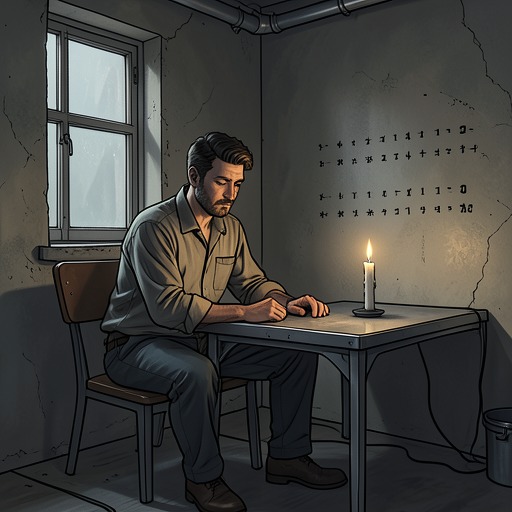
The filming sharpens a contradiction in Limonov’s response to release. He longs to regain his freedom, see Nastia, and return to the people in the party. Yet he also wonders whether leaving will cost him something that the prison has given him. By the force of his mind, he has made the camp seem almost like a monastery: its three daily roll calls have become services, meditation a form of prayer. A process that began in the Altai with the trapper Zolotarev has, in his understanding, brought him toward a deeper and more lasting liberation.
That inner freedom complicates the obvious meaning of the event. Prison is a place he is eager to leave, but it has also become the setting in which he has made reality, routine, and confinement into a spiritual discipline. The television crew’s staged version of prison life cannot convey that private transformation; it records the inmate’s name and sentence while missing the life he has built around them. As the release approaches, Limonov fears that freedom from the camp may deprive him of the more inward freedom he found there. The departure is therefore not only an escape from a sentence. It closes what he regards as the best chapter of his life, even as it returns him to the people and political life beyond the camp.