Blue Bass Lake
MasqueradeBlue Bass Lake is the geographic center of a sequence in which the Federal Bureau of Investigation’s attempt to protect Claire Rothman becomes entangled with Victoria Belle’s escape and Robert Rothman’s flight. The surrounding landscape is at once a place of refuge and a weakness in the operation: a safe house stands near the shore, but wooded roads and isolated lakeside homes give fugitives somewhere to move and hide.
Setting and Geography
The lake is associated with a sparsely populated area of woods and lake homes rather than a developed public destination. The FBI’s safe house lies near Blue Bass Lake, and one dirt road running behind it ends at the water. That road links the protected house to a stretch of shoreline where vehicles can leave the main route and where movement through the woods remains possible.
A condemned house stands close to the lake’s edge. It has visible water damage, and the water reaches its front steps. The details place the building at a threshold between land and water: it is still usable as a stopping point, though its condition marks it as abandoned or neglected. Nearby, the Old Man's Lakeside House provides another point of human presence along the shore. The evidence offers no broader map or description of the lake, but it repeatedly makes the relationship between homes, woods, roads, and water consequential.
The Safe House and the FBI Operation
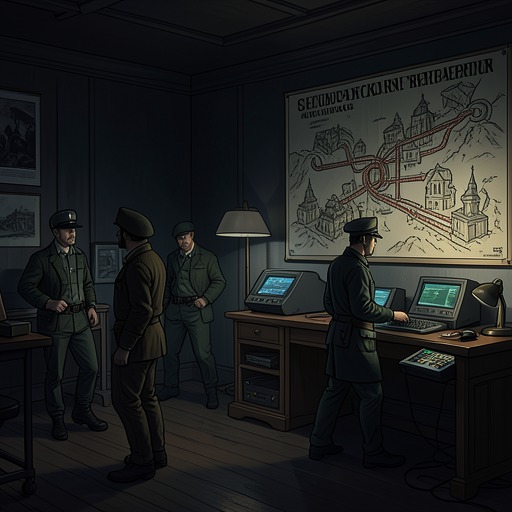
The FBI places Claire Rothman at a safe house near the lake while setting a trap elsewhere at the Pines Way Motel. At the motel, John Brice describes a staged appearance of ordinary occupancy: ten cars are to be brought in, and agents are assigned roles that would let them move around without drawing attention. Claire and a decoy made up to resemble her are both brought into the operation. Brice plans to supervise Claire at the lakeside safe house, with Jessica White and her husband joining him there, while Robyn Dyer is left in charge at the motel.
The separation of the decoy and the protected Claire makes the lake more than a backdrop; it is where the operation’s real protective purpose is concentrated. But the same geography makes the safe house vulnerable to approach. Victoria Belle learns that Claire is there after following a man from the motel and photographing him with Claire and several federal agents. The lake’s secluded setting does not prevent surveillance or guarantee concealment. The FBI’s arrangements depend on keeping the location secure, while Belle’s information gives her a reason to reach it.
Escape Routes and Concealment
Kaye Swan reaches the safe house after escaping from Belle and running through the woods. She arrives with her wrists bound, and an FBI agent sees her from the kitchen window. He treats the approach cautiously, directing other agents to protect Claire and cover the front of the house while he handles the apparent emergency. Belle, however, follows Swan to the house. Her concealed knife allows her to attack the agent at the back entrance and take his gun before moving into the kitchen. The scene turns the house’s rear approach into a breach: the route through the woods brings a would-be escapee to help, but also lets Belle close in behind her.
Later, Belle drives a news van onto the dirt road behind the safe house. She turns through a rusted chain at its entrance and follows the road to the lake’s dead end. There, she and Robert Rothman leave the vehicle and continue toward the woods. After stopping beside the water-damaged house, they remove their captive, take his phone, and keep his knife. Belle then drives the van into the lake. It travels only a short distance through the mud before stopping, with its upper portion beneath the water. The shoreline thus serves as a means of getting off the road and as a place to obscure the vehicle they expect the searchers to seek.
Search and Narrative Significance
The lake complicates the pursuit rather than ending it. Brice anticipates that the fugitives will abandon the news van once they realize the FBI will be looking for it. Chief Stevens points out that the area’s sparse population and scattered homes make a house-to-house search feasible, though the many lake houses and woodland dwellings provide possible hiding places. The investigators’ advantage is the limited number of homes; their difficulty is that the landscape offers multiple places to disappear.
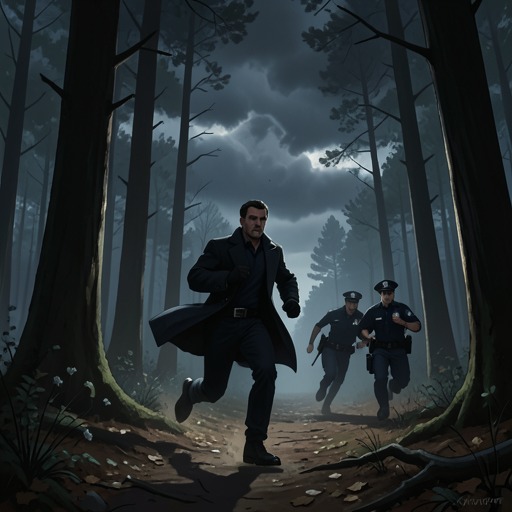
That tension is reinforced when a low-flying helicopter passes along the shore while the old man at the lakeside house tells Rothman that authorities are looking for him. The search is close enough to be heard and seen, but it has not yet secured the surrounding houses or roads. Blue Bass Lake therefore marks a change in the story’s spatial logic: the staged motel operation gives way to an improvised search across private homes, wooded ground, and a shoreline where a vehicle can be hidden. The water is not simply an escape route; it is part of the evidence-management and pursuit problem that shapes what the characters can do next.