Rothman Farm
MasqueradeRothman Farm is the private property of Robert Rothman and Claire Rothman, but its most consequential feature is the renovated barn: a place where a concealed trapdoor and long-hidden activity turn an apparently quiet rural site into the center of a major police discovery.
Setting and Use
The farm is a farm in name only. Its roughly fifty acres had produced no crops for decades, a change dating back to Claire Rothman’s marriage to Robert Rothman. The property’s agricultural identity had therefore outlasted its agricultural use, leaving the barn and grounds with a history more concealed than productive.
The barn also serves as Robert Rothman’s working space. Scattered granite blocks occupy its interior, including pieces that rise to about twenty feet, while his latest sculpture, an angel poised on one foot with its wings spread, stands near the center. The contrast between the monumental stonework and the barn’s hidden trapdoor gives the building two distinct functions: a visible workshop and a place concealing what lies below.
The Barn and the Hidden Space
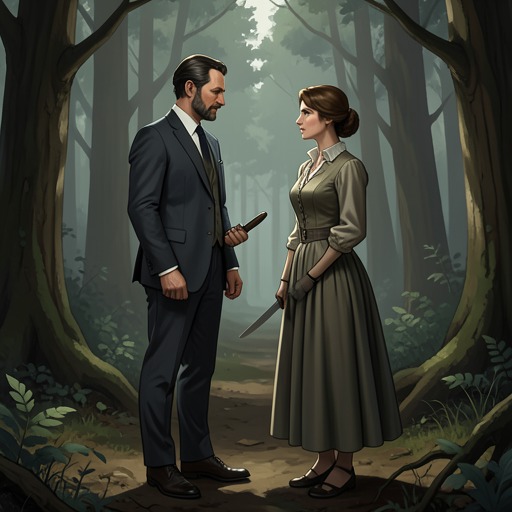
When three men entered through the barn’s side door, Robert Rothman had already received warning from silent alarms that someone was approaching. He had not, however, managed to close and cover the trapdoor. His wife and mother-in-law were with the men as they approached him, and he assessed them before turning his attention to his wife, who was wet and shivering. The compromised entrance and uncovered trapdoor made the hidden space part of the confrontation rather than a secret safely removed from it.
The discovery at the property suggested that activity beneath the barn had continued for years, perhaps decades, without coming to the attention of local authorities. The concealment was not merely a feature of the building: it was the means by which a sustained hidden history could exist beneath an ordinary rural surface.
Discovery and Consequences
Chief of Police Dan Stevens arrived at the renovated barn after a call shortly before one in the morning. He had been visiting his widowed mother in Florida and received the call while retrieving his luggage at the airport after a red-eye flight. Inside, he confronted a scene with numerous dead bodies, a scale of violence unlike anything he had encountered in his work as a police officer in a town of fewer than five thousand people.
The evidence overwhelmed the facilities available to the local police. Stevens concluded that federal investigators had to be called in, turning the barn’s discovery into a larger investigation. The farm thus marks a breach in the town’s accustomed sense of scale: what had remained hidden beneath the property for years or decades could no longer be handled as an ordinary local case.
Narrative Significance
Rothman Farm’s defining contrast is between what can be seen and what has been concealed. The unused acreage and the sculptural angel establish the barn as a place of apparent stillness and deliberate craft; the trapdoor and the discovery below expose the darker history occupying the same space. The farm is consequential not because it remains an active agricultural site, but because its neglected exterior and concealed interior allow the story’s central revelation to emerge in one place.