Pines Way Motel
MasqueradePines Way Motel becomes the visible half of a Federal Bureau of Investigation trap for Robert Michael Rothman: a modest roadside setting dressed to look occupied, with a decoy made to resemble Claire Rothman and agents assigned to wait for his approach. Its importance lies not in serving as a secure refuge, but in giving the Bureau a public-looking stage on which to make its preparations appear like ordinary motel business while the real Claire is guarded elsewhere.
Setting and First Impression
When John Brice and Robyn Dyer enter the motel office, its No Vacancy sign is lit, although the parking lot contains only Brice’s SUV and two police cars. That mismatch gives the place an immediately peculiar appearance: the sign claims a full house, but the visible vehicles disclose a nearly empty lot and a concentration of law enforcement. The motel is not described through detailed architecture or a particular room; its office, parking area, and rooms are enough to establish the practical spaces the operation will use.
The discrepancy is not an accidental detail. The agents plan to bring in ten vehicles from a used-car dealership and park them in front of the rooms, supplying the outward evidence of guests that the lot lacks. The staged appearance will make the motel seem busier than it is and help conceal the operation within a familiar scene of parked cars and routine service. Its ordinary character is therefore part of its tactical value: the Bureau wants Rothman to see a plausible place to approach, not an obvious concentration of agents.
The Motel as a Federal Bureau of Investigation Trap
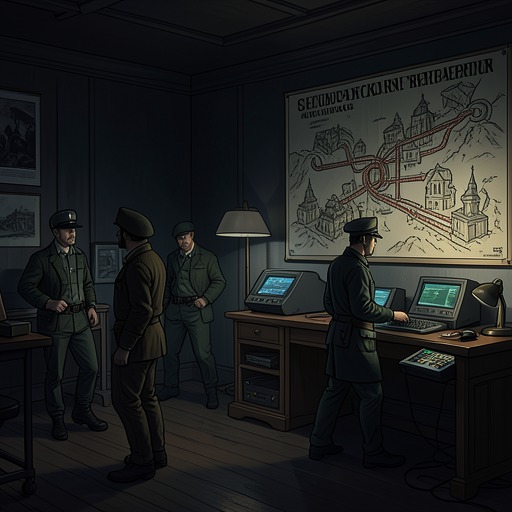
Dan Stevens meets Brice and the agents at the entrance and introduces two deputies, including Joe Perkins. Brice lays out the disguise plan: two female agents will wear uniforms and act as maids, while Perkins will pose as a handyman, giving him a reason to move around without attracting notice. These roles make the motel’s rooms and service routines part of the cover. The operation does not rely only on hidden surveillance; it gives its personnel ordinary-looking tasks that could explain their presence on the premises.
Robyn Dyer is placed in charge at the motel, while Brice says he will watch over Claire at the safe house by the lake. Jessica White and her husband are to join him there. The division creates two sites with different functions: the motel is the conspicuous lure, while the safe house is the more protected location where the real Claire is kept. The Bureau also brings a second woman made up to resemble Claire. Dan Stevens remarks that, from forty feet away, he would have difficulty telling the two apart. Dyer turns that resemblance into the plan’s central condition, reasoning that if Rothman comes within forty feet of the motel, the agents will have him.
Decoy, Distance, and Rothman’s Counter-reading
The plan depends on Rothman accepting the motel as the place where Claire can be reached. Its physical arrangement is joined to a public performance: later, television footage shows a woman wearing sunglasses walking into a motel ten miles away while reporters shout questions at her. Rothman watches the report from Kaye Swan’s bed and recognizes that the woman is not his wife, despite the resemblance. The motel thus serves not only as a prepared ambush site but as the setting through which the Bureau’s decoy is presented to the public—and to its intended target.
Rothman interprets the footage as evidence that the real Claire is being held somewhere more hidden and secure than a motel off a back road. He understands that the Bureau expects him to return for her and reads the decoy arrangement as a way of dividing its forces between two locations. He bets that more agents are guarding the motel decoy than the real Claire, and intends to exploit what he sees as a weakness. The trap therefore becomes a contest of spatial inference: the agents use the motel’s apparent accessibility to draw him in, while Rothman treats that accessibility as a clue that the location may be false.
Narrative Function
Pines Way Motel is defined by the difference between what it appears to be and what it is being used to do. A lit vacancy sign, parked cars, maids, and a handyman are arranged to suggest normal occupancy, while the rooms and their approaches are folded into an attempted capture. The staged scene gains force from the contrast with the safe house, where Claire is actually guarded and which the television report does not identify as the place she entered.
The motel’s role also marks the limits of the Bureau’s control. The preparations are specific, and Dyer’s forty-foot threshold expresses confidence in the disguise and the agents’ readiness; yet Rothman sees through the televised decoy before he approaches. In this way the motel is both a physical location and a misleading image: the operation turns it into bait, but the broadcast gives Rothman information with which to question the bait. Its significance rests on that reversal, as a carefully constructed appearance becomes a strategic signal to the person it was meant to deceive.