Underground Torture Chamber
MasqueradeThe Underground Torture Chamber is a concealed space whose discovery transforms a hidden opening behind wooden shelving into evidence of Robert Rothman’s capacity for organized cruelty. Reached through a narrow, reinforced tunnel, the chamber contains a chained figure and devices identified as instruments of torture. Its significance lies both in what investigators find there and in the architecture of concealment that keeps the space out of view.
Setting and Concealed Entrance
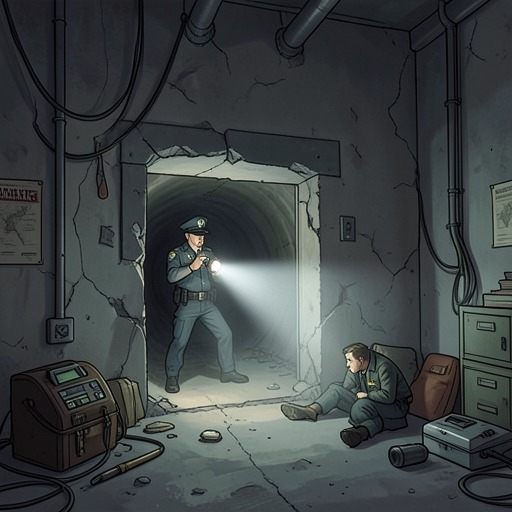
The route into the chamber begins with an ordinary-looking rack of wooden shelves. Colson grips one end and swings it around, revealing an opening in a corner of the right-hand wall. Rather than a conventional doorway, the entrance gives onto a narrow shaft, braced with thick pieces of wood. Dan Stevens likens its construction to a mineshaft, a comparison that makes the passage’s cramped, supported form legible without making it any less secretive.
The entrance and passage create a sharp division between the visible room and the hidden space beyond it. The shelves conceal the opening; the timber framing marks a route that has been made passable, not a natural hollow accidentally discovered. The evidence establishes these physical details but does not identify the larger building or specify how long the passage had been concealed. What it does show is that reaching the chamber requires someone to move the shelves and then follow the tunnel: access is deliberately obscured, and discovery depends on recognizing that the apparent wall is not the end of the space.
Discovery and Interior
Before entering, the investigators refer to going down into the crypt, where they expect to find the remaining bodies. Another question raises whether this was where Robert Rothman kept women, but it is posed as an inquiry rather than settled confirmation. The language establishes the chamber’s association with the investigation while preserving a distinction between what the investigators suspect and what the scene itself demonstrates.
After following Colson out of the tunnel, Dan Stevens sees a naked body suspended from chains attached to the ceiling. The sight shocks him. The discovery marks a change in the scene’s rhythm: the concealed route first narrows attention to the effort of passage, then opens onto an unmistakable sign of violence. The chamber is not described as a fully mapped or measured room, and the available account does not identify the person hanging there. Its most concrete features are the chains and the body they support, details that make the hidden space’s purpose impossible to mistake.
An assortment of devices lies on a table. To Dan Stevens, their design and function seem medieval; he understands them as tools intended for torture. The table and its contents add a separate kind of evidence to the chamber’s grim revelation. The chained figure makes the violence visible in the room, while the instruments indicate that the space contains equipment for inflicting suffering. The account does not inventory individual devices, so their significance rests on their collective appearance and the purpose Stevens assigns to them.
Association with Robert Rothman
The investigators’ question about whether Robert Rothman kept women in the chamber connects the location to the possibility of captivity, while the reference to remaining bodies places it within the search for victims. Neither statement alone supplies a full account of who was held there or when. The more definite evidence comes from the concealed construction and the torture equipment found inside: these details make the chamber a physical part of the inquiry into Rothman’s crimes, rather than merely a rumored or symbolic place.
The chamber’s design also gives concealment a practical form. A movable rack hides the entrance, and a supported tunnel separates the hidden area from the room in which the shelves stand. The scene therefore reveals not simply that a chamber exists, but how its existence could remain out of sight until someone altered the arrangement of the room. That distinction matters to the investigation: the passage is itself a clue, and the discovery beyond it changes what the investigators can know about the space and its use.
Narrative Significance
The chamber’s reveal proceeds from indirect expectation to physical confirmation. The investigators speak of a crypt and of bodies before the passage is opened; the hidden entrance then supplies a concrete route, and the interior supplies the chains and torture devices. This sequence makes the space a place of disclosure: what had been concealed behind shelves becomes visible through a series of increasingly specific discoveries.
Its architecture and contents work together. The mineshaft-like tunnel suggests deliberate access and concealment; the body and equipment establish the chamber’s association with torture. The room thus gives material form to crimes that might otherwise remain abstract in the investigation. At the same time, the unanswered question about whether Rothman kept women there cautions against treating every suspicion as confirmed. The Underground Torture Chamber is decisive because it exposes a hidden site and provides direct evidence of its violent function, while leaving some details of its history unresolved.