Jessica's Husband's Workshop
MasqueradeJessica's Husband's Workshop is both a working studio and the site of Jessica White's discovery of a hidden chamber beneath it. Jessica had regarded the building as her husband's separate work space; when she enters it after returning from the airport, its ordinary equipment gives way to a concealed underground room. The discovery transforms a place she had seldom questioned into the physical focus of her fear and betrayal.
A Separate Space in the Household
Jessica's husband spends much of his time in the workshop, but she had paid little attention while it was being built and rarely interrupted him there. Its separation from the home had therefore become routine: he could work behind its walls while she remained largely unaware of what the building contained. Only after thinking about Claire Rothman's history of ignorance and misplaced trust does Jessica look at the workshop differently. Her recognition of Claire's experience prompts her to consider her own trust in her husband, and the building becomes a question she can no longer leave unasked.
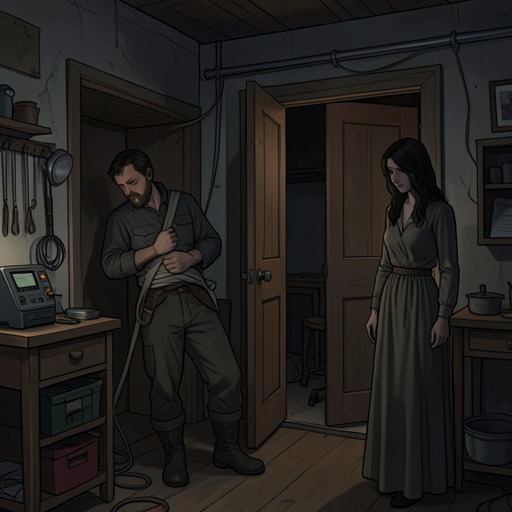
The workshop's visible interior is practical and recognizably functional. It contains computers, monitors, and the special lasers her husband uses while researching 3D technology. At the back are a small bathroom and a counter with a coffee maker and microwave, beside a refrigerator. These details establish the studio as a place arranged for extended work, not simply a room he visits briefly. Their everyday character also sharpens the contrast with the hidden space Jessica is about to uncover.
Entry and Concealment
Jessica approaches hesitantly and discovers that she does not know the keypad combination for the workshop door. She tries the numbers used for the home security system, and the door unlocks. That familiar code gets her inside, but her access does not mean she understands what her husband has kept there. The moment briefly eases her tension; the deeper discovery reverses that relief.
Inside, the refrigerator is too large for Jessica to move by pushing. She then notices a switch on the wall behind it. When she flips the switch, it clicks, and the refrigerator slides aside easily, revealing an opening below. Fluorescent lights come on, illuminating a metal ladder descending into the earth. The mechanism makes the concealment part of the room's design: an ordinary appliance masks the entrance, and a switch—not brute force—releases it. Jessica's discovery is consequently gradual. She finds the hidden space only after entering the workshop, looking closely at its furnishings, and recognizing that the refrigerator can move.
The Chamber Below
Jessica pauses at the opening for more than a minute, imagining terrible possibilities about what might be below. With her heart beating wildly, she climbs down the ladder. The chamber is empty except for a wall of bare shelves; its floor is concrete, and its walls are made of cinderblock. It contains neither torture instruments nor a body, the specific horrors Jessica fears she might find.
The room's plainness does not settle what it means. Its emptiness brings relief, but that relief does little to quiet her growing fear. Jessica knows that her husband built the chamber and kept it hidden from her; the scene does not explain why he made it or what, if anything, he used it for. The distinction between what she discovers and what remains unknown preserves the chamber's disturbing force without turning suspicion into proof of a particular crime.
Discovery and Significance
The workshop's meaning changes through Jessica's movement from its front door to the concealed room beneath it. At first she stands outside, thinking of Claire Rothman and of how love can sustain blind trust. She then enters using a code associated with the home, surveys the familiar work equipment, finds the hidden switch, and descends. Each step brings her closer to an answer about the existence of the chamber while leaving its purpose unresolved.
After understanding that her husband built and concealed the room, Jessica sinks to her knees and weeps from betrayal. The workshop is thus more than the setting of a secret's revelation: its division between visible studio and hidden chamber gives physical form to the distance between the life Jessica thought she shared with her husband and what she does not know about him. The story closes on her discovery and grief, not on an explanation of the chamber or a resolution of her suspicions.