The Old Man's Lakeside House
MasqueradeThe Old Man's Lakeside House is a secluded residence that becomes a temporary refuge for Victoria Belle and Robert Rothman, and then a place where their control over two captives begins to break down. The house’s kitchen, upper railing, and yard shape the confrontation: the captors use its rooms to restrain and monitor the men, while Jessica White's husband eventually turns an outdoor fire into a signal for the helicopters searching for them.
Setting and Approach
The house enters the story after Belle and Robert Rothman leave a water-damaged, condemned property beside the lake, where they had stopped to hide their van and change clothes. They continue along an unused road and approach the first house they encounter. It is a split-level residence with cedar shingles, set close enough to the lake for its location to become part of the escape route’s geography. The condemned property and the old man’s house are separate stops; the latter is where Belle and Rothman bring their hostages.
The homeowner is an elderly man, in his seventies, who answers Belle’s knock. She pushes him inside and signals for Rothman to follow. The house is described not as an established hideout but as an inhabited private home, and the old man’s presence makes its rooms a place of immediate risk for everyone brought into it. Later, he says that he lives alone, though Belle remains wary that someone else may be in the house.
Occupation of the House
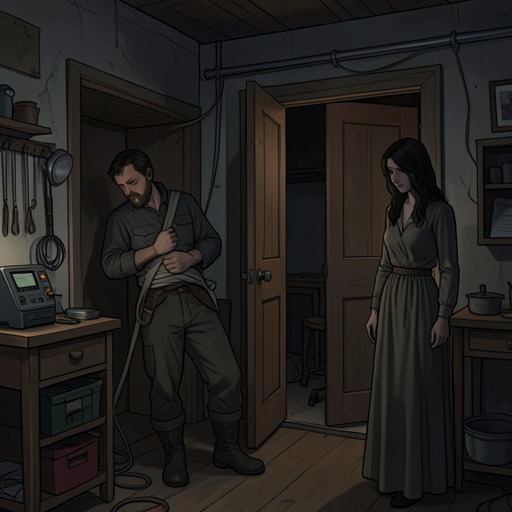
Belle and Rothman herd the old man and White into the kitchen. The domestic space supplies food as well as shelter: Belle takes a drumstick from a box of take-out chicken in the refrigerator and eats while moving away. She then announces that she will search the house, look for a bandage for her leg, check whether the old man is alone, and cut the phone lines. The account establishes these as her stated intentions, rather than confirming that she completes every task.
Rothman stays with the two men. He knocks White down and orders him to remain beside the old man, then searches Belle’s purse for duct tape. The remaining tape is just enough to bind the homeowner’s wrists. The small quantity matters: the captors are improvising with what they have carried into the house, rather than relying on equipment prepared for a long-term occupation.
The old man recognizes Rothman’s predicament from a radio report he heard shortly before the pair arrived. His question about Rothman’s name makes clear that the fugitive’s identity has become public knowledge, even inside this isolated residence. The house therefore offers concealment only in a limited sense: its distance from help does not keep its occupant unaware of the search.
Resistance and Signal
The turning point comes outside the house. Still handcuffed behind his back, White moves toward Rothman despite the old man’s warning that Rothman has a rifle. Rothman raises the small weapon, but White’s charge carries them over a waist-high railing and down to the grass below, a drop of twelve feet. The house’s raised edge, intended simply as part of its structure, becomes the boundary across which the balance of control shifts.
White then looks for a way to alert rescuers. The old man suggests calling the police from a neighbor’s house half a mile away, but White chooses a signal that can be seen from the air. In the yard, he pulls back a blue plastic tarp covering a stack of firewood, pours lighter fluid over the pile, and lights a match. The resulting smoke rises into the sky. The old man recognizes the signal’s intended audience: helicopters searching for the fugitives.
Narrative Significance
The house’s importance rests on the contrast between its ordinary uses and the emergency forced into it. A refrigerator, kitchen, railing, grill, tarp, and woodpile are not introduced as specialized equipment; each becomes consequential because the characters must act within the house and its yard. Belle and Rothman initially use the residence to contain the old man and White, but its physical layout also gives White an opening to resist and materials with which to attract attention.
The location also marks a change in the fugitives’ circumstances. After leaving the lake-edge property where they hid the van, they reach a house that offers access to supplies and temporary shelter, but they cannot make it secure: the old man knows Rothman is being sought, White finds a way to resist, and the fire sends a visible signal toward the search aircraft. The evidence ends with that signal rising from the yard; it establishes an attempt to bring rescuers to the house, not the eventual outcome of that attempt.