Bruce Bogtrotter
MatildaBruce Bogtrotter’s ordeal over a stolen slice of chocolate cake becomes a public contest between Miss Trunchbull’s authority and a boy who endures her punishment without giving her the defeat she wants. Summoned before the assembled school, Bruce is accused, displayed, and ordered to eat a cake so large that finishing it seems impossible. His eventual success turns the spectacle against its organizer: the children celebrate him, while Miss Trunchbull leaves in fury.
Identity and Entrance
Bruce enters this episode not as a volunteer or a prizewinner but as the pupil Miss Trunchbull suddenly calls before the whole school. A finger rises among the seated children, and he is ordered to come forward quickly. The distinction between public recognition and public punishment shapes his entrance: he understands that he has not been summoned for an award.
At the side of the stage, Bruce looks nervous and watches Miss Trunchbull cautiously. He inches farther away from her, in a comparison that makes him seem like a rat retreating from a terrier. His face has gone gray with fear, and his socks have slipped down around his ankles. These details make his vulnerability visible before the accusation is even explained. Miss Trunchbull, by contrast, points at him with her riding crop as though it were a sword, turning the school’s platform into a place of judgment.
The Accusation and the Cake
Miss Trunchbull brands Bruce a criminal and a thief, piling up insults before stating the specific charge. She alleges that he sneaked into the kitchen during the previous morning’s break and stole a slice of her personal chocolate cake from a tea tray prepared for her by the cook. She emphasizes that the cake was made with real butter and cream, and contrasts it with the food she says is served to the children. Her account makes the stolen slice a trespass not merely against school rules but against her private privilege.
Bruce responds with bewilderment and denies knowing what she means; when she calls him a thief, he turns pale. Miss Trunchbull insists that the cook saw him eat the cake, and the cook backs her up. The accusation is thus staged as a case already decided: Bruce is made to stand while the headmistress and her witness define him before his classmates.
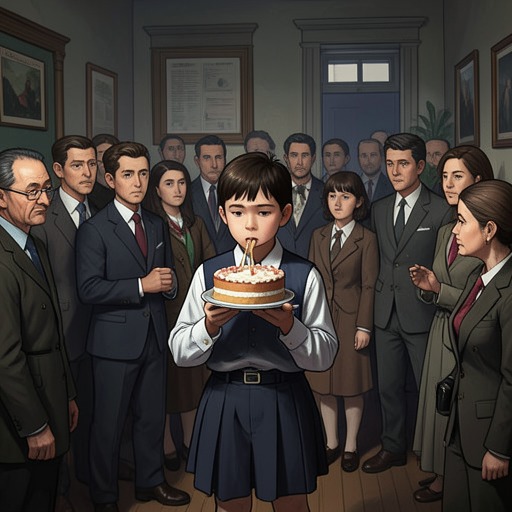
The punishment gives the charge a physical, public form. The cook returns carrying a huge round chocolate cake on a porcelain platter. Nearly half a meter across and covered with dark chocolate icing, it is placed on a small table at the center of the stage. A chair waits behind it. Bruce approaches carefully, sits when ordered, and stares at the cake. Its scale makes the task look less like an ordinary serving than a test arranged to overwhelm him.
A Punishment Made into a Contest
At first Miss Trunchbull tells Bruce to take another piece; when he says he does not want more, her voice sharpens into an order. She declares that he will not leave the stage, and that nobody will leave the hall, until he has eaten the whole cake. The command extends the punishment beyond Bruce: the gathered school must remain as an audience to its completion. Her repeated demand that he eat makes obedience the only permitted response.
Bruce does not answer with a counterattack. He looks from Miss Trunchbull down to the enormous cake, then continues eating. As the task goes on, he slows, but he keeps pushing the cake into his mouth with the persistence of a long-distance runner nearing the finish. That comparison shifts the scene’s emphasis from appetite to endurance. The cake remains an instrument of coercion, yet Bruce’s steady continuation gives him a goal of his own: reach the last bite.
The children watch in suspense. Matilda whispers to Lavender that Miss Trunchbull is growing redder and predicts that she will finish Bruce off if he wins. The remark frames the apparent contest as dangerous even at its moment of success. Bruce’s progress is not simply a victory over an impossible quantity of food; it is a direct challenge to a headmistress who has made the outcome a test of her control.
Victory and Aftermath
When Bruce swallows the final bite, the school erupts. Children jump on their chairs, shout, and applaud, celebrating him as if he has earned a medal. For a moment, the audience’s response overturns the arrangement Miss Trunchbull created: the boy she summoned to shame becomes the focus of collective admiration.
Miss Trunchbull stands motionless on the stage, her face described as the color of glowing lava and her eyes flashing with fury. Bruce is drenched in sweat and so full that he can barely speak, but he wears a triumphant grin. His body registers the cost of the ordeal, while his expression refuses the humiliation its author intended.
Miss Trunchbull then snatches up the large empty porcelain platter and brings it down on Bruce’s head with such force that it breaks into pieces across the stage. He shakes his head a few times and keeps grinning. The blow does not undo his achievement or produce the submission she seeks. Miss Trunchbull curses and marches off, followed by the cook, leaving the children’s celebration and Bruce’s composure as the episode’s lasting reversal.
Narrative Role
Bruce’s scene turns an act of punishment into a public measure of authority. Miss Trunchbull controls the summons, the accusation, the food, and the rule that no one may leave; Bruce has almost no freedom within those terms. Yet the more absolute her control appears, the more his persistence changes the meaning of the spectacle. The school’s cheers make visible a judgment she cannot command, and her final attack exposes her anger at a victory she had meant to prevent.
The contrast between the cake and the broken platter gives the episode its sharpest reversal. Bruce consumes the object chosen to overwhelm him and completes the imposed task; Miss Trunchbull, unable to turn that completion into submission, destroys the serving dish instead. Bruce is left exhausted and nearly speechless, but still smiling. His endurance does not remove the violence of the punishment; it makes clear that the headmistress has failed to control what the audience sees in it.