Hortensia
MatildaHortensia is a ten-year-old pupil whose stories give Matilda Wormwood and Lavender their first detailed account of the violence governing life at school. A veteran of Miss Trunchbull’s punishments, she presents the younger girls with both a warning and a model of resistance: children, she says, endure a war in which they must try to support one another.
Identity and First Appearance
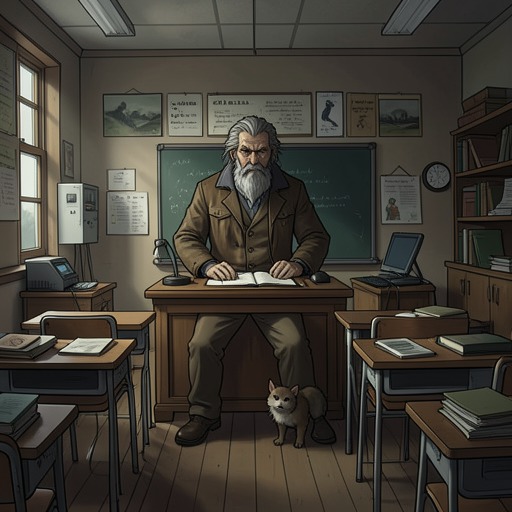
Hortensia enters the story on Matilda and Lavender’s third day at school. She is physically imposing beside the two much smaller newcomers: a sturdy girl with a wart on her nose, eating chips from an oversized bag as she addresses them from above. Her manner is blunt and teasing, but her purpose is to acquaint them with the dangers they have not yet encountered. She calls their new school a place of punishment and explains that Miss Trunchbull especially hates the youngest pupils, whom she regards as undeveloped and contemptible.
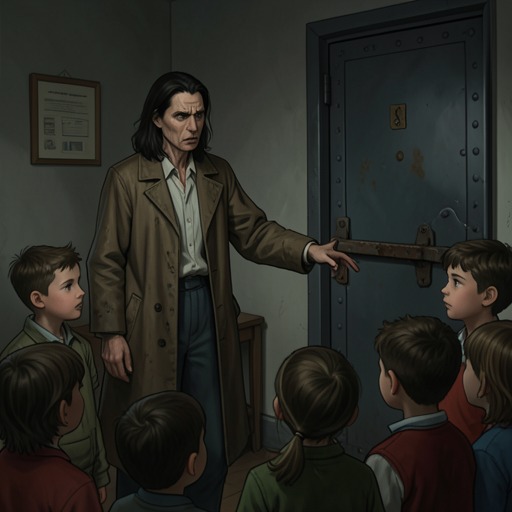
The account also establishes Hortensia as more than a rumor-carrier. When she describes the school’s narrow punishment cupboard, the Chokey, she speaks from repeated experience: during her first half-year she was confined there six times, twice for a whole day and otherwise for two hours at a time. Its cramped floor leaves no room to sit or crouch; the children must stand in darkness, with glass shards on the walls and sharp nails projecting through the door. Her precise explanation makes the threat tangible before Matilda or Lavender has seen the place for herself.
Pranks and Punishments
Hortensia explains that her first confinement in the Chokey followed a prank aimed directly at Miss Trunchbull. She poured half a pot of syrup onto the headmistress’s chair; when Miss Trunchbull sat down, the chair answered with a loud, sucking squelch, which Hortensia compares to a hippopotamus sinking its foot into the muddy bank of the Limpopo River. The delight she takes in the elaborate sound makes clear that her defiance is not merely theoretical: even under a regime of punishment, she has found ways to make its authority ridiculous.
A later escapade began when Miss Trunchbull was teaching the sixth grade. Hortensia raised her hand as if asking permission to use the lavatory, then sneaked into the headmistress’s room and searched for a drawer of gym clothes. She had ordered a potent itching powder through the mail; its label promised blisters as large as walnuts. Hortensia sprinkled it through the gym trousers and neatly folded them back into the drawer. Miss Trunchbull blamed her, apparently because the earlier syrup prank had already made her a suspect. Hortensia says there was no evidence, but denial did not protect her: Miss Trunchbull seized her by the ear, dragged her to the Chokey, and pushed her inside. When she emerged, she was covered in cuts and wounds. The story sets the ingenuity of the prank against the bodily cost of resisting a teacher who can punish first and demand no proof.
A Schoolyard Account of Resistance
Hortensia frames the children’s position as a war: they are an outnumbered force with few weapons, facing Miss Trunchbull, who controls the school’s arsenal of punishments. Yet her account is not only a catalogue of danger. She says that the pupils try to support one another, making solidarity a practical response to the headmistress’s power. When Lavender offers the newcomers’ help, Hortensia brushes the offer aside because they are still so small, though she leaves open the possibility that they may prove useful later. The exchange sets her seasoned caution against Lavender’s eager toughness, while showing that Hortensia measures belonging by a readiness to take part in the struggle.
Her story of a boy punished for eating during a writing lesson gives the threat a public, physical form. Miss Trunchbull grabbed him by the arm and hurled him through an open first-floor window; the children watched him cross the school garden and land in a lettuce patch. He suffered several broken bones. Hortensia adds that Miss Trunchbull had competed in Olympic hammer throwing and took particular pride in her right arm, connecting the headmistress’s athletic strength to the punishment she imposes. The incident explains the severity of the rule against eating in class: anyone caught doing so, Hortensia reports, would be thrown out of the window.
Hortensia’s place in these scenes is that of an older pupil who turns firsthand knowledge into a warning for the newcomers. Her tales are at once alarming and defiant: the punishments are real, but so are the children’s pranks, their shared knowledge, and their attempts to stand together. Matilda and Lavender do not respond to her warnings with visible panic, and Hortensia’s mixture of grim experience, mischief, and guarded welcome introduces them to the school’s informal culture of resistance.
Memory, Performance, and the Logic of Resistance
Hortensia admits that she cannot remember every offense that landed her in the Chokey; the account presents her as a veteran for whom repeated punishment has become almost ordinary. One confinement nevertheless remains sharply marked in her memory: after a whole day inside, she says, she was so disoriented that she babbled nonsense when released. The gap between her matter-of-fact delivery and this consequence keeps her hardiness from making the punishment seem harmless.
Her testimony also helps distinguish two kinds of power in the story. Miss Trunchbull can punish Hortensia despite having no proof, because suspicion is enough for her; later, Matilda reasons that an act so outrageous may instead be dismissed as unbelievable by adults. Hortensia’s experience shows the danger of resisting an authority who decides what counts as truth, while Matilda’s observation identifies disbelief itself as a possible shield. Hortensia does not propose that tactic, but her account makes the school’s unequal contest between children and adults concrete.