Barrayaran Imperial Security
MemoryBarrayaran Imperial Security is the Empire’s intelligence and security service, responsible for covert action and the protection of imperial interests. Its power depends not only on formal command but also on concealed information and delegated work: the same arrangements that let it operate beyond the reach of regular forces can make oversight difficult. The investigation into Simon Illyan’s collapse turns that problem inward, making the service both investigator and subject of scrutiny.
Mandate and Covert Reach
Miles Vorkosigan’s work illustrates how Barrayaran Imperial Security extends its influence beyond the Empire’s regular military. Political barriers and the distances between wormhole routes could prevent regular forces from reaching a situation; Miles’s cover as Admiral Naismith and his command of the Dendarii Free Mercenary Fleet offered a supposedly independent means of intervention. He had spent a decade building that identity as a vehicle for the service’s galactic affairs work.
The Zoave Twilight rescue shows the arrangement in practice. Hijackers seized an unarmed freighter and took Lieutenant Vorberg, a Barrayaran courier carrying credit chits and diplomatic information. Simon Illyan assigned Miles the operation after the hijackers tried to sell their captive. Although the Dendarii Fleet’s official sponsor was the freighter’s insurer, the Empire also backed the mission. That covert sponsorship served a public purpose as well: making clear that interference with imperial couriers could bring consequences.
This division of responsibility also depended on operational expertise outside the formal chain of service. Miles relied on Baz Jesek for engineering, logistics, continuity when Miles was away, and care that private contracts did not conflict with Barrayaran interests. The fleet was not simply a disguise; it was a working organization whose commercial cover and access to sensitive information helped protect imperial aims.
Information, Duty, and Institutional Risk
The service’s reliance on secrecy could place individual careers and institutional knowledge in tension. Miles experienced seizures after his cryo-revival but concealed them from Barrayaran Imperial Security. He feared that disclosure would remove him from field duty, confine him to desk work, or result in medical discharge—and end Admiral Naismith’s career. The concealment meant that the service’s medical staff and Illyan were trying to assess his fitness without knowing a crucial part of his condition.
The problem came to light only after complete copies of the cryo-revival surgeon’s records were found and examined. Their route was delayed by the Durona Group’s hurried departure from Jackson’s Whole, the scattering of its records between Escobar and House Fell, and the time required for Barrayaran Imperial Security’s analysts to recognize the records’ significance. Illyan treated Miles’s deception not as a private medical matter but as a breach of trust toward both superiors and subordinates. Lieutenant Vorberg’s body made the consequences of the concealed risk concrete: Miles’s actions had exposed others as well as himself.
The service’s internal hierarchy also intersected with Barrayar’s social and political order. Miles described the military as formally committed to merit over birth while acknowledging that Vor status remained a governing reality for the high-born officers it was charged to protect. He presented that system not as a personal preference but as one he and his colleagues were oath-bound to uphold. The exchange underscores that the service’s responsibilities operate within imperial institutions and obligations, not apart from them.
Illyan’s Collapse and the Audit
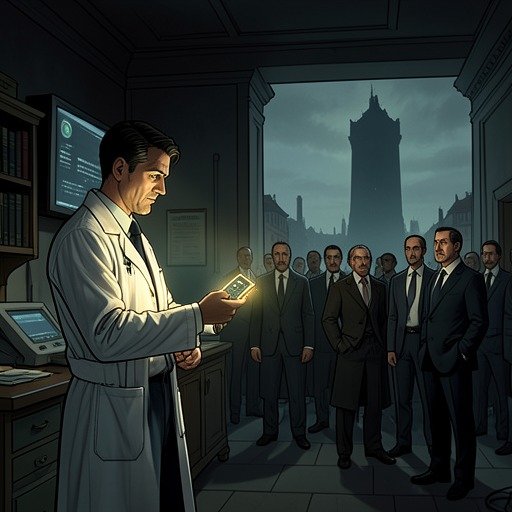
When Illyan began showing signs of cognitive difficulty, the evidence first accumulated through routine work. Galeni reported four unusual incidents over three days. In one, Illyan requested a digest Galeni had already delivered, then found the related code card on his own desk and apologized. At a later weekly briefing, Illyan fidgeted with objects and snapped a data card, then gave instructions that were grammatically coherent but failed to connect into a meaningful sequence. His department heads recognized the change; Illyan initially denied that he needed medical evaluation.
Haroche, who was present, urged Illyan to seek medical attention. Later, however, Haroche controlled access to Illyan and twice blocked Miles from seeing him, threatening to have Miles stunned if he continued pressing. Miles argued that his right to see Illyan also came from family and Vor obligation, not simply from his former position beneath him in the service. He feared that Haroche’s inexperience or poor judgment was worsening the situation, while recognizing deliberate sabotage as a possibility that required investigation rather than assumption.
Miles asked Gregor Vorbarra for access to all raw medical and other case data, then sought the independent authority of an Imperial Auditor. Gregor appointed him acting Imperial Auditor to investigate Illyan’s breakdown, while limiting the assignment to matters connected with that case and emphasizing evidence, due care, and decorum. The appointment placed an external investigator inside Barrayaran Imperial Security with authority to examine the institution’s handling of its own chief.
The inquiry required ordinary investigative work as well as independent judgment. Haroche directed Galactic Affairs to investigate whether the biological agent might have originated beyond Barrayar, including at Jackson’s Whole or Escobar, and proposed reviewing Illyan’s movements during a period of several weeks. Miles accepted the value of the service’s agents and analytical capacity, while recognizing that a real Imperial Auditor would normally have staff to delegate such work. The investigation therefore relied on the organization’s resources even as it tested the reliability of its leadership.
Exposure and Institutional Consequences
The investigation culminated in action against Haroche. After forensic testing made the relevant evidence visible, Miles appointed Guy Allegre acting chief of Barrayaran Imperial Security pending Gregor’s approval and ordered Haroche’s arrest on the capital charge of treason. Haroche denied that he had committed treason, but the change in command made the service’s internal crisis unmistakable: its chief was now the subject of an arrest ordered by an Imperial Auditor, and a replacement had to be installed at once.
Haroche had also obtained Miles’s Imperial Military neurologist’s reports about his seizure disorder. He told Miles that he wanted to discuss the treatment and offered him a return to Dendarii work under terms like those Miles had once had with Illyan, adding a captaincy. The offer brought Miles’s former covert career into the same institutional conflict as the medical information Haroche had acquired. For a service built around confidential records and delegated loyalties, the episode sharpened the question of whether private leverage could distort official judgment.
Barrayaran Imperial Security emerges as capable of extending imperial power through covert networks and specialized agents, yet vulnerable when information is delayed, access is controlled, or authority is exercised without sufficient independent review. Its recovery in this episode depends not on the service acting alone, but on an Imperial Auditor’s scrutiny, cooperation from its working staff, and a change of command. The institution’s reach is therefore both its strength and its exposure: it can investigate threats across political and geographic boundaries, but it must also be made answerable when the threat lies within its own hierarchy.