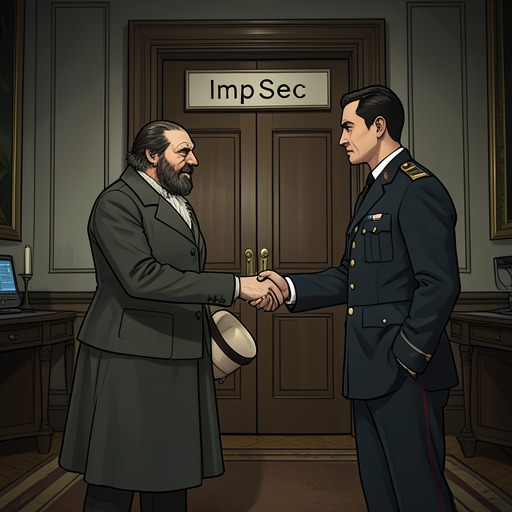
Barrayaran Imperial Auditor system
MemoryThe Barrayaran Imperial Auditor system is Barrayar’s answer to the problem of who watches those entrusted with power. Its Auditors investigate in the Emperor’s name, bringing authority that can reach across ordinary hierarchies; the same authority is constrained by the matter assigned to them and by expectations of evidence and restraint. The system’s history joins imperial oversight to the political order of the Vor, making it neither a routine accounting office nor simply another military command.
Origins and purpose
The title began with the Counts’ financial administration. In the account Miles Vorkosigan gives Laisa Toscane, the earliest Counts were tax collectors for Voradar Tau, and the Auditors’ original task was to police those powerful officials for the Emperor. Although the name derives from accounting, the institution’s remit is much broader: it serves as an independent check on those who exercise authority in the Imperium.
That oversight acquired force through the Emperor’s backing. Miles describes the early Auditors as difficult to intimidate, in part because attacks on them brought severe imperial consequences. A story that they could travel with bags of gold and few guards, while bandits discreetly cleared the way to hasten their departure, illustrates the office’s legendary reach. Miles treats the story as legend rather than established fact, but its persistence conveys the kind of protection and fear associated with the institution.
The office therefore occupies an unusual place in Barrayaran government. It is not limited to financial accounts: the Auditor is a special investigator and inspector of those who might otherwise escape scrutiny. Miles explains its purpose through the question of who will guard the guardians, while also emphasizing that the institution is part of a society organized around Vor power. Its independence serves imperial oversight, but its authority ultimately belongs to the Emperor and operates within the Imperium the Auditors are sworn to uphold.
Membership and imperial authority
Nine is the traditional number of Auditors, though Duv Galeni estimates that only seven are living at the time of the conversation. The office does not follow a single tenure rule. Some Auditors are appointed for life; others receive appointments for a specific case. During Aral Vorkosigan’s regency, appointments were made on an acting basis, and Gregor confirmed several after attaining his majority.
In matters related to their investigations, Auditors speak with the Emperor’s Voice. Gregor describes the role as more than formal representation: an Auditor is also the Emperor’s eyes and ears, an independent observer able to go where the ruler cannot and report back from a separate vantage point. This combination of delegated authority and investigative independence is central to the system. The Auditor acts for the Emperor, but is expected to bring an independent account rather than merely repeat the perspective of the institution under examination.
That authority is broad but not unlimited. When Gregor appoints Miles to investigate Illyan’s breakdown, he confines the assignment to matters at least remotely connected to that event. Miles cannot order executions; any arrests should be supported by evidence sufficient for prosecution. Gregor also invokes traditional decorum and due care. The conditions make clear that an Auditor’s exceptional standing is not permission to act without justification: investigative power comes with an obligation to keep its use relevant and defensible.
Appointment and the ImpSec investigation
Miles seeks more than permission to visit Illyan. After General Haroche blocks him from seeing Illyan, Miles asks Gregor for access to every item of raw data in the case, including medical material, and requests an Auditor’s authority so he can oversee the investigation. Gregor appoints him acting Imperial Auditor for the inquiry into Illyan’s breakdown, giving him a formal position from which to examine the handling of the case.
The appointment immediately changes the balance between Miles and Haroche. Haroche objects to admitting him to Illyan’s presence, but acknowledges that he must do so under protest and addresses him as Lord Auditor. Miles’s new authority does not erase the conflict between them; it changes the terms on which that conflict can be pursued. His standing as a Vor also matters in his earlier appeal to Gregor: Miles distinguishes his family obligation to see Illyan from his former status in ImpSec. The episode shows formal office and personal, aristocratic obligation operating alongside one another rather than neatly replacing each other.
The investigation also demonstrates that an Auditor’s work depends on institutional cooperation and scrutiny of records. Haroche proposes that Galactic Affairs trace the laboratory behind the suspected biological material, possibly beyond Barrayar, and offers to review Illyan’s movements during an earlier period. Miles recognizes that this kind of research is work ImpSec can perform more effectively than an Auditor working alone, while noting that a fully established Auditor would ordinarily have staff. Delegation can extend an investigation’s reach, but the Auditor remains responsible for checking the reports rather than accepting them uncritically.
At ImpSec headquarters, Miles’s access to the evidence-room records is initially blocked by an outdated clearance entry issued under Haroche’s order. The error is corrected after Haroche’s office is contacted, and the records show Miles’s visits over nearly a decade, with dates, times, and codes for items he carried in or out. The incident places the Auditor’s review inside the machinery being examined: access depends on administrative records, and those records themselves can require investigation.
Limits, conflict, and institutional significance
The investigation tests the distance between an office’s authority and the conduct of the person holding it. Haroche invokes Miles’s resentment over his dismissal from ImpSec as a possible motive for involvement. Miles, in turn, keeps his attention on the evidence and later reveals to Gregor and Illyan that Haroche offered him a return to the Dendarii, on better terms than before and with a captaincy. The offer makes the risk of personal inducement explicit; Miles’s disclosure allows the Emperor and Illyan to know what was offered rather than leaving the Auditor’s conduct open to concealed influence.
When the forensic test at an air grille produces a positive result, Miles orders Guy Allegre, newly acting chief of ImpSec pending Gregor’s approval, to arrest Haroche on the capital charge of treason. The order demonstrates how the Auditor’s investigative mandate can reach into the leadership of the agency under review. It is an arrest order, not a finding of guilt, and Haroche immediately denies that he committed treason. That distinction accords with the limits Gregor set at the appointment: the office can initiate consequential action, but the case must still be addressed through evidence and proper proceedings.
The system’s significance lies in its capacity to interrupt institutional self-protection without standing wholly outside Barrayaran society. Its authority comes from the Emperor, its history is bound to the policing of the Counts, and its officers operate within an Imperium sustained by the Vor. Miles’s appointment puts that structure to practical use: independent oversight is not merely a constitutional ideal but a power capable of opening access, examining records, and confronting the head of ImpSec. The same episode insists that such power must remain tied to the assigned case, supported by evidence, and exercised with care.