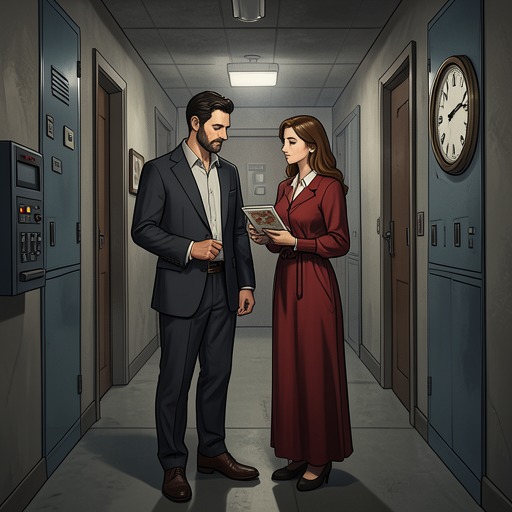
Miles Vorkosigan and Taura
MemoryMiles Vorkosigan and Sergeant Taura’s relationship joins private love to rescue, freedom, and the knowledge that time is running short. Their bond began when Miles returned for Taura and changed an assignment to terminate an experiment into a rescue. Years later, they remain lovers as well as comrades in the Dendarii Free Mercenary Fleet, their intimacy shaped by military rules and by Taura’s engineered, shortened life.
First Encounter and the Beginning of Their Bond
Taura was the living prototype of a super-soldier project conceived and carried out on Jackson’s Whole. The project’s committee consisted entirely of biological engineers, without an experienced soldier among them, and sought a spectacular result for its client. The result was a formidable soldier, but one designed for a short life. Miles first encountered Taura when she was sixteen and already eight feet tall, lean and muscular, with heavy claws, fangs, golden eyes, and a metabolism that gave her extraordinary strength and speed. Her concentrated stare could frighten armed men into dropping their weapons; Miles had witnessed that effect himself.
Their first meeting did not produce immediate love for either of them. Miles remembered being terrified at first, then falling in love after about an hour. Taura likewise said that she began to fall seriously in love with him when he came back for her. That return became the defining turn in their relationship: Miles had not originally been hired to rescue her, but he changed the purpose of the mission. In retrospect, he called it one of his first personnel retrievals and one of the best, though its course had been unconventional.
Intimacy Under Military Rules
The relationship persisted across the six or seven years since their first encounter, and its private history mattered to Miles even though he described his Dendarii missions as blurred together. He could remember each rare occasion they had made love, including that their intimacy began before he and Elli Quinn became a couple. Taura was a singular first for him, as he was for her, and he understood their bond as a secret that had not faded.
Their relationship also crossed a boundary the Dendarii Free Mercenary Fleet formally guarded. Its regulations against fraternization across ranks were intended to protect rankers from exploitation and officers from losing control of discipline. As the young Admiral Naismith, Miles had meant to set a virtuous example. That resolve gave way over time, and he and Taura tried instead to keep their encounters discreet. The contrast between a rule meant to preserve institutional trust and a relationship that repeatedly breached it frames their intimacy as both personal and professionally risky; the evidence establishes the rule and their discretion, but not any specific disciplinary consequence.
Trust, Tenderness, and the Present
During a later meeting aboard a ship, Taura checked the adjoining rooms for bugs and reported that no new passengers or cargo had been added since their booking; the ship had just left orbit. Miles welcomed her with a kiss they understood as a promise. Her powerful build made the deck creak slightly beneath her combat boots, and her kiss was hot; he loosened her neatly pinned mahogany braid before she left to use the bathing facilities. The scene sets the scale and force of Taura’s body beside the familiar, deliberate tenderness between them.
Afterward, Miles woke much later and watched her sleep. Her usual genetically programmed alertness made sleep itself meaningful to him: she trusted him enough that his slight movement did not rouse her. He regarded this as especially telling among her many responses. His attention to her breathing and to the heat rising from her golden skin makes affection inseparable from apprehension. Even in a quiet shared room, he cannot regard her body as simply secure or her future as open-ended.
Taura’s Engineered Life and Miles’s Fear of Loss
Taura was the last survivor of her fellow prototypes. Their designers had programmed them for short lives, perhaps as a fail-safe and perhaps in the mistaken belief that a soldier expecting little time would be more readily sacrificed. The other prototypes died quickly; when deterioration came, it lasted weeks or months rather than stretching into a long old age. Miles judged that the researchers had misunderstood both courage and life. The description of the soldiers as made to go up in flame rather than down in shame captures the brutal terms of their design, not a fate Taura had chosen.
At twenty-two, Taura was already showing tiny silver glints in her mahogany hair that had not been there the year before. The Dendarii fleet surgeon had studied her and prescribed drugs to slow her fierce metabolism. The treatment reduced her appetite from the equivalent of four people to that of two, and, year by year, medical intervention had extended her life. But Miles knew the extension could not be permanent. His imagined measure of their remaining time narrowed to her breaths, a fear that makes the intimacy of watching her sleep carry the shadow of possible loss.
Rescue, Freedom, and What the Relationship Reveals
Taura identifies a pattern in Miles: he seems especially cheerful during a rescue, however dangerous it becomes. She distinguishes rescue from its result, describing freedom as what rescue produces and suggesting that Miles gives freedom away because he wants it himself. Miles answers that he craves the adrenaline high. Their exchange preserves both explanations without reducing his conduct to a single motive: the thrill is real, but Taura reads the repeated rescue as connected to a deeper value.
That value also defines their shared history. Taura did not fall seriously in love simply because Miles was powerful or because he had been assigned to her; she names his return as the moment that changed her feelings. For Miles, the mission’s transformation into a rescue became a cherished early memory, and his regard for Taura endured even as his life with Elli Quinn developed. Their relationship therefore holds together desire, professional constraint, gratitude, trust, and mortality. It offers no assurance that love can defeat Taura’s engineered lifespan; its force lies instead in the freedom Miles chose to give, the trust Taura places in him, and the value both attach to the time they share.