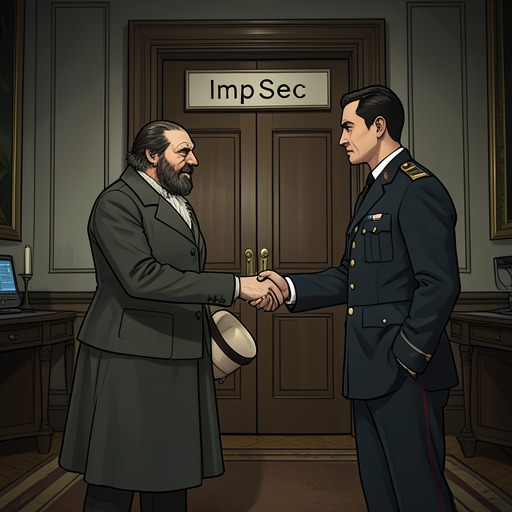
Miles Vorkosigan and Gregor Vorbarra
MemoryMiles Vorkosigan and Gregor Vorbarra share a relationship in which friendship and family-like trust coexist with the demands of rank, public office, and Vor obligation. Gregor treats Miles as more than a gifted subordinate: he recognizes his capacity for independent judgment and entrusts him with power. Miles can speak to Gregor with candor, yet repeatedly frames his claims through duty—to the Imperium, to his family, and to people connected to them. Their closeness is most visible not in freedom from hierarchy but in how they use it: Gregor makes room for Miles’s judgment, while Miles trusts Gregor with remorse, uncertainty, and appeals that cross formal chains of command.
Trust within a hierarchy
The relationship is tested after Miles has made a serious mistake and Gregor must speak to him as the ruler who has to reckon with it. Gregor begins by acknowledging that the conversation is difficult for both of them. Miles answers with dry skepticism, and Gregor admits that he wishes Miles had not acted as he did. Miles does not evade responsibility: he says he also wishes he had not done it. Their exchange allows regret to be mutual without pretending that the consequences can be reversed. Gregor insists that what has happened cannot be undone, while Miles imagines having one wish and wonders whether he would use it to undo an earlier loss—the death of Sergeant Bothari—or to change his more recent choices. He distinguishes that earlier, more innocent mistake from the calculated errors he believes he has since made.
Gregor’s disappointment is set against genuine investment in Miles’s future. He says he had thought Miles might become the first man of their generation whom he could place in a position of real power and responsibility in the upper levels of government. Miles rejects the implied promise of a career in Domestic Affairs, but the disagreement does not erase what Gregor’s expectation reveals: he has imagined Miles as a consequential partner in governing, not merely as a talented officer. Their different perspectives sharpen the cost of Miles’s failure. Miles recognizes that he has sacrificed his integrity to preserve an identity that would soon have been taken from him anyway; Gregor, meanwhile, mourns a future role for him that Miles does not value in the same way.
When Gregor asks what Miles intends to do next, Miles cannot offer a plan. He asks instead for serious time off, distinguishing medical leave and travel from the time he needs to think. Gregor then asks him not to contact the Dendarii Mercenary Fleet independently, warning that although Miles might evade restraint, Gregor could not save him from a treason charge. The exchange makes their trust neither sentimental nor unconditional: Gregor speaks plainly about the legal danger, and Miles remains seated to hear him. As they walk toward the door, Miles manages a quiet apology. Gregor’s presence has made room for that admission without turning the conversation into either absolution or a rupture.
Shared obligation and political judgment
Their bond operates within a society where formal office and personal ties overlap. Miles invokes that overlap when he insists to Gregor that he has a right to see Simon Illyan—not as Illyan’s former subordinate, but as his father’s son and a Vor. He argues that this obligation passes around ImpSec’s military hierarchy and gives him a different basis for acting. His appeal is personal, but it is also an argument about inherited responsibility; he asks Gregor to recognize that a bond of duty can matter even when official channels obstruct it.
Miles explains the emotional force behind the claim by describing Illyan as a foster uncle and a family retainer. He had called Illyan Uncle Simon until entering the Service Academy, then addressed him as Sir. Gregor says he had not realized Miles thought of Illyan as a foster father; Miles narrows the description to a foster uncle and insists that it is a family matter, adding that he is Vor. Gregor is pleased to hear him acknowledge this. Miles then calls himself the only Vorkosigan on the planet at that moment and accepts responsibility for what he owes Illyan. Gregor does not dismiss the appeal as mere nostalgia: his response recognizes Miles’s claim to a duty that is at once familial, political, and personal.
The exchange also shows Gregor able to draw out an aspect of Miles that Miles can be slow to own. In a conversation about the Vor system, Miles describes the military’s meritocratic ideal and the high Vor’s insistence on the reality of their inherited responsibilities as competing fantasies. He nevertheless maintains that the system is the one they are both oath-sworn to uphold. This is Miles’s assessment, not a declaration of Gregor’s private beliefs; its relevance to their relationship is that Miles speaks to Gregor as someone who understands the obligations binding them, even when he can criticize the system they serve.
Appointment as an act of confidence
When Gregor appoints Miles acting Imperial Auditor to investigate Illyan’s breakdown, the relationship becomes the means by which personal trust is translated into public authority. Gregor describes an Auditor as his eyes and ears: an independent listener and probe able to go where the Emperor cannot. He chooses Miles because of the unusually independent angle of view that Gregor believes him to possess. The appointment is thus not simply a way to give Miles work; it is an explicit judgment about his ability to investigate without becoming an extension of the existing hierarchy.
Gregor also defines the limits of the trust. Miles’s actions must be related, at least broadly, to the matter assigned to him, and any arrests should be supported by evidence capable of sustaining prosecution. Gregor expects decorum and due care. The boundaries matter because the appointment gives Miles wide investigative latitude while requiring him to exercise it responsibly. Miles responds with renewed energy, and Gregor recognizes the source of his remark about doing worthwhile work well. Their familiarity is present in the exchange, but the substance is institutional: Gregor delegates power and specifies accountability; Miles accepts both the opportunity and its constraints.
That confidence carries into the investigation’s decisive confrontation. After the evidence against Lucas Haroche has been brought into view, Miles tells General Allegre that he is acting chief of ImpSec pending Gregor’s approval and orders Haroche’s arrest as Imperial Auditor. Miles hesitates over the charge before naming treason, and Haroche denies it. The scene demonstrates the reach of Gregor’s delegated authority, but it does not make Gregor the investigator or the source of the evidence: Miles gives the order under his own Auditor authority. The distinction captures their working relationship. Gregor supplies a mandate and trusts Miles’s independent judgment; Miles acts within that mandate and must stand behind the consequences.
Kinship expressed through ceremony
Gregor’s request that Miles serve as his Second at his wedding gives their private bond a public and ceremonial form. Gregor says there is no one he would rather have stand on his wedding circle except the people he names as his closest choices, and asks Miles to take the role. Miles accepts, then immediately asks about the timetable for the public ceremony. His response joins affection to practical awareness: he understands that a royal marriage entails public arrangements as well as a personal commitment.
Gregor’s account of those arrangements reveals how much the occasion is being shaped around him. He had wanted an immediate betrothal ceremony, while Alys Vorpatril insists that the announcement wait until her return from Komarr, after she has acted as Gregor’s Voice to the bride’s parents. The formal betrothal and eventual wedding are also subject to negotiation. Gregor recounts the delay with impatience, especially the need to allow the Vor ladies time to prepare. Miles is not merely informed of the plans; Gregor shares the private friction and asks him to occupy a recognized place in the ceremony. The invitation places him among the people Gregor wants beside him at a defining public transition.
A bond that holds regret and confidence together
Across these encounters, Gregor’s regard for Miles survives disappointment without dissolving the distinction between personal affection and public consequence. He can warn Miles against an act that could expose him to treason charges, regret the loss of the future he imagined for him, and later entrust him with an independent investigation. Miles, for his part, can challenge Gregor’s assumptions about career and power, acknowledge his own wrongdoing, appeal to Vor responsibility, and accept a place at Gregor’s wedding. The relationship is therefore not defined by uncomplicated agreement. Its steadiness lies in the continued willingness to speak frankly, recognize obligations, and place trust where judgment—not obedience alone—is required.