Expendable status
Mickey7Expendable status makes Mickey Barnes at once a worker, a replaceable body, and the person forced to confront what replacement means. He volunteers for the role to leave Midgard, accepting lethal assignments in exchange for passage aboard the Drakkar. The institution treats his death as a manageable cost; Mickey’s experience makes that cost harder to dismiss, because each successor inherits his memories while leaving open whether the person who died continues at all.
Recruitment and the promise of immortality
Mickey did not become an Expendable through a criminal act or as a punishment. He volunteered. The recruiter, Gwen Johansen, presented the position under the more appealing label of an Immortal, though Mickey understood, more or less, what he was signing up for. In her office on Midgard, she read from a screen a list of jobs likely to kill a particular instance of him. He listened through the long list before tuning out, but he knew that his tissue samples would be taken and his pattern uploaded. The signature meant that he would be first in line for dangerous work.
His decision was driven by the narrowness of his alternatives. He had no practical skills that qualified him as a pilot, medic, geneticist, botanist, xenobiologist, or even a spear-carrier, and he urgently needed to leave Midgard. The Drakkar was the first colony ship chartered since the settlers’ landfall two hundred years earlier; volunteering as an Expendable was the only way he expected to secure a berth. The choice was formally his, but the conditions surrounding it left little room for a different route off-world.
Mickey’s understanding of the job was also incomplete. He assumed that machines would take on much of the most dangerous work, as they did on Midgard, and imagined his posting might therefore be relatively easy. The realities of a beachhead colony undermined that expectation: unstable crevasses and potentially carnivorous local fauna were among the hazards people might send him to investigate. His initial consent was not consent to a rare emergency, but to a continuing supply of tasks in which his replaceability could make risk seem acceptable to everyone else.
What the role demands
The job description ranges from external repairs during interstellar transit to exposure to local plants and animals, medical experiments, and combat against hostile forces. Mickey’s own account of the role extends the examples to reactor trouble, tests of uncertain vaccines, and even checking whether a homemade batch of absinthe is poisonous. These examples make the Expendable’s purpose plain: when a task might destroy the person doing it, the colony can use Mickey and, if he dies, make another.
That calculation is not merely a matter of machines being costly. During instruction, Jemma explains that the Drakkar’s propulsion specialists can direct emergency repairs, but a crisis may leave little time. An hour after shutdown, neutron flux in the combustion chamber can deliver a lethal dose through full combat armor in less than sixty seconds; the person sent in would not be wearing that expensive armor. Drones fare poorly under the same high-energy particles and can shut down in under a minute. A human body might remain useful for an hour or more after exposure that has made survival impossible, while a damaged machine is harder to replace far from Midgard’s industrial base. With no serious mineral extraction or heavy industry available early in colonization, lost metal cannot readily be recovered; the raw materials for another Mickey depend instead on getting agriculture established.
The contrast is brutally practical. The colony does not send Mickey because his body is invulnerable, but because it can tolerate his loss more readily than the loss of equipment. His official title is Mission Expendable, and Jemma insists that he understand what it means. The designation converts a difference in replacement costs into a rule about whose life may be used up first.
Death, memory, and personal continuity
The system’s promise of repeated life does not settle whether Mickey survives his deaths. He describes the arrangement as a nightly thought experiment made literal: if a person dies while asleep and someone wakes with all the same memories, hopes, fears, and wishes, would the difference be practically detectable? In his case, sleep is replaced by crushing, vaporization, fire, or another lethal assignment. The next instance can remember the former one so completely that memory feels like lived experience, while the prior instance has nevertheless ceased to exist.
Mickey remembers being Mickey1, though not the final minutes of that life. Mickey1 died after a hull breach in transit; a few hours later Mickey2 woke believing himself to be thirty-one and to have been born on Midgard. The continuity is emotionally persuasive but philosophically uncertain. Mickey cannot tell whether the original Mickey Barnes is somehow looking out through the successor’s eyes, or whether each new instance merely inherits the conviction that he is the same person. He imagines that dying in the cavern might mean waking as Mickey8, but does not believe that this possibility resolves the question. The stored pattern can reproduce memory and identity as experienced; it cannot reassure the person about to die that consciousness itself will carry across.
This uncertainty gives the job’s language of immortality an unsettling double meaning. To the colony, a death can be followed by another usable body. To Mickey, every instance has a present-tense life and faces its own end, even if a successor will remember it. Replaceability is therefore not the same as safety, and a record of prior lives is not proof that any one life continues.
Command, coercion, and refusal
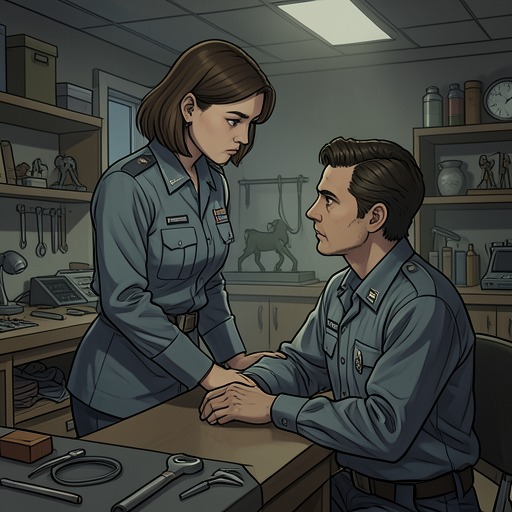
The status becomes an immediate instrument of control when Marshall confronts Mickey and Mickey8. Mickey8 points out that he has been getting himself killed for Marshall for nine years and argues that if the colony simply wants to eliminate a multiple, Marshall could kill one of them or both. Marshall answers that this would not be an ordinary death followed by regeneration: their personalities and body template would be erased from the server. The threat is not simply to kill an instance but to end the possibility of further instances.
Mickey8 counters that only 176 colonists remain and the colony is moving to a war footing; it cannot casually discard its only Expendable. Marshall replies that Cat Chen has volunteered to take the berth if needed. When the room falls silent, Mickey8 asks what they must do to avoid being sent down the hole. Marshall offers a mission and frames fulfilling duty as the way out. Mickey immediately suspects the assignment will kill them. In this exchange, the status is both a scarce operational resource and a vulnerability: the colony needs an Expendable, but its leaders can threaten to destroy the stored pattern and offer the position to someone else.
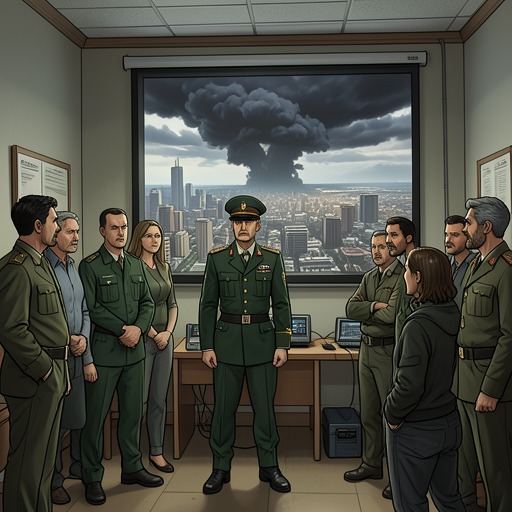
Marshall later accuses Mickey of failing to finish the mission and calls him afraid to die. Mickey acknowledges that he may not have wanted to die, but rejects the idea that the only issue was fear. He did not want genocide on his conscience. The proposed use of a doomsday weapon against the creepers had already gone wrong when they took Mickey8 before he could trigger it; Mickey insists that Marshall’s decision to send the weapon, not his own refusal to complete the killing, created the crisis. He argues that the creepers are another intelligent species and that the colony now needs diplomacy, particularly after handing them an antimatter weapon.
Resignation and the role’s changed meaning
Marshall threatens to wipe Mickey’s pattern and recordings from the servers and personally put the last instance of him down the corpse hole. Mickey responds by resigning as the colony’s Expendable. He tells Marshall to wipe the servers if he wishes, but argues that Marshall cannot afford to kill him: he is the colony’s only liaison to the creepers, and the truce could be ended if the colony laid a hand on him. Marshall’s threat has not disappeared, but Mickey’s value is no longer limited to his willingness to die for human operations.
The decision brings a weight lifting from Mickey’s shoulders, and he laughs when Marshall is left momentarily unable to respond. Resignation does not undo the years in which the colony treated his body as a renewable resource, nor does it answer whether a successor would truly be him. It does mark a break in the role’s governing logic. Mickey refuses to let the job description decide that his death is acceptable, and turns the very replaceability that once made him expendable into a position he can leave. His status ends not with another regeneration but with a refusal: the person treated as a disposable instrument claims authority over what he will do with his own life.