Union Ban and Social Stigma Against Multiple Instances
Mickey7The Union Ban and Social Stigma Against Multiple Instances turns the existence of more than one living copy of a person into a question of social legitimacy, religious belief, and collective survival. Its force comes not from a single source: the Natalist Church’s doctrine of one soul per body gives the taboo a spiritual vocabulary, while Alan Manikova’s conquest of Gault supplies a historical catastrophe that makes the fear of copies visceral. When Mickey Barnes and Mickey8 are exposed, those long-standing arguments converge in a demand to treat them as monsters rather than as two people who did not choose to coexist.
Technology, Souls, and Ethical Objections
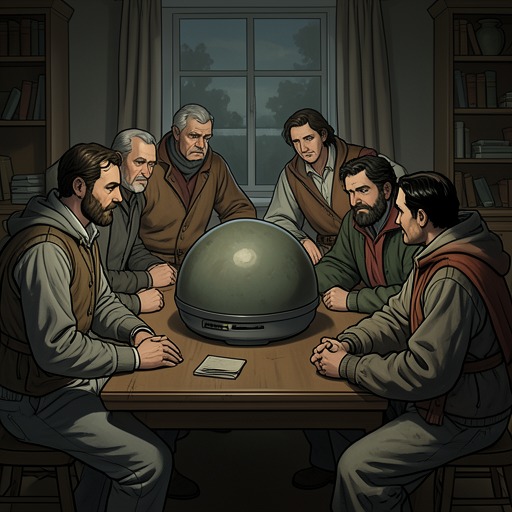
The technology behind copied bodies predates the use of Expendables. Early bio-printers could scan and reproduce bodies, and researchers later learned to reproduce synaptic connections. Experiments with animals and humans nevertheless showed that this was not enough to reproduce consciousness: the resulting bodies were empty, unformed beings rather than returned persons. The distinction matters to the taboo’s history. A copied body was not automatically understood as a continuation of the person whose pattern it carried, and technical ability did not resolve the question of personal identity.
The Natalist Church gives that uncertainty a firm religious answer. One of its prime doctrines is the sanctity of the unitary soul: one soul belongs to one body, and when the original body dies, the soul dies with it. A bio-printed body imprinted from a backup is therefore condemned as soulless and not fully human. The belief is not shared by Mickey Barnes, but its social consequences reach beyond church members; religious language helps define why backups and multiple living instances can provoke a response more severe than ordinary disapproval.
There are also objections to the Expendable system itself. Mickey’s research into its history reveals that the technology had been viable for only about two centuries and was not used by every colony mission, despite its apparent practical value to isolated settlements with few adults and embryos that would take years to mature. Some critics object to taking people from the streets or prisons and forcing them to die repeatedly. Volunteering, as Mickey did, changes some of those ethical considerations, but does not remove the larger controversy surrounding copied bodies and repeated death.
Manikova and the Catastrophe on Gault
The decisive historical warning is Alan Manikova’s campaign on Gault. The bio-printer had existed before the launch of the Ching Shih, but before Manikova it had been little more than a curiosity. Manikova, an exceptionally wealthy heir from Eden and a prodigy with doctorates in three fields by the age of twenty-five, founded Universal Eternity, Inc. after his parents died and he inherited their fortune. He brought the project to Gault, where he turned replication into a means of taking power.
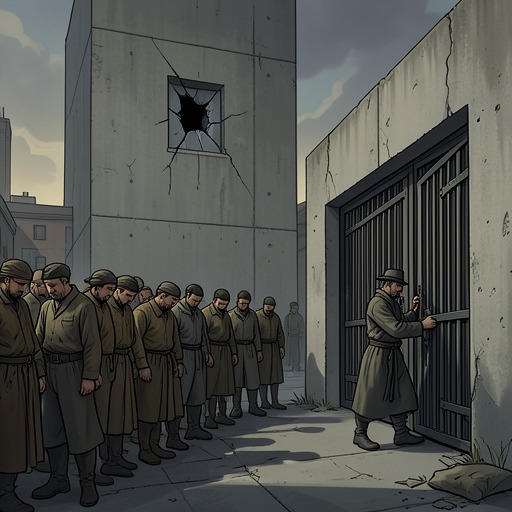
After using up his initial feedstock, Manikova had nearly a hundred copies of himself and had built two more replication units. He began by abducting isolated people and others unlikely to be missed, then moved on to victims with families and friends. When the clan hosting him sent security forces to question him, it discovered that he had withheld the advanced military technology he had brought to the planet. Manikova put members of that clan through the printer, made copies of himself, armed them, and attacked a neighboring clan.
Gault’s divided communities did not unite quickly enough to stop him. Nearly a year passed before the surviving clans seriously considered a common response; by then, Manikova and his copies made up an absolute majority of the planet’s human population. The final clans managed to send a desperate appeal to Eden, but the message took seven years to arrive, and the authorities then spent almost two years deciding how to respond. The episode shows the danger feared by the ban: copies could multiply an individual’s power, while fragmented opposition and long communication delays gave that power time to become overwhelming.
The aftermath fixed the stigma in public memory. The Farhome catastrophe turned a habitable planet into molten slag, an act regarded as the Union’s greatest crime, but people did not blame Farhome. They blamed Manikova. In the resulting moral hierarchy, being a multiple could be judged worse than being a child stealer or a human head collector. The comparison is deliberately extreme: it conveys not simply suspicion of a technology but the social degradation attached to anyone identified with it.
The Ban in Everyday Judgment
The historical example makes the fear of multiples feel immediate even when no new Manikova is present. The prospect of making several Expendables at once can be imagined as useful for a dangerous task requiring two people, but that apparent efficiency is precisely what the history of Gault makes frightening. If copies can be produced in numbers, the boundary between a person and a growing force of replicas becomes politically consequential. The taboo therefore persists even where replication might appear to answer practical needs.
Its pressure is visible in Mickey’s awareness of the danger of being reported as a multiple. Trapped underground after falling into a tunnel, he worries that Nasha will not know whether he is alive and that Berto may file a loss report. He also recognizes that, across many colonies, the Union’s moral tolerance is broad in other respects but being a multiple can carry an exceptionally severe stigma. His predicament links public prejudice to the practical vulnerability of an Expendable: whether a person is recorded as dead or returned can determine whether another instance is made, and the existence of more than one living instance invites condemnation.
Mickey Barnes and Mickey8
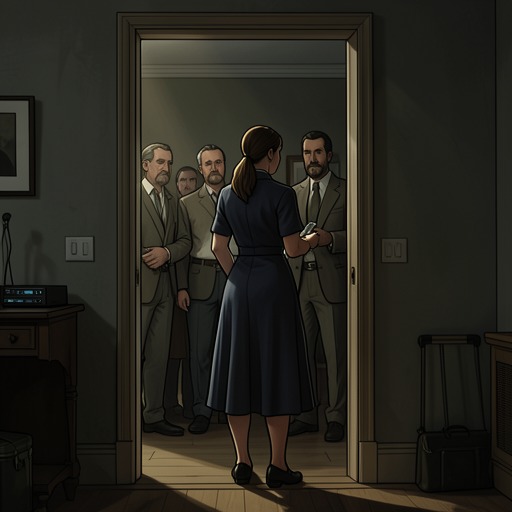
When Mickey Barnes and Mickey8 are confronted by Hieronymus Marshall, Mickey8 argues that their accidental duplication could help a colony already close to viability. Marshall rejects the distinction between deliberate and accidental creation. He cites the seventy kilograms of calcium and protein consumed by the two bodies in a colony on the brink of starvation, and insists that one of them should have returned to the cycler as soon as they realized they were multiples. The material cost gives the taboo a local, urgent form: in a hungry settlement, the copies’ bodies represent scarce resources as well as a breach of social rules.
Marshall’s anger also turns on the two instances having had relations with one another. His disgust breaks into silence before he recovers a controlled tone and calls them monsters. He declares that both will go into the cycler and frames the remaining questions as whether there will be a ninth iteration of Mickey and whether Nasha should be sent down the corpse hole with them. The confrontation shows how quickly the social stigma becomes a question of survival and punishment, extending from the copies themselves to someone associated with them.
The ban’s significance lies in this collision between historical precedent, religious doctrine, and immediate material pressures. Manikova’s use of copies to dominate Gault makes fear of replication more than an abstract theological dispute; the Natalist Church’s unitary-soul doctrine makes it a judgment about who counts as human; and Marshall’s response to Mickey Barnes and Mickey8 makes the accumulated judgment actionable. The taboo does not merely condemn duplication as an idea. It places the duplicated person at risk of being treated as an enemy, a resource burden, and an abomination all at once.