Multiple status
Mickey7Multiple status is the condition of two living instances of Mickey Barnes occupying the same colony at once. When Mickey returns to his small room in the dome’s upper racks, he finds Mickey8 asleep in his bed and realizes that the new copy has emerged from the tank while the original remains alive. The duplication is not merely a violation of the Union’s taboo against multiples: it puts both Mickeys at risk in a colony where one identity, one berth, and one ration card are already under pressure. Their eventual separation by death resolves the immediate practical crisis, but leaves the surviving Mickey grieving someone he understands as both another person and himself.
Discovery and Definition
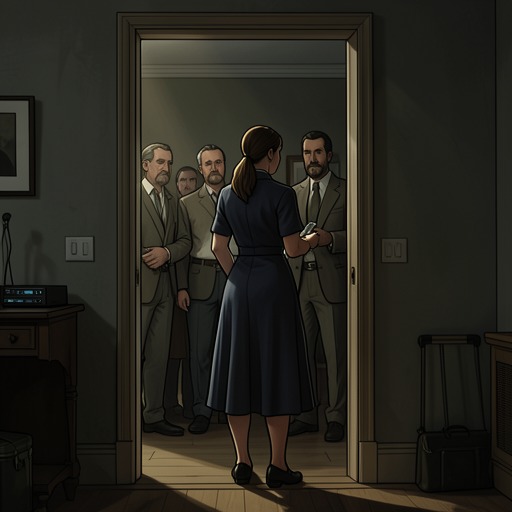
The status begins with a domestic shock rather than an official announcement. Mickey’s room is among the low-status racks near the dome’s roof, reached by climbing four floors of bare metal stairs. Its plastic dividers and thin foam doors mark the cramped conditions of the slums; Mickey has a double room to himself partly because he is an Expendable. Returning to it, he finds the door unlocked and another man in his bed, wrapped in his blanket. The stranger recognizes himself as Mickey8, making the impossible fact plain: a second Mickey has come out of the tank even though Mickey is not dead.
The copies share a person and a registered identity, but their simultaneous existence does not erase the immediate distinction between them. Mickey initially treats the situation as a problem of rightful succession: since he is alive, he believes Mickey8 should not have been printed and that one of them must go. Mickey8 rejects the idea that he should pay for circumstances that were not his fault. Neither can yield without surrendering his life, so the disagreement is not a negotiable dispute over preference; it is a conflict produced by the system’s assumption that there can be only one Mickey at a time.
Scarcity and Institutional Danger
The colony’s material limits make the duplication especially dangerous. The human Diaspora is compared to settlement by small Pacific islands: arrivals depend on what they bring with them until a new land can sustain food production. On Niflheim, crops cannot be relied upon to grow, and even the hydroponics tanks are struggling. The initial ration is fourteen hundred kilocalories a day, with supplements tied to lean body mass and work schedule; rations have already been cut twice. In this setting, the rule that beachhead colonies cannot support surplus people becomes a force acting directly on the two Mickeys. Even if multiple copies did not violate a powerful Union taboo, there is little food for an extra Expendable.
Mickey and Mickey8 try to make their existence workable without disclosing it. Mickey8 proposes living on discounted paste, which would provide each of them twelve hundred and fifty kilocalories of actual nutrition. The compromise might delay starvation, but it does not solve their lack of a second berth, ration card, or registered identity. The distinction matters: the status is not sustained by secrecy alone. Their daily presence requires resources and recognition the colony has allocated to one Mickey, while the colony’s conditions leave little room for an informal second life.
Going to Command appears no safer than remaining hidden. Mickey fears that Marshall, already hostile to the existence of a Mickey in the colony, would send one of them to the biological recycler. That hostility has a history: after Mickey’s confrontation with Darius Blank, Marshall interpreted the episode as evidence that criminals had infiltrated the colony and nearly had Mickey thrown out an airlock before the Drakkar’s captain intervened. Marshall also comes from a religious tradition that regards bringing people out of the tank as an abomination even when done one at a time. The duplicate therefore intensifies an existing conflict between Mickey’s continued existence and the authority responsible for the colony.
Exposure and the Threat of Erasure
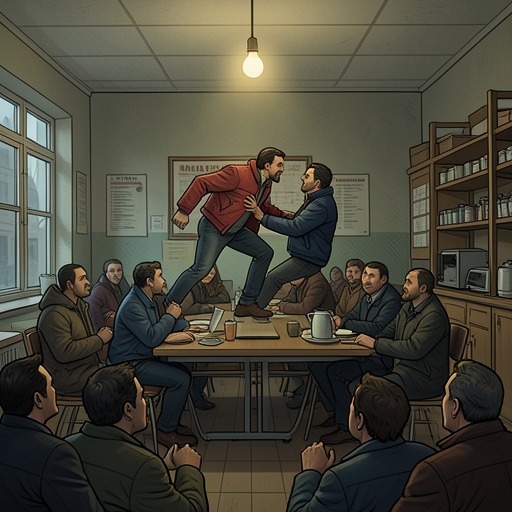
When Mickey8 finally confronts Marshall, he describes nine years spent getting himself killed for him and insists that Marshall is not simply a villain. The appeal makes the stakes personal, but Marshall’s response clarifies that the threatened punishment is more final than another trip through the tank. If both Mickeys are sent down the hole, Marshall says, their personality will be erased from the server and their body template destroyed. The threatened end is not another copy made from stored information; it is the loss of the means to produce either Mickey again.
Mickey8 argues that the colony has only one hundred and seventy-six people left and is moving to a war footing, so it cannot afford to discard its only Expendable. Marshall concedes the general need for bodies but rejects the claim that Mickey is irreplaceable: Corporal Cat Chen has volunteered to take the Expendable berth if necessary. Her offer shows that the role, rather than the duplicate status itself, can be transferred. It also strips Mickey8 of the protection he had tried to claim through usefulness. Faced with the possibility that neither copy will survive, he has no assurance that the colony will preserve even one of them.
Death, Continuity, and Aftermath
Mickey8’s death ends the period in which two Mickeys exist at once, but the surviving Mickey does not experience that ending as a clean restoration of the original arrangement. Back in his rack, he tries to reason through the loss by setting aside the fact that Mickey8 had to die if he was to remain. They knew one another for only a few days, and Mickey8 had often annoyed him; yet those explanations do not prevent grief. Mickey recognizes the paradox that the dead copy is both gone and not wholly separate from him: he understands Mickey8 as himself, even as he mourns him as someone who has died.
The image of mourning a reflection after a mirror breaks gives the status its lasting significance. A reflection is inseparable from the person looking at it, but the broken mirror makes the loss visible and irreversible. Mickey’s grief does not resolve whether the two instances were one person or two in every meaningful sense. Instead, the episode makes that uncertainty felt through consequence: the colony’s rule can end multiple status by killing one copy, but it cannot make that copy’s loss emotionally simple for the one who remains.