Niflheim colony food crisis
Mickey7The Niflheim colony food crisis is more than a shortage of meals: it is a structural weakness in a settlement that has not yet made its own food supply reliable. Crops struggle both outside the dome and in hydroponics, forcing the colonists to reduce rations while depending on recycling systems and finite stores. Scarcity reaches into questions of who may consume, how much risk the colony can afford, and whether it can keep its essential infrastructure running.
Causes and Material Conditions
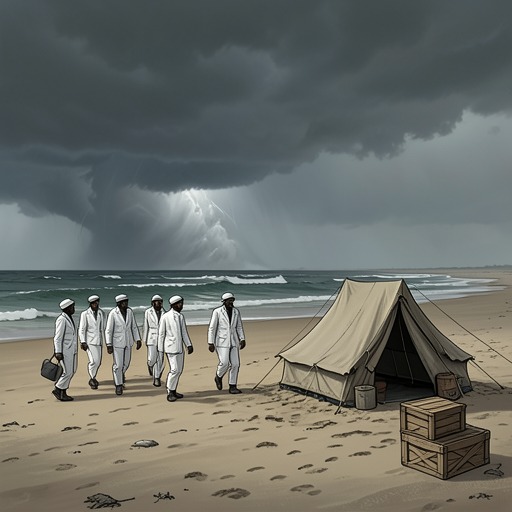
The colony arrives with the familiar uncertainty of a beachhead settlement: supplies must last until local production can take over, but no one can be certain that imported crops will grow after landfall. On Niflheim, cultivation proves especially difficult. Growing anything outdoors is expected to be a serious long-term challenge, while something in the local microbiota interferes with plants being raised inside the dome. Even the hydroponics tanks struggle, so the hoped-for transition from carried provisions to dependable agricultural output remains incomplete.
The general ration at landfall is 1,400 kilocalories per day, with adjustments based on lean body mass and work schedule. That baseline is cut twice as the crops fail to meet expectations. The shortage is visible in the colonists’ bodies as well as their accounts: most are described as gaunt. The settlement has not reached cannibalism, but that comparison marks how narrow the margin has become. The governing assumption is that residents must endure scarcity until agriculture improves, not that the colony can quickly replace its food supply through outside commerce or industrial production.
This predicament is part of the wider economics of establishing a colony. The materials needed to create another human body can eventually be supplied by agriculture, but Niflheim’s agricultural base is precisely what has not yet come online. Meanwhile, heavy industry and serious mineral extraction lie in the future, making lost metal difficult to replace. The colony’s scarce resources are therefore linked: food production is needed not only to feed people but also to support the material systems on which continued settlement depends.
Rationing, Recycling, and Survival
When two Mickey Barnes instances confront the problem of sharing provisions, the crisis becomes immediate and personal. Mickey8 points out that their heavy ration card provides 2,000 kilocalories a day between them, assuming nothing has happened to change their status since the last upload. Divided evenly, that amount keeps both alive, though not comfortably. A discounted serving of paste offers a short-term calculation: at a 25 percent reduction in price, relying on it alone would provide 1,250 kilocalories of actual nutrition to each. The arithmetic offers a way to postpone starvation, not to resolve the underlying issue of there being two people drawing on a ration intended for one.
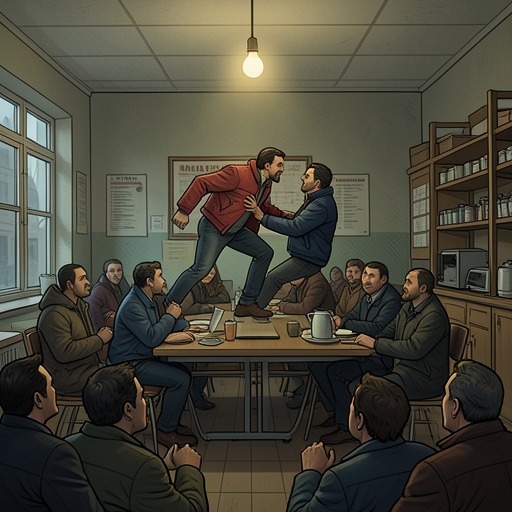
That extra claim matters because the Union strongly stigmatizes multiple instances of the same person. Even without that taboo, the colony’s limited leftovers leave little room for a surplus Expendable. Scarcity turns an already forbidden duplication into a practical dispute over food and survival: Mickey8 does not accept that he should simply enter the Biological recycler on Mickey’s behalf, and he regards the predicament as no fault of his own. The food shortage does not create their conflict, but it gives it a measurable daily cost.
The Biological recycler makes that cost part of a larger cycle of recovery. It accepts waste ranging from tomato stems, potato peels, and animal bones to hair, fingernails, and eventually corpses, then returns protein paste, vitamin slurry, and fertilizer. Its corpse hole breaks material down into component atoms and reassembles them according to specification. The process demands enormous energy, but the colony’s antimatter-driven power plant supplies more than enough for the task. Recycling can sustain a desperate settlement for a long time; it cannot by itself make failed agriculture succeed, and its products do not make the scarcity feel like abundance.
Administrative Consequences
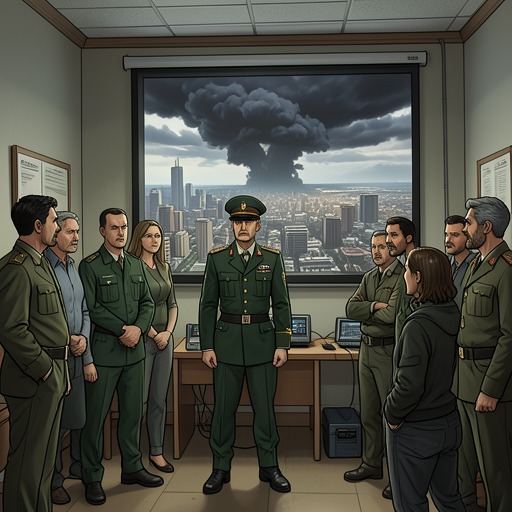
Marshall converts the crisis into a disciplinary measure after the Mickey instances’ activities have, in his account, removed nearly 300,000 kilocalories from the colony’s energy budget over several weeks. He argues that the loss requires another reduction in rations until agriculture reaches full production, and rules that the two instances should bear the greatest part of that reduction. He permanently docks both ration cards by 20 percent. The decision makes clear that rationing is not only an automatic response to the quantity of food available: command can distribute the burden unevenly and impose it as a consequence of conduct.
The colony’s dependence on energy links this food pressure to another finite resource. Producing two devices has dangerously depleted the remaining antimatter stores, with no foreseeable prospect of producing more fuel. If the power plant shuts down, the consequences threaten everyone. The food system and the energy system are not interchangeable, but both have bottlenecks that the settlement cannot readily replace. The recycler can turn waste into useful material only while its power source remains dependable; agricultural recovery, meanwhile, is still held back by biological conditions the colonists have not solved.
Prospects and Significance
Later, the landscape begins to show signs of seasonal renewal: after the snow has been gone for only a couple of months, lichen gives way to something resembling grass, woody-looking shrubs appear, and small animals emerge. These observations suggest a biosphere capable of rapid activity after winter, but they do not establish that the colonists’ crops have recovered or that the food shortage is over. The difference between life returning to the land and food production becoming reliable remains important.
The crisis exposes the material fragility beneath the colony’s promise of settlement. The colonists depend on imported crops that may not suit their destination, hydroponics that are already struggling, ration cards that can be cut, and a recycler whose output depends on functioning infrastructure. For Mickey Barnes and Mickey8, the shortage turns the abstract taboo against multiple instances into a question of calories and continued existence. For the colony as a whole, survival depends on converting a temporary outpost into a place that can produce enough to sustain its population—an achievement that the evidence of green shoots alone cannot guarantee.