Niflheim colony creeper threat
Mickey7The creeper threat on Niflheim transforms the colony’s dangerous surroundings into an immediate test of survival and judgment. First encountered as skittering in tunnels beneath the ice, the creatures become a visible danger to the surface patrols; their attacks make the colony’s routines vulnerable and raise a more consequential possibility: the apparent monsters may belong to an intelligent native population that the colonists have failed to recognize.
An Unseen Presence Beneath the Ice
Mickey Barnes first hears the skittering while moving through tunnels he already knows are not natural formations. The sound starts and stops, like small rocks tumbling down a granite face, and grows closer as he walks faster. At a cross-tunnel he can no longer tell whether it is coming from ahead or behind. When he turns, the creature is almost within reach. The scene turns an uncertain noise into a sudden encounter, but it does not make the danger comprehensible: the passage itself is evidence that something powerful has been burrowing through solid rock.
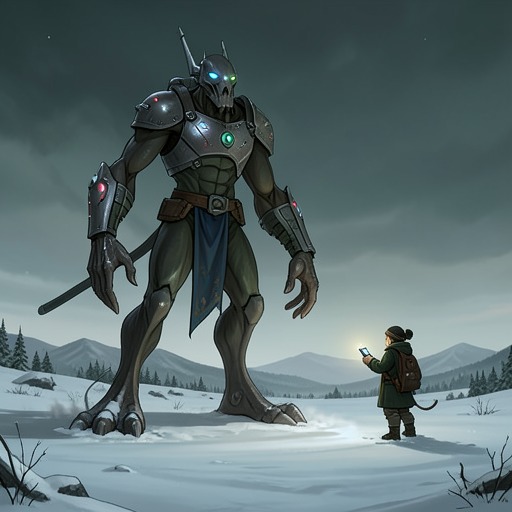
The animal resembles a creeper in its segmented body, repeated pairs of legs, sharp claws, feeding legs, and round, toothed mouth. Its mandibles are arranged differently, however, and its scale makes the resemblance unsettling rather than reassuring. Ordinary creepers are about a meter long and weigh a few dozen kilograms; this creature is as wide as Mickey Barnes is tall and extends down the tunnel beyond his sight. Even its coloration remains uncertain in the infrared light. What the colony faces is therefore not simply a familiar local pest enlarged, but a creature whose anatomy and presence exceed the categories its personnel already use.
From Tunnel Encounter to Colony Alarm
The danger crosses from the underground passages into the colony’s security routines when a guard at the east checkpoint disappears. Gabe Torricelli reports in at eight but has not checked in by eight thirty. Searchers find only churned-up snow. The unexplained loss changes the meaning of a routine sweep: Nasha is sent back out only four hours after finishing her previous shift, without being told why. The blank space left by the missing guard gives the threat a human consequence before the colony has an explanation for it.
Mickey Barnes immediately wonders whether the creatures followed him back to the dome. He recalls an earlier act of freeing a spider and revises its possible meaning: perhaps the animal was not spared but allowed to lead its pursuers toward its nest. The thought is speculation, not proof, but it shows how the tunnel encounter has altered his sense of safety. A threat once encountered at a distance beneath the ice may now be tracking the colony itself.
The danger becomes unmistakable during an outdoor sweep with Dugan, Cat Chen, Berto Gomez, and Nasha. Dugan lifts his right leg from the snow to reveal a creeper wrapped around it. Its feet have dug divots into his armor while its mandibles work at the seam behind his knee. The attackers turn their burners on the creature, but the armor begins to glow and the creeper keeps chewing, driving its legs deeper into the softened material. Steam rises; Dugan’s yelling becomes screaming. The attack exposes the weakness of protective equipment at its joins and makes the patrol’s attempt to kill the creature dangerous to the person it is meant to protect.
Mickey Barnes runs for a nearby rock, falls in the snow, and is hauled upright by a powered gauntlet. After Berto asks whether he has a sample, Mickey retrieves part of the creeper and hands it to Cat Chen, who is carried up by Berto’s descending grapple. The pause for evidence-gathering takes place amid an expanding swarm: when Mickey looks back, creepers cover the top of the rock. Nasha arrives low and fast in Berto’s flitter, having already launched two missiles. The bay door closes, and the group escapes on the first wave of expanding plasma. The patrol has secured a fragment, but the retreat makes clear that the creatures can mass around a position faster than the humans can safely hold it.
The Danger of Misreading Native Life
Mickey Barnes reads the encounter against the history of Roanoke, a colony established almost two hundred years earlier. Its inhabitants failed to recognize the local sentients because they showed none of the familiar signs of tool-using civilization: no electromagnetic emissions, power plants, roads, cars, cities, or agriculture. They were nevertheless exceptional genetic engineers. The colonists’ failure to identify them in time ended in disaster. Thinking about that history, Mickey wonders whether the enormous tunnel-digger on Niflheim might likewise be one of the locals, and whether someone who encountered it might have recognized its intelligence but failed to report it.
That possibility remains a question, not a confirmed account of the creatures’ nature. Its importance is that it unsettles the colony’s default interpretation of the danger. A burrowing animal attacking personnel would be a security problem; a native intelligent population defending its territory would make the colony’s own presence and response part of the conflict. Mickey fears that Niflheim could fail because of the same kind of missed recognition that preceded Roanoke’s collapse. The creatures’ strangeness thus matters not only as a source of bodily danger, but as a warning about how easily unfamiliar intelligence can be classified as hostile fauna.
A Threat to Survival and Judgment
The colony is already a precarious beachhead. Its personnel are expected to perform dangerous work that remotes cannot handle as well, and its food system depends on establishing agriculture despite difficulties posed by Niflheim’s local microbiota. The Biological recycler can turn waste and, eventually, corpses into protein paste, vitamin slurry, and fertilizer, but even this essential system depends on the colony’s machinery and abundant power. Creeper attacks add immediate danger to a settlement whose long-term survival already rests on fragile biological and technical systems.
The later discussion of the two devices produced to address the crisis brings the threat into the colony’s energy calculations: making them has taken a dangerous bite out of its remaining antimatter, with no prospect of replenishing the fuel soon. The power plant is indispensable, so a response to one danger risks tightening another constraint. The creeper threat is consequently more than a succession of frightening encounters. It pushes the colony toward decisions under pressure, while leaving open whether survival requires defeating an enemy, understanding a people, or recognizing that those descriptions may have been confused from the start.