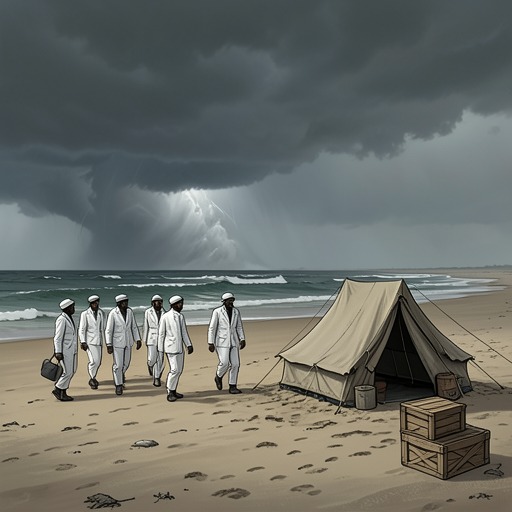
Niflheim Colony Command
Mickey7Niflheim Colony Command is the governing and operational authority that directs the settlement’s personnel, security response, and scarce resources. Under Hieronymus Marshall, it treats Mickey Barnes’s repeated deaths as part of the colony’s work requirements, disciplines losses through ration cuts, and mobilizes armed searches when the native creepers threaten the dome. Its reach is real, but the colony’s dependence on fragile food and energy systems limits what command can secure by decree alone.
Organization and operational remit
Command’s distinction from routine personnel administration is clear in Mickey Barnes’s assignments. A semiautonomous human-resources system rotates him among ordinary jobs, including tending Agriculture Section’s rabbit hutches, standing sentry for Security Section, and temporarily doing administrative work. A direct summons from Command means something different: it signals that the colony needs him in his role as an Expendable, the person assigned dangerous work that could kill an individual incarnation. This arrangement makes Mickey a reserve of human labor for tasks that the colony cannot readily delegate or safely perform with machines.
The risks attached to that role were spelled out before Mickey left Midgard. His contract listed external repairs in interstellar transit, exposure to local organisms, medical experiments, and combat among the duties likely to kill an incarnation. Yet the day-to-day abundance of dangerous work on a beachhead colony exceeded what he had understood when he signed. A human body can survive some radiation exposures longer than a mech, while medical experiments may require a human subject; on Niflheim, replacing an Expendable also depends on agricultural production, whereas lost metal cannot be replaced until serious mineral extraction and industry exist. Command’s labor system is therefore shaped by a practical imbalance: people are expendable in ways that scarce machinery is not.
Marshall’s authority and discipline
Hieronymus Marshall exercises Command’s authority in person. When Mickey arrives for a reprimand with Berto Gomez, Marshall first establishes that he is speaking to the eighth iteration of Mickey Barnes, then asks Berto why the colony has reached that iteration. Berto invokes the requirement that a functioning Expendable always be available. Marshall presses for an account in ordinary language of how the two men wasted seventy-five kilograms of protein and calcium. The exchange shows him testing both the explanation and the people responsible, rather than treating protocol as a substitute for accountability.
His reprimand turns a local incident into a colony-wide consequence. Agriculture Section has been unable to grow almost anything reliably, leaving a very narrow calorie margin. Marshall calculates that the men’s activities have permanently removed nearly 300,000 kilocalories from the colony’s energy budget, and orders both ration cards docked by 20 percent until agricultural production improves. He presents the penalty as an equitable allocation of the damage, but makes clear that the decision is final. The resulting hunger is meant to make the cost of wasting colony assets tangible. Mickey challenges Berto after they leave, accusing him of lying; Marshall’s discipline has punished both men without resolving the distrust between them.
Security decisions and the creeper threat
When the creepers become an immediate security concern, Marshall issues a coordinated order rather than relying on a single patrol. Nasha and Berto are assigned air cover and a ground-penetrating-radar sweep extending from the dome to 2,000 meters beyond its perimeter. Marshall requires their missile tubes to be full, orders the field cleared of the creatures for at least a kilometer after the colonists have been extracted, and sends the remaining team on foot from the auxiliary lock. Dugan is told to secure a specimen for his laboratory; Marshall frames the expedition as a snipe hunt. The plan combines surveillance, extraction, armed force, and biological investigation, while presuming that the creatures are threats to be cleared from the settlement’s approaches.
That presumption is narratively significant because Mickey recognizes a danger in the colony’s way of classifying unfamiliar life. He recalls Roanoke, where colonists failed to notice intelligent natives because they lacked familiar signs of technology such as roads, cities, or electromagnetic emissions. The inhabitants were instead highly capable genetic engineers, and the colony’s failure to recognize them ended disastrously. Having encountered a giant tunnel-dwelling creature on Niflheim, Mickey worries that a similar failure to report or understand native intelligence could make this colony’s fate its own responsibility. The evidence does not establish that Marshall’s orders are identical to the earlier colony’s policies; it does show the tension between Command’s urgent security objectives and Mickey’s growing concern that the targets may be sentient.
Material limits and the colony’s survival
Command’s decisions take place within an infrastructure that makes waste and fuel shortages existential. The colony’s biological recycler can break discarded matter down into atoms and reassemble them as needed, returning protein paste, vitamin slurry, and fertilizer from refuse and eventually corpses. It requires enormous energy, supplied by the antimatter-driven starship engine. This system can sustain a desperate colony, but it cannot remove the underlying dependence on energy or solve the difficulty of growing food: Niflheim’s local microbiota interferes with crops, and the agricultural base remains unreliable.
The danger of that dependence becomes explicit after two devices are produced. Marshall warns that their construction has taken a dangerous bite out of the remaining antimatter stores; there is no foreseeable way to make new fuel, and losing power would threaten everyone. His appeal to resume the work of keeping the colony alive follows a precarious truce with the creatures, which he hopes will remain in their tunnels and away from the dome. Command can direct labor, ration food, and deploy weapons, but it cannot command the fuel reserves to replenish themselves or guarantee that the native population will stay beyond the perimeter.
Narrative significance
Niflheim Colony Command embodies the practical authority required to keep a beachhead settlement functioning, while exposing the costs hidden inside that authority. The Expendable system makes lethal labor administratively available; ration policy converts a damaged food budget into punishment borne by individuals; security orders turn an uncertain encounter into an armed operation. In each case, the institution acts under real pressure, not from abundance. Its judgments are consequential precisely because food, machinery, antimatter, and time cannot be replaced at will.
Marshall’s command style also shifts with the problem before him. In the reprimand, he controls the conversation and closes debate with a permanent penalty. During the creeper emergency, he coordinates several teams and assigns sharply defined tasks. After the antimatter loss, however, his effort to secure Mickey’s cooperation has the character of negotiation, because the colony’s survival depends on resources and judgments no order can manufacture. The organization’s central predicament is therefore not simply how to enforce discipline or defend the dome, but how to protect a settlement whose survival depends on understanding the world around it before force makes misunderstanding irreversible.