Niflheim colony
Mickey7The Niflheim colony is a precarious beachhead settlement where survival depends on making limited bodies, materials, energy, and time serve several purposes at once. Its dome and machinery cannot insulate it from local ecology or scarcity: the colony relies on an Expendable for work too dangerous for machines, a Biological recycler to turn waste into food and fertilizer, and a fragile agricultural effort that must support both ordinary life and the means of replacing lost people. Its struggle against the native creepers ultimately makes the colony’s future depend not only on security, but on whether it can share a world it first approached as a threat to be eliminated.
A Beachhead Built on Risk
Niflheim is a difficult place to settle. The colony’s immediate survival takes priority over the comforts or redundancies available to an established industrial world. Mickey Barnes explains that a human body can endure some dangers, especially lethal radiation, longer than a mech can; other tasks, including medical experiments, cannot be performed by a mech at all. On a beachhead, an Expendable is also easier to replace than a machine. The colony lacks serious mineral extraction and heavy industry, so lost metal may be unavailable for a long time, while the biological materials needed to make another Expendable should eventually come from agriculture.
That replacement economy is a promise rather than a functioning safeguard. Niflheim’s local microbiota appears to interfere with crops grown inside the dome, and growing anything outside is expected to be a long-term challenge. The same agricultural base that could make Expendables replaceable is therefore itself exposed to the planet’s conditions. The colony’s use of a person for hazardous work is not an isolated expedient: it follows from a system in which human bodies can withstand some conditions better than scarce machinery, while the machinery and food supply that might reduce such dependence remain difficult to secure.
The Colony’s Material Circulation
The Biological recycler is central to the settlement’s ability to persist. It accepts a broad stream of organic waste, from food scraps and plant stems to hair, tissues, and eventually corpses, and returns protein paste, vitamin slurry, and fertilizer. Its output is not an appealing substitute for ordinary food, but it can sustain a desperate colony for a long time. In this way, the recycler links daily consumption, sanitation, agriculture, and death: what the colony cannot afford to waste is broken down and returned to circulation.
The process works by reducing material deposited through the corpse hole to component atoms and reassembling those atoms according to instructions. That transformation consumes enormous energy, but the colony’s power plant is an antimatter-driven starship engine, so energy has been more abundant than the other resources on which settlement depends. This apparent abundance has limits. Producing two devices later takes a dangerous bite out of the remaining antimatter stores; the colony has no foreseeable means of making replacement fuel, and losing power would threaten everyone. The recycler’s dependable work thus rests on an energy supply that is powerful but finite, turning an unseen reserve into an immediate condition of survival.
Local Intelligence and the Security Perimeter
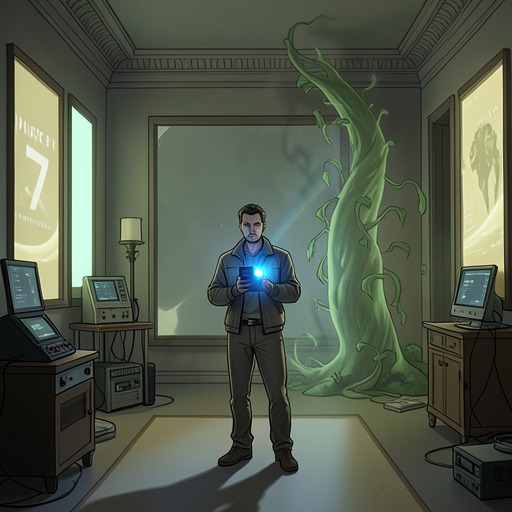
The colony’s understanding of its surroundings is shaped by the danger of misreading life that does not resemble familiar human technology. Nearly two centuries earlier, the Roanoke beachhead failed to recognize that its hostile native organisms were the work of intelligent beings. Those locals did not build roads, cities, power plants, or other classic signs of tool use, but they were highly capable genetic engineers; their territoriality and hostility helped destroy the colony. The memory of that failure informs Mickey’s fear that Niflheim could repeat it if the colonists overlook intelligence among the tunnel-digging locals.
Niflheim’s own defenses make the colony’s fear tangible. During a high-alert approach to the dome, a person carrying a dangerous device is challenged while still a hundred meters from the perimeter. Two pylons activate, raise their burners, and orient them toward the approaching figure. A warning over the general communications channel prevents the weapons from firing, but they do not withdraw immediately. The encounter shows a settlement organized to treat an uncertain approach as a possible attack, even as its inhabitants face the more difficult question of whether the beings beyond the defenses are enemies, neighbors, or both.
The colony’s dwindling numbers intensify that tension. At one point, only 176 colonists remain, and the settlement is shifting to a war footing. Marshall acknowledges the practical need for an Expendable but rejects the claim that the two competing instances are the only people able to fill the role: Cat Chen has volunteered to take the berth if necessary. The exchange makes security and staffing inseparable from questions of who can be sacrificed. A role designed around repeated exposure to death becomes, under pressure, a contested post that the colony can imagine assigning to someone else.
Command, Loss, and a Conditional Peace
The resolution of the conflict with the creepers allows the colony to consider survival in terms broader than military defense. Marshall speaks of the hope that the former opponents will remain in their tunnels and away from the dome, and calls for everyone to return to the work of keeping the settlement alive. The hope is conditional, not proof that danger has vanished. Yet the shift matters: the colony’s immediate future is no longer framed solely as a campaign against the locals, but as an attempt to continue living alongside them without another attack.
That turn comes at a personal cost. After returning to the dome, Mickey grieves for Mickey8, whose death has secured the possibility that one of them can remain. The loss is difficult for him to separate from his own survival because the two share the same identity and memories; his grief arrives despite the fact that he had known Mickey8 only briefly. The colony’s policy problem and Mickey’s private response converge in that death: the settlement may need an Expendable, but the existence of a duplicate does not make a life emotionally disposable.
Recovery Beyond the Dome
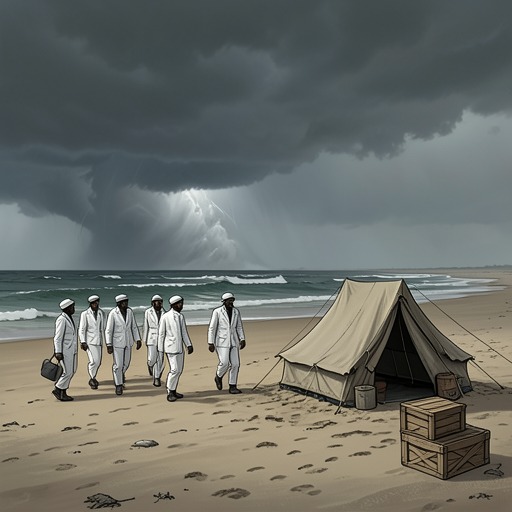
The colony’s recovery becomes visible in environmental and agricultural changes. After a few months, conditions settle somewhere between brisk and balmy, and the Agriculture Section manages to establish an experimental plot outside the dome. Green growth coincides with a slow, perceptible rise in atmospheric oxygen partial pressure, although the colonists still need rebreathers and have no certainty about how long the favorable season will last. The improvement is real but provisional: the season could continue for years or end the next day, and the atmosphere is not yet safe to breathe unaided.
As outdoor activity becomes possible, colonists discuss decanting the first embryos, suggesting that the settlement can begin to imagine a future population rather than only immediate survival. Many have also begun to forget the creepers, although Mickey and Marshall remain alert to them. Mickey’s invitation to Nasha for a walk marks a small return to ordinary life, but even that walk takes place in rebreathers and under an uncertain sky. The colony’s fragile achievement is not that it has made Niflheim safe; it is that, after violence and scarcity, it has gained enough room to plant, plan, and cautiously step outside.