Universal Eternity, Inc.
Mickey7Universal Eternity, Inc. was the research company through which Alan Manikova pursued the recording and replication of human minds. Built on his inherited fortune and shrouded in secrecy, it turned that pursuit from rumor into public spectacle with a demonstration that remade Manikova’s standing across the Union. The company did not endure: after revealing its breakthrough, Manikova liquidated it and departed Eden with the prototype replication unit. Its importance lies both in that abrupt history and in the technology’s lasting challenge to the meaning of being the same person.
Founding and Secret Research
Manikova established Universal Eternity, Inc. after the sudden deaths of both his parents, which occurred within a few days of one another. The causes remained unexplained, and local authorities tried but failed to connect him to the deaths. Six months after their deaths, he had become one of the ten wealthiest people in the Union; within a year, he had committed his entire inheritance to the new venture. The sequence made the company’s origins conspicuous, but it did not establish that Manikova was responsible for his parents’ deaths.
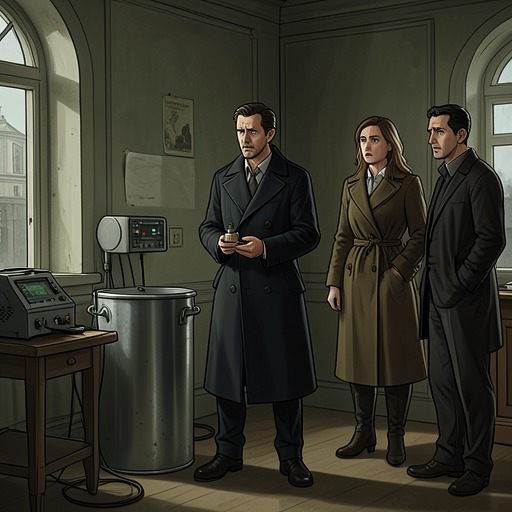
The company’s scale set it apart from a merely virtual enterprise. It built a large research facility two hundred kilometers from the nearest town and hired substantial numbers of engineers and scientists. People came and went from the campus, but none disclosed what took place there. The public press on Eden treated Universal Eternity as a possible boondoggle or tax dodge. Speculation also turned to aging research and cryogenic storage, but neither theory had supporting evidence. After roughly a year, the press lost interest, leaving the company’s work unreported while its staff continued behind closed doors.
The Replication Demonstration
Five years after the company’s founding, Manikova appeared on a talk show and announced that he had uncovered a way to record and replicate a human mind. The announcement moved the company from rumor into a public argument about what a replicated person was. In the initial demonstration, Universal Eternity produced a duplicate of its human-resources director. She spoke briefly to the assembled dignitaries; Manikova then had her tranquilized and reduced back into slurry. The demonstration displayed replication as an operational process, but its immediate termination of the duplicate made the person’s treatment part of the revelation rather than a detail separate from it.
The financial and public response was swift. Universal Eternity’s stock price soared, and Manikova went from being one of the Union’s ten wealthiest people to by far its richest. On Eden, his public image shifted from that of a possible parent killer to that of a celebrated, unsettling genius, regarded by many as perhaps humanity’s greatest. The contrast between the spectacle’s scientific achievement and the duplicate’s disposal remained central to what the demonstration revealed: a mind could be reproduced, while the status and survival of the person produced were treated as matters under the company’s control.
Liquidation and Departure
Manikova did not use his new wealth or celebrity to establish a permanent public empire. Instead, he liquidated everything he owned, including Universal Eternity, Inc. The transactions passed through enough cash and shell companies to cause a planetary economic recession, an unusual consequence of one person’s financial decisions. The company that had supported the breakthrough was thus dismantled by its founder soon after the breakthrough became public.
A year later, Manikova left orbit alone in a custom-built interstellar transport packed with equipment, supplies, and the same prototype replication unit used in the demonstration. He told no one where he was going. Some speculated that he intended to cross the galactic plane, reproducing himself as necessary to survive the journey. That explanation proved wrong: his destination was Gault, a recently established beachhead colony seven light-years anti-spinward from Eden. Universal Eternity therefore did not continue as the organization behind his next undertaking; its research apparatus gave way to a private expedition centered on Manikova and the prototype he carried with him.
Legacy of a Replicable Mind
The company’s historical weight exceeds its short public life. Its work supplies the technological premise for a world in which a person’s memories can be carried into another body, but replication does not settle whether the new individual is numerically the same person as the one who died. Mickey Barnes’s experience makes that distinction concrete: he remembers being earlier iterations of himself, yet recognizes that memory cannot tell him with certainty whether the original person continued or whether a successor merely believes that he did. His six deaths over eight years, and the uncertainty surrounding an iteration that did not upload before death, show how much depends on what the process preserves and what it fails to carry forward.
That uncertainty sharpens when Mickey Barnes confronts Mickey8. Mickey Barnes argues that the two are not the same person and that another iteration would not be him, even if it inherited his memories and occupied his place. The technology associated with Universal Eternity makes continuity appear administratively reproducible: record a mind, instantiate it again, and let the new individual resume a life. The novel’s lived cases resist that neat equation. Memory, bodily survival, and the testimony of friends such as Nasha and Berto may support a sense of continuity, but they cannot provide the dead with proof that they themselves have awakened again. Universal Eternity’s legacy is therefore not simply that it made replication possible; it is that its achievement exposes the gap between reproducing a person’s remembered life and resolving who, if anyone, persists through the copy.