Ahab is killed by the whale line
Moby-DickAhab is killed by the whale line in the decisive reversal of the chase: after harpooning Moby Dick, he bends to clear a foul in the rapidly running line, and the rope catches him around the neck, hurling him from the boat before the crew can save him. His death is both an immediate accident of whaling practice and the final consequence of a pursuit that has made the Pequod, its crew, and its commander instruments of one consuming objective.
The Final Confrontation
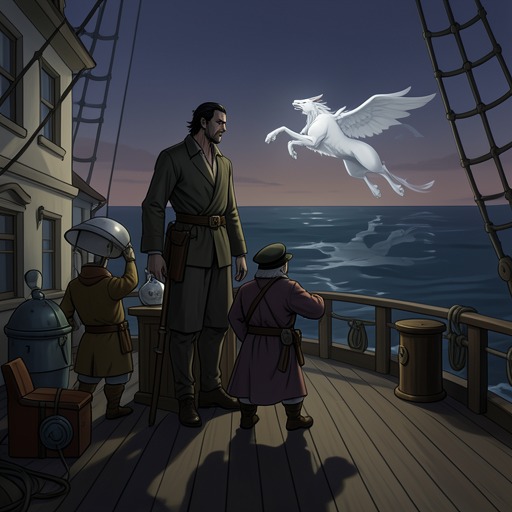
The scene begins with Ahab still bound to the fate of the Pequod. As the whale passes beneath the sinking ship and returns near Ahab's boat, he turns toward the vessel and hears Tashtego's hammer. The ship remains an object of pride even at the moment of destruction: Ahab calls it a death-glorious ship and grieves that it must perish without him. His attachment to the vessel is not a retreat from the chase; it intensifies the tragic situation, placing his command, his identity, and his desire for revenge within the same narrowing field of danger.
Ahab then addresses Moby Dick as an unconquered enemy and declares that he will grapple with the whale to the last. His language joins hatred, death, and pursuit in a single act of will. He imagines the whale as all-destroying but unconquered and rejects the possibility of separating himself from the object of his vengeance. The final gesture, in which he gives up the spear, is immediately followed by renewed action: the harpoon is darted, the whale surges forward, and the line races through its groove.
The Fatal Reversal
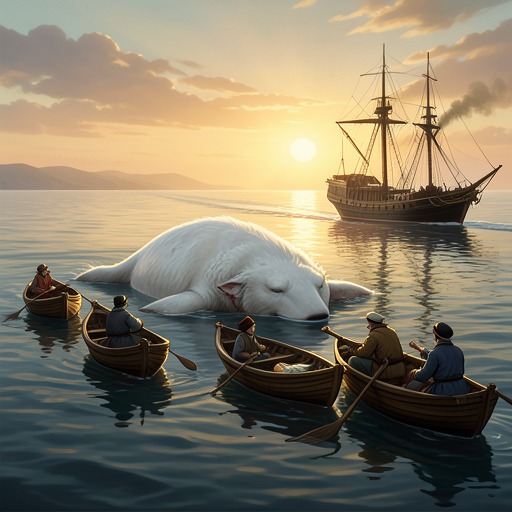
The line first appears as the ordinary instrument of the hunt, carrying Ahab's attack toward Moby Dick. Its sudden fouling transforms that instrument into the mechanism of his death. Ahab stoops to clear it and succeeds, but the flying turn catches him around the neck and shoots him out of the boat in silence. The heavy eye-splice then flies from the empty tub, knocks down an oarsman, and disappears into the sea. The sequence makes the reversal brutally precise: Ahab is not killed by a distant, abstract fate, but by the physical operation of the weapon and line through which he has chosen to pursue the whale.
The event also fulfills the logic of the Pequod's whaling world, where skill, hierarchy, and danger are inseparable. The ship's officers and harpooneers occupy specialized positions because the success of a voyage depends upon their handling of whale gear; yet the same gear can erase the distinction between commander and crew in an instant. Ahab's authority cannot master the line once it has been set in motion. His command of the ship and his exceptional will are overcome by the material contingency of the hunt.
The Death of the Pequod
Ahab's death is immediately accompanied by the disappearance of the Pequod. The boat's crew stands motionless before searching for the ship and seeing only its fading upper masts. The pagan harpooneers remain at their lookouts as the vessel sinks, while concentric circles draw the boat, oars, lance-poles, crew, and floating fragments into a vortex. The captain's death therefore does not conclude the catastrophe by itself; it is part of a larger destruction in which the entire organized world of the voyage is pulled out of sight.
The sinking ship preserves a final image of resistance. Tashtego continues hammering the flag to the subsiding spar, and a sky-hawk becomes caught between the hammer and the wood. The bird, the flag, the spar, and the sinking vessel descend together. Ahab's death thus occurs within an image that binds human pursuit to the destruction of ship, crew, and the natural world surrounding them. The Pequod goes down carrying a living part of heaven with it, while the captain who demanded the final encounter has already been taken by the line attached to it.
Meaning and Consequence
The death completes Ahab's revenge plot as a tragedy of self-entanglement. His pursuit has been presented against the wider dignity and power of whaling, a vocation associated with global commerce, exploration, and the production of oil and other valuable commodities. Whaling ships are described as pioneers of remote seas and as agents in the opening of routes linking Europe, America, the Pacific, Australia, and other regions. Against that expansive historical and economic background, Ahab's private purpose contracts the ship's global enterprise into a single feud.
The contrast is crucial. The Pequod belongs to a commercial system in which ownership is divided among many investors, including old annuitants, widows, fatherless children, and chancery wards; its crew is paid through lays, or shares of the voyage's clear net proceeds; and whaling is governed by collective customs such as the rules of Fast-Fish and Loose-Fish. Ahab nevertheless treats the ship as an extension of his personal conscience and dismisses the owners' claims when they conflict with his purpose. His death exposes the cost of that concentration of authority: the commander who claims the ship as his own cannot prevent his command from becoming a vessel for collective ruin.
The whale line gives the event its governing image. A line connects hunter and hunted, but it also makes each vulnerable to the other's motion. Ahab's final attack does not simply fail; it returns through the apparatus of his own action. The death therefore joins external chance to inward compulsion. The line's sudden turn is contingent, yet Ahab has placed himself in precisely the situation where such contingency carries the greatest possible consequence. His death is the moment when the pursuit's physical hazards and its moral structure become indistinguishable.