Moby Dick sinks the Pequod
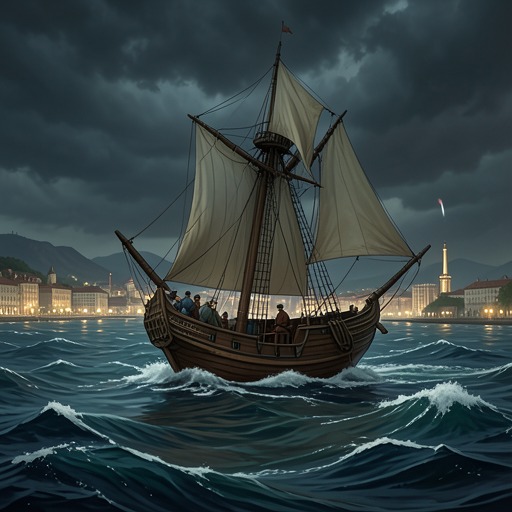
Moby-DickMoby Dick sinks the Pequod at the decisive culmination of Captain Ahab’s pursuit, transforming a whaling ship into a wreck, a hearse, and finally a vanishing emblem of human purpose. The White Whale’s attack does more than destroy timber: it turns the Pequod’s organized power against itself, leaves Captain Ahab fatally separated from the ship, and draws the crew, its weapons, its flag, and its remaining visible structure into the sea.
Causes and Background
The sinking grows out of the Pequod’s conversion from a working whaling vessel into the instrument of Captain Ahab’s monomania. Whaling is presented elsewhere as a global enterprise whose ships explore unknown waters, connect distant coasts, carry missionaries and supplies, and participate in commerce and political change. The Pequod therefore embodies both practical navigation and an expansive maritime network. Yet Captain Ahab narrows that broad vocation into a single objective: he plans to cross the Sperm Whale grounds of the Javan sea, pass toward the Philippine Islands and Japan, sweep through the principal cruising grounds, and descend upon the Line in the Pacific, where he expects to meet Moby Dick.
That pursuit is enforced through the ship’s formal hierarchy. Captain Ahab normally demands implicit and instantaneous obedience, and the quarter-deck’s maritime usages give his private will an official shape. The officers may behave boldly on deck, but at the captain’s cabin table they become ceremonially deferential, revealing how ritual can make authority feel natural even when it serves a destructive end. Captain Ahab also gathers the entire ship’s company, has the harpooneers bring their weapons, arranges the three mates with lances beside him, and encloses himself in a circle of armed men. The ship’s discipline thus becomes an instrument for binding everyone to a pursuit that began as one man’s grievance.
The danger is recognized before the final collision. Starbuck sees the loaded muskets outside Captain Ahab’s cabin and considers whether the captain should be put aside before he can drag more than thirty men to death. Captain Ahab answers resistance by presenting his course as immutably decreed: he calls himself the Fates’ lieutenant and insists that the men have vowed his vow. The language of destiny does not remove his agency; it gives his command an absolute form. The Pequod reaches its catastrophe because an individual purpose has been installed inside a collective command structure and made indistinguishable from duty.
The Collision
During the final attack, the White Whale breaks away from the strained boat and turns toward the advancing black hull. The narrative imagines Moby Dick as recognizing the ship as the larger source of his persecutions and therefore as a greater foe. This turn redirects the violence of the chase: the whale is no longer merely fleeing or resisting the boats but bears directly upon the Pequod’s prow.
The crew watches from the bows, still holding hammers, planks, lances, and harpoons as if ordinary work had been suspended in the presence of an approaching destiny. Moby Dick’s head sends a wide band of foam before him, and his forehead strikes the starboard bow with such force that men and timbers reel. The hull opens, and water pours through the breach like a mountain torrent. The value at stake changes instantly from pursuit to survival, while the men’s weapons become nearly useless in the face of the ship’s structural destruction.
Captain Ahab, still in his boat, sees the Pequod become a second hearse and identifies its wood as American. The image compresses the vessel’s national, commercial, and human meanings into a funeral object. The ship that carried its crew across nearly the entire known whaling world now becomes the vehicle of their death. The White Whale dives beneath the settling hull, runs along its keel, and rises again near Captain Ahab’s boat, leaving the damaged vessel to founder behind him.
Destruction of the Ship and Crew
As the Pequod goes down, its disappearance is described not as a simple sinking but as a progressive erasure. The boats’ crews perceive the ship through dim and bewildering conditions as a fading phantom, with only the uppermost masts still above water. The pagan harpooneers remain fixed at their lofty lookouts, maintaining their stations even as the vessel that supports them descends. Their continued posture makes loyalty, professional habit, and fate visually indistinguishable.
The vortex then takes hold. Concentric circles seize the lone boat, its crew, the floating oars, the lance-poles, and every piece of the Pequod that remains on the surface. The motion gathers animate and inanimate things together, carrying the smallest chip of the vessel out of sight. The ship’s organization, distinctions of rank, and material inventory are reduced to one revolving field of wreckage. What had been a hierarchy of captain, mates, harpooneers, and sailors becomes a common descent.
The final visible image concentrates the sinking’s symbolic force without separating it from physical action. As the last waves cover the Indian at the mainmast, a few inches of the spar remain above the water, with the flag streaming from it. Tashtego’s red arm and hammer are raised as he continues nailing the flag more firmly to the descending spar. A sky-hawk, which had followed the main-truck downward and had been pecking at the flag, becomes caught between hammer and wood. Its wing is folded into the flag as the submerged harpooneer’s death-grip holds the hammer in place.
The Pequod therefore sinks with both a human and an aerial fragment attached to it. The ship carries down Tashtego, the flag of Captain Ahab, and the bird of heaven, as though its destruction refuses to leave the realm of life or transcendence untouched. The vessel goes under only after dragging a living part of heaven with it. The sea then closes over the wreck, leaving a white surf and a yawning gulf before the ocean resumes its ancient motion.
Consequences and Aftermath
The sinking completes the destructive logic of Captain Ahab’s command. His insistence that the White Whale will rise for a final encounter is fulfilled, but the apparent fulfillment is also a reversal: Moby Dick rises not only to be attacked but to destroy the ship that has pursued him. Captain Ahab’s authority proves effective in assembling men and weapons, yet that very effectiveness supplies the whale with a concentrated target and carries the whole crew into the consequences of one fixed purpose.
The event also exposes the instability behind the Pequod’s outward order. The ship’s ceremonies, quarter-deck authority, armed mustering, and habitual obedience can organize action, but they cannot master the sea, the whale, or the chain of consequences released by pursuit. The sinking makes visible the tension between discipline and madness: the crew acts with collective precision, but the mission itself has become irrational. Ahab’s dictatorship has transformed maritime cooperation into collective self-destruction.
The wreck is not merely the end of a voyage but the negation of the ship’s earlier civilizing and exploratory promise. Whaling ships elsewhere are credited with opening harbors, linking peoples, supplying settlements, and carrying knowledge across oceans. The Pequod reverses that historical image. Its global itinerary ends without a port, cargo exchange, or safe return; it carries only its crew, weapons, and wants, and finally loses even those into the sea. The ship that once represented movement across the world becomes an isolated object swallowed by the element it had crossed.
Narrative and Thematic Significance
The sinking is the great peripeteia of the chase: the hunters become the destroyed, the vessel becomes a hearse, and the captain’s confidence in command meets an external power that cannot be subordinated. Its imagery repeatedly joins death with persistence. Captain Ahab continues to pursue while the ship is already going down; Tashtego continues his work at the flag; the crew remains at its posts; and the White Whale disappears only after the Pequod and its human world have been drawn into the vortex.
The event also embodies the novel’s tension between fate, free will, and chance. Captain Ahab calls himself an agent of the Fates, but his fate is enacted through chosen orders, repeated refusals, and the deliberate concentration of the crew’s labor around Moby Dick. At the same time, the final details depend on violent contingencies: the whale’s sudden turn, the ship’s collision, the vortex, and the sky-hawk’s accidental entanglement with Tashtego’s hammer. The sinking is consequently both a planned culmination and a catastrophe whose exact form exceeds any human plan.
Its closing movement enlarges the wreck into a meditation on the limits of human mastery. The Pequod, its flag, its crew, and the bird are all briefly held in a single tableau before the sea erases them. The ocean does not pronounce a final judgment; it simply rolls on as it did long before the ship appeared. Against that continuity, the Pequod’s destruction becomes the measure of human ambition: immense in intention, powerful in organization, and finally fragile before the living, material, and unknowable world it sought to dominate.