Ishmael survives on the coffin life-buoy
Moby-DickIshmael survives the sinking of the Pequod because Queequeg’s coffin rises from the wreck and carries him through the aftermath until the Rachel rescues him. The episode converts a funerary object into a vessel of life and gives the survivor a narrative task: to tell what happened to the lost ship and its crew.
The Wreck and Ishmael’s Position
The survival occurs after the Pequod has been drawn into the final vortex. Ishmael is not safely removed from the disaster; after the Parsee disappears, he is assigned to take the place of Ahab’s bowsman, and when that bowsman assumes the vacant post, Ishmael is dropped astern as the boats are violently emptied. He therefore remains within sight of the closing scene while the suction of the sinking ship slowly pulls him toward the whirlpool.
The narration places him at the exact boundary between witness and victim. He reaches the vortex after its strongest motion has subsided into a creamy pool, then revolves around its contracting center until a black bubble at the axis bursts upward. From that opening, Queequeg’s coffin life-buoy shoots out of the sea and floats beside him. The reversal is both physical and symbolic: the object designed to contain a dead man becomes the only reliable support available to a living one.
The Coffin as Life-Buoy
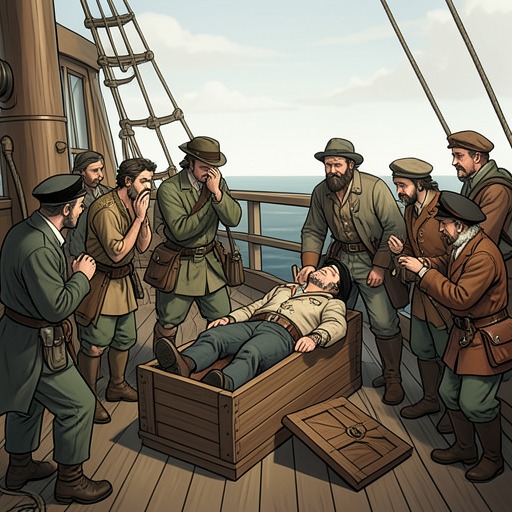
Queequeg’s coffin is unusually prepared for this later function. When Queequeg is gravely ill, he has the coffin fitted with the iron part of his harpoon, one of his boat’s paddles, biscuits, fresh water, woody earth, a sail-cloth pillow, and his idol Yojo. He lies inside it to test its comfort and declares that it will do, treating the coffin as a practical final bed rather than merely as a sign of terror. Its construction therefore joins death, travel, subsistence, and spiritual identity in one object.
When the Pequod sinks, those provisions are no longer part of a private preparation for Queequeg’s death. The coffin’s buoyancy allows it to emerge from the wreck and support Ishmael for almost an entire day and night. Its earlier association with Queequeg’s body becomes the material condition of Ishmael’s survival, while the presence of Queequeg’s belongings preserves the memory of the friendship that shaped Ishmael’s entry into the whaling world.
A Day and Night Adrift
Buoyed by the coffin, Ishmael floats alone on a soft and dirgelike sea. The immediate environment remains threatening, but the sharks pass harmlessly, as though their mouths were locked, and the sea-hawks move above him with their beaks sheathed. These details do not erase the violence of the wreck; they mark a temporary suspension after it, a still interval in which the survivor is held between death and rescue.
The duration matters. Ishmael is not rescued immediately after the Pequod disappears. He remains exposed through almost one whole day and night, sustained by the object that had belonged to Queequeg and surrounded by the ocean that has just swallowed the ship. His survival is consequently neither a quick escape nor a return to ordinary safety. It is a prolonged condition of suspension, dependent on chance, buoyancy, and endurance.
Rescue and Narrative Consequence
On the second day, a sail approaches and the Rachel finally picks Ishmael up. The ship is cruising back over the disaster’s course in search of its own missing crewmen, but it finds Ishmael instead. The rescue creates an ironic correspondence: the Rachel is looking for absent children and discovers another orphan, while Ishmael becomes the only surviving human link to the Pequod’s final pursuit.
The epilogue frames this outcome through the declaration that only one has escaped to tell the tale. Survival is therefore not simply physical deliverance. Ishmael’s continued life supplies the narrative through which the Pequod’s voyage, Ahab’s pursuit, and the deaths of the crew can be remembered. The coffin that preserves his body also enables the book’s testimony, making the object a literal life-buoy and a structural bridge between catastrophe and narration.
Symbolic and Structural Significance
The episode gives the novel’s ending a stark reversal of expectation. A coffin ordinarily closes a life and seals it away; here, Queequeg’s coffin opens the possibility of continued existence. Its function depends on an earlier act of preparation, but its beneficiary is not Queequeg. The object passes from one man’s anticipated death to another man’s survival, binding the two friends beyond Queequeg’s illness and beyond the destruction of the ship.
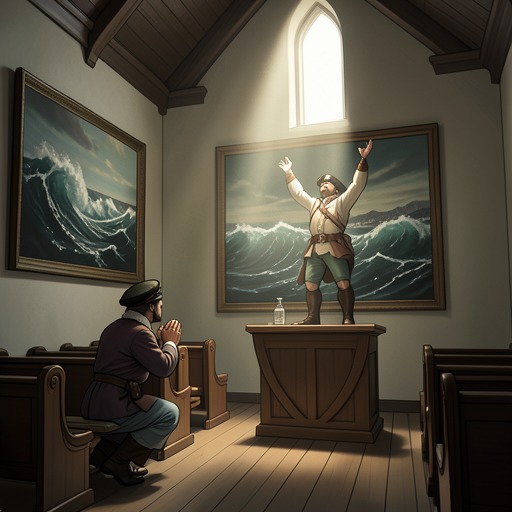
The survival also completes Ishmael’s position as an observer who has repeatedly moved among different forms of belief and communal life. He has witnessed Father Mapple’s devout prayer and sermon on Jonah, joined Queequeg in a shared act of worship despite their different religious practices, and watched Ahab turn the ship’s ceremonies toward his private war against the White Whale. At the end, no sermon or command saves the crew. Instead, a material object associated with Queequeg, sustained by the sea, carries Ishmael into the role of witness.
The final rescue preserves neither the Pequod nor its project of pursuit. It preserves only the teller. That asymmetry is the decisive meaning of Ishmael survives on the coffin life-buoy: the voyage ends in shipwreck, but the story survives because the one man who can recount it is carried out of the wreck on the emblem of a dead companion.