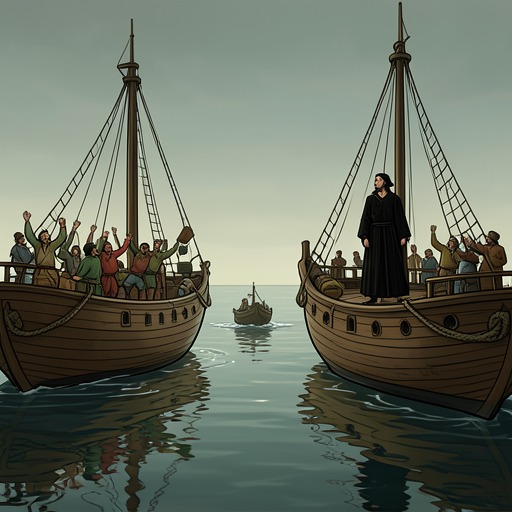
Ahab refuses to help the Rachel search for its missing crew
Moby-DickAhab refuses to help the Rachel search for its missing crew at the moment when ordinary maritime fellowship and paternal compassion most urgently demand his aid. Captain Gardiner asks the Pequod to suspend its pursuit and join the search for a lost boat, but Ahab rejects him, sacrificing a possible rescue to the timetable of his hunt for Moby Dick. The encounter makes the Pequod’s pursuit not merely obsessive but ethically isolating: a ship built within a global whaling culture of exploration, exchange, and mutual dependence becomes an instrument of one man’s vengeance.
Causes and Setting
The refusal occurs during the Pequod’s methodical circumnavigation of the world’s sperm-whale grounds. Ahab has studied charts and old logbooks almost nightly, tracing courses through the four oceans according to currents, feeding grounds, migration routes, and the recurring Season-on-the-Line. The voyage is designed to sweep through waters near the Javan sea, the Philippine Islands, Japan, and finally the equatorial Pacific, where Ahab most confidently expects to encounter Moby Dick. Because the Pequod’s course is organized around that pursuit, every delay is measured against the possibility of losing the whale.
This single-minded course contrasts with the broader historical image of whaling presented elsewhere in the narrative. Whaling is defended as a peaceful global force that explored uncharted waters, opened contact between distant peoples, carried missionaries, supplied isolated settlements, and helped connect Europe, America, Australia, Polynesia, and the Pacific coast of South America. The whale-ship is therefore associated not only with extraction and violence but also with movement, exchange, and maritime cooperation. Ahab’s refusal perverts that communal and connective tradition: the same mobile vessel that might serve as a lifeline instead narrows its world to one prey.
The Appeal from Captain Gardiner
The encounter begins when the Rachel comes alongside the Pequod. Ahab immediately asks whether Gardiner has seen the White Whale, and Gardiner answers that he saw Moby Dick the previous day. Ahab’s excitement is abruptly complicated when Gardiner’s purpose in boarding becomes clear: he wants the Pequod to join the search for a drifting whale-boat. The Rachel has already spent the night attempting to recover it, sailing over the sea, lowering boats, using the try-pots as a beacon, and searching until daylight without finding the missing keel.
Gardiner proposes a practical rescue plan. The two ships are to sail four or five miles apart on parallel lines, sweeping a double horizon and greatly widening the area searched. His request is not vague charity but a limited, concrete maritime operation. He asks to charter the Pequod for forty-eight hours and offers to pay generously if necessary. The appeal becomes personal when he reveals that his own son is among the missing men. The boy is only twelve, a child sent early into the perils and wonders of whaling, and Gardiner’s paternal urgency gives the scene its decisive moral pressure.
Gardiner then invokes Ahab’s own fatherhood. Ahab, he reminds him, also has a boy, safely at home and born in the captain’s old age. The argument asks Ahab to imagine the loss from the other side: to do for Gardiner what he would expect another captain to do for him. Stubb, who initially suspects that Gardiner’s anxiety concerns a lost coat or watch, immediately changes his judgment when he learns that the missing man is Gardiner’s son. Stubb declares that the boy must be saved, expressing the ordinary human response that Ahab is about to suppress.
Ahab’s Rejection
Ahab receives Gardiner’s petition with an emotional hardness likened to an anvil. When Gardiner begins to believe that Ahab is relenting and orders the men to prepare the yards, Ahab abruptly stops them. He tells Gardiner that he will not go, says that he is already losing time, and orders Starbuck to monitor the binnacle watch and warn off all strangers after three minutes. The Pequod is to brace forward and continue sailing as before.
Ahab’s words make the refusal more severe because they acknowledge the time cost without disputing the value of the rescue. He does not argue that the search is impossible, that Gardiner’s son is certainly dead, or that the Pequod lacks the means to help. He simply subordinates the missing men to his own schedule. His command therefore reveals a hierarchy of value: Moby Dick’s pursuit is treated as necessity, while the lives of other whalemen become an interruption.
The rejection also exposes the limits of Ahab’s identification with suffering. He has been marked by his own encounter with the White Whale, and his entire voyage is driven by the injury and vengeance born from it. Yet the sight of another father seeking a lost son does not awaken solidarity. Ahab’s private wound has become so absolute that it blocks the reciprocal compassion expected among sailors and even the imaginative sympathy demanded by his own parental status.
Consequences and Aftermath
Gardiner leaves the Pequod stunned by the unconditional refusal. Once back aboard the Rachel, he continues the search, tacking and turning toward every dark patch on the sea while his crew crowds the masts and yards in pursuit of any sign of the missing boat. The Rachel’s halting, winding course communicates its grief more powerfully than a formal lament: the ship appears to weep for its children because they are absent. The two ships soon diverge, and their separate wakes become a visual record of opposed purposes—the Rachel moving through uncertainty in search of human lives, the Pequod pressing onward toward a single whale.
The refusal places Ahab’s hunt within a pattern of escalating isolation. His charts promise that the movements of sperm whales can be calculated through seasons, currents, food supplies, and oceanic “veins,” but the search for Gardiner’s son belongs to another order of knowledge: immediate, human, contingent, and morally urgent. Ahab trusts instruments and inferred regularities when they serve his vengeance, yet rejects the plain claim made by a grieving father. His confidence in a mapped pursuit thus coexists with a deliberate blindness to the lives directly before him.
Narrative Significance
The Rachel episode is a decisive test of Ahab’s command. A captain’s authority normally organizes the crew around survival, navigation, and mutual aid; Ahab uses the same command structure to protect the private objective that has taken possession of the voyage. His order to Starbuck shows that the refusal is not an impulsive hesitation but an enforced policy, transmitted through the Pequod’s hierarchy and imposed upon the ship’s collective movement.
The event also sharpens the novel’s contrast between whaling as a global network and Ahab’s monomania as an anti-social force. Whaling ships historically open routes, exchange knowledge, rescue settlements, and carry people across oceans. In the Rachel encounter, however, Ahab refuses the most basic form of maritime cooperation. The Pequod’s worldwide reach becomes morally empty when it will not be used to recover a child.
By rejecting Captain Gardiner, Ahab chooses the White Whale over a living human claim that resembles his own presumed grief. The decision does not advance the rescue, and it leaves the Rachel to continue searching without comfort. It instead advances the tragedy of the Pequod: every ordinary obligation—fellowship, fatherhood, mercy, and the shared law of the sea—is made subordinate to Ahab’s pursuit, until the ship’s global voyage has become the narrow track of a single obsession.