Pip is abandoned at sea
Moby-DickPip is abandoned at sea when fear, the economics of whaling, and the unforgiving momentum of a whale chase converge. Temporarily serving as Stubb’s after-oarsman during the ambergris affair, he twice leaps from the boat after the struck whale’s violence terrifies him. The first time he is saved; the second time the crew leaves him behind, and the ship’s eventual rescue cannot restore him to his former state. His abandonment becomes both a literal survival crisis and one of the novel’s sharpest exposures of the human cost hidden beneath the celebrated business of whaling.
Circumstances Before the Abandonment
Pip enters the episode because Stubb’s regular after-oarsman has sprained his hand and become temporarily disabled. The substitution places Pip, who is inexperienced and nervous in the whale boat, directly inside the danger of the hunt. His first lowering with Stubb ends without close contact with the whale, allowing him to escape without disgrace, but Stubb urges him to cultivate courage because such courage will often be necessary in the fishery.
The immediate setting is the recovery of ambergris, a soft, waxy, intensely fragrant substance of high commercial value. Stubb has obtained several handfuls from the whale, although more is lost in the sea, and Ahab impatiently orders him to stop and return aboard. The episode therefore places Pip within a system that measures danger against profit: the whale is valuable, the oarsman is expendable, and the urgency of preserving the catch governs the boat’s response to human fear.
The Two Leaps from the Boat
On the second lowering, the boat paddles toward the whale, and the whale receives the iron with its customary violent movement directly beneath Pip’s seat. Startled, Pip jumps overboard with his paddle. A length of slack whale-line strikes his chest, becomes entangled around his chest and neck, and is then pulled taut when the whale begins its fierce run. Pip is dragged foaming toward the boat’s chocks, nearly strangled by the same line that connects the hunters to their prey.
Tashtego, standing in the bow and animated by the excitement of the hunt, draws the boat-knife and holds it over the line. Stubb orders him to cut. The whale is consequently lost, but Pip is saved. The reversal is immediate and severe: the crew sacrifices the catch to preserve the frightened oarsman, yet Stubb’s subsequent treatment makes clear that the rescue has not altered the hierarchy of value aboard the boat.
Stubb and the crew curse Pip, while Stubb gives him practical advice in a half-humorous, businesslike manner. The ordinary rule is to stay in the boat, although exceptional circumstances can make jumping the wiser act. Stubb finally abandons the qualification and commands Pip not to jump again, warning that the crew cannot afford to lose whales because of him and bluntly comparing the value of a whale with Pip’s value. The remark turns economic calculation into an ethical wound: benevolence exists, but it is continually interfered with by the money-making purpose of the fishery.
Abandonment and Rescue
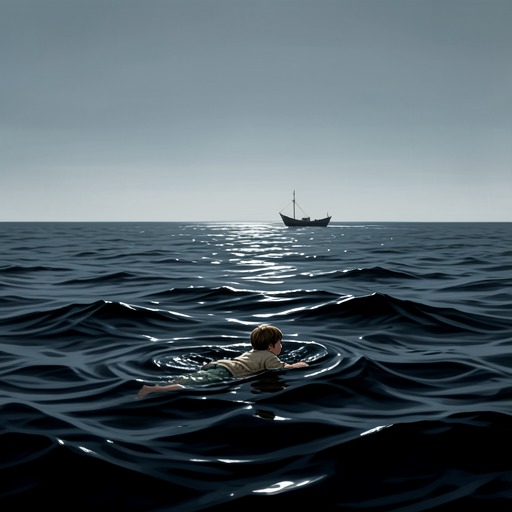
Pip jumps again under circumstances similar to the first incident. This time he does not catch the whale-line against his body. When the whale starts to run, he is left behind on the sea like luggage hurriedly forgotten by a traveler. No knife is raised, and Stubb’s boat continues after the whale. Within three minutes, a mile of open ocean separates Pip from the boat, while the calm blue sea makes his small dark head appear almost weightless against the horizon.
Stubb does not consciously intend to condemn Pip to death. Two other boats are behind him, and he assumes they will quickly reach the castaway. Instead, those boats suddenly see whales and turn to pursue them. Stubb and his crew are equally absorbed in their own fish. The accident reveals how abandonment can arise without a formal decision: the fishery’s pursuit of whales converts every nearby human obligation into a secondary concern.
Pip is eventually rescued by the ship through sheer chance. The rescue saves his body but does not return him to ordinary life. The sea has kept his finite body afloat while, in the narrator’s formulation, carrying his soul down into depths of vision. From that hour, his shipmates regard him as an idiot. His apparent madness is thus the consequence of an actual maritime ordeal, not merely a comic trait or a convenient eccentricity.
Vision, Insanity, and the Castaway State
The passage treats Pip’s isolation as an encounter with an immensity that ordinary social life cannot contain. Even an experienced swimmer may find calm open water physically easy, but the loneliness of being surrounded by a “heartless immensity” becomes intolerable. Sailors bathing in a dead calm cling closely to their ship; Pip, by contrast, is cut off from the vessel that ordinarily gives the ocean scale, direction, and human meaning.
After his rescue, Pip is said to have seen strange forms of the primal world, the hidden wisdom of the sea, and the innumerable living processes moving through the water. He perceives the divine as active within the ocean’s depths and attempts to speak of what he has seen. The crew interprets such speech as madness. The narration reverses that judgment by suggesting that what appears insane from the standpoint of human reason may resemble a higher or more comprehensive sense.
Pip therefore becomes a castaway twice over. First, he is physically separated from the boat and left alone in the sea. Later, although restored to the deck, he is socially separated from the ordinary assumptions of the crew. His body returns to the ship, but his consciousness no longer fits comfortably within its practical language of whales, lines, prices, and orders.
Significance in the Whaling World
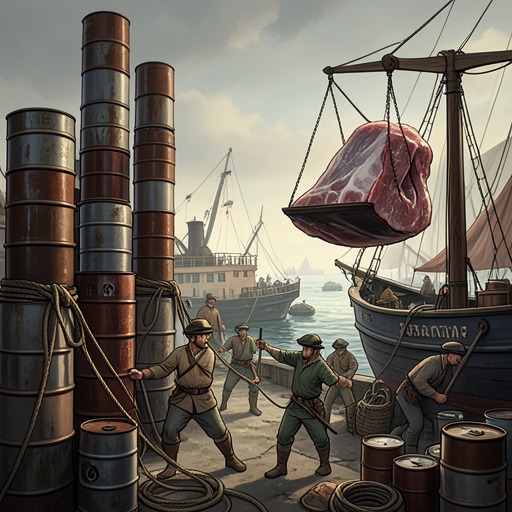
Pip’s abandonment exposes the contradiction between the dignity claimed for whaling and the violence built into its labor. The narrator defends whaling as a powerful, globally important vocation: whale oil illuminates lamps and candles across the world; whaling fleets have explored remote waters, opened routes, aided settlements, and helped connect Europe, America, Australia, Polynesia, and the Pacific coast of South America. Yet the same enterprise that is praised for its civilizing reach treats a vulnerable crewman as less valuable than a whale when the chase is underway.
That contradiction is intensified by the episode’s connection to the whale-line. The line first appears as a technical instrument of pursuit, then as a snare around Pip’s chest and neck, and finally as the absent link whose tightening would have dragged him to death. It binds human labor to the whale’s motion, but it also reveals how completely the hunters are bound to the commercial system they serve. Pip’s abandonment is not an accidental interruption of whaling’s order; it is a moment in which that order becomes visible.
The event also foreshadows the novel’s larger concern with castaways, survival, and the limits of rational judgment. Pip’s ordeal anticipates later forms of abandonment at sea, while his altered state gives the narrative a figure who has crossed beyond the crew’s shared reality without wholly leaving the human world. His apparent descent into insanity is presented less as simple loss than as a terrible, involuntary awakening to an oceanic scale of existence. The ship rescues Pip from drowning, but the sea has already changed what rescue can mean.