Ishmael's survival and rescue by the Rachel
Moby-DickIshmael's survival and rescue by the Rachel is the final reversal of the Pequod's catastrophe. When the drama of the chase is over and the ship, Captain Ahab, and the crew have vanished, Ishmael alone remains to convert total destruction into a tellable history. His survival depends on the coffin made for Queequeg, an object prepared for death that becomes a buoy of life, while the Rachel's rescue gives the orphaned narrator a human return from the sea.
The Survivor After the Wreck
The event begins at the boundary between narrative conclusion and testimony. After the Pequod disappears, the epilogue invokes Job's declaration, “AND I ONLY AM ESCAPED ALONE TO TELL THEE.” Ishmael immediately explains why anyone steps forward after the drama has ended: one person survived the wreck. Survival is therefore not merely a physical accident; it is the condition that makes the entire account possible. The wreck leaves no ordinary community, no returning crew, and no shared explanation. It leaves a single witness responsible for carrying the lost world into language.
Ishmael's position during the sinking is precarious. After Fedallah disappears, he takes the place of the bowsman when that sailor assumes the vacant post; later, when three men are thrown from the rocking boat, Ishmael is dropped astern. He is close enough to see the final destruction but not secure enough to control his own fate. The story places him at the margin of the catastrophe, a witness exposed to the same annihilating force that destroys the others yet separated from it by a narrow and accidental interval.
The Vortex and the Coffin Life-Buoy
The suction of the sunken ship slowly draws Ishmael toward the closing vortex. He circles its creamy surface, contracting toward the black bubble at its center, in an image that makes survival appear almost impossible. The sea does not simply receive the Pequod; it turns the wreck into a revolving mechanism that threatens to absorb the last observer as well. Ishmael's movement toward the center briefly places him within the same fatal pattern as the ship and its crew.
At the vital center, however, the black bubble bursts upward and releases the coffin. Because of its buoyancy and its cunning spring, the coffin life-buoy shoots lengthwise from the sea, overturns, and floats beside Ishmael. Queequeg's intended burial vessel thus changes function at the precise moment when Ishmael needs a means of continued existence. The object carries the memory of Queequeg into the aftermath of the wreck, but it also materially preserves Ishmael, joining the dead man's preparation for death to the living narrator's unexpected escape.
The coffin's earlier preparation gives this reversal its full meaning. Queequeg had furnished it with the iron part of his harpoon, a boat paddle, biscuits, fresh water, woody earth, sail-cloth for a pillow, and his small god Yojo. He had lain inside it, tested its comfort, and accepted it as a final bed. In the epilogue, the same vessel becomes a life-buoy. Its contents and ritual associations remain linked to Queequeg even though it now sustains Ishmael, making survival inseparable from friendship, memory, and the material remains of a vanished companion.
A Day and Night Adrift
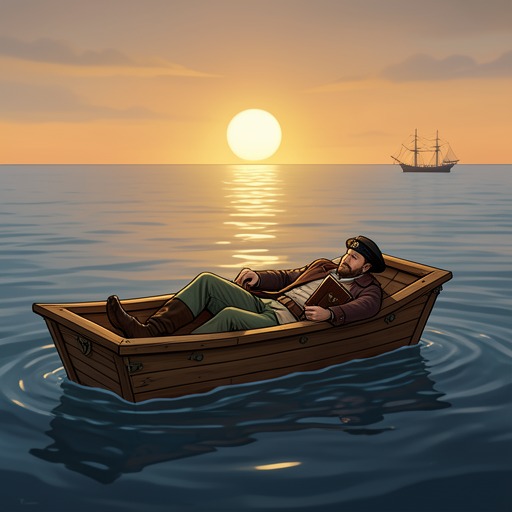
Ishmael floats on the coffin for almost one whole day and night. The sea is described as soft and dirgelike, extending the atmosphere of mourning while refusing to close the story in death. Sharks pass without harming him, and sea-hawks glide overhead with their beaks sheathed. The natural world, so often associated with violence in the chase, becomes temporarily nonaggressive around the solitary survivor. This quiet does not erase the disaster; it creates a suspended interval in which Ishmael remains between shipwreck and rescue, death and return.
His survival is also marked by isolation. He has no vessel, crew, or working equipment, only the coffin's buoyancy and the open sea. The Pequod's destruction has stripped away the structures that organized his life, leaving him as a castaway supported by an object associated with another man's death. The contrast makes the ending both miraculous and material: fate may determine that Ishmael lives, but the coffin's construction is what keeps him above the water long enough for help to arrive.
Rescue by the Rachel
On the second day, a sail approaches and draws nearer until the Rachel picks Ishmael up. The rescue is connected to the ship's retracing search for its missing children. The Rachel does not find the children it seeks; instead, it finds another orphan. This parallel gives the rescue a mournful irony. Ishmael is saved, but the larger loss remains unresolved, and his recovery is folded into another vessel's search for those who have disappeared.
The Rachel's arrival restores Ishmael to human society without restoring the Pequod or its dead. It supplies the practical conclusion to his ordeal, yet the wording of the rescue preserves its incompleteness: the ship that searches for missing children discovers a solitary survivor rather than recovering the lost crew. Ishmael returns not as a member of a reunited company but as the orphaned remnant of a destroyed one.
Narrative Significance
The event transforms catastrophe into witness. Captain Ahab's pursuit ends in the destruction of the Pequod, while Ishmael's survival provides the narrative channel through which that pursuit, its violence, and its consequences can be remembered. The distinction between the two endings is fundamental: Ahab seeks mastery through confrontation, whereas Ishmael endures through marginality, accident, and receptiveness to what the wreck leaves behind.
The coffin life-buoy also reverses the meaning of death without abolishing it. Queequeg's coffin cannot save Queequeg, and the Pequod's destruction cannot be undone. Yet the object preserves a connection between the dead and the living, allowing Ishmael to survive upon the physical sign of a friend's anticipated death. His rescue by the Rachel therefore closes the plot through a chain of substitutions: one survivor replaces the lost crew as witness, one orphan is found in place of the missing children, and a coffin intended for burial becomes the instrument of life.