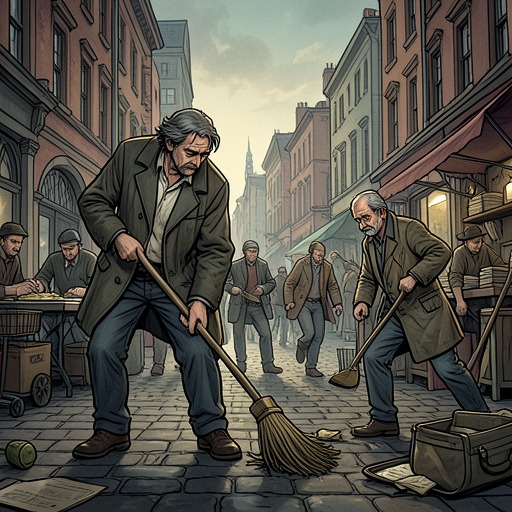
Beppo’s street-sweeping maxim
MomoBeppo Roadsweeper’s street-sweeping maxim makes the work of clearing a long street a lesson in how to meet a task without being overwhelmed by its scale. Rather than hurry toward an imagined finish, the sweeper attends to one step, one breath, and one stroke at a time. The method joins practical steadiness to enjoyment of work, and stands in sharp contrast to the city’s later creed of saving time by accelerating, measuring, and cutting away whatever seems unnecessary.
The principle of the next step
Beppo explains the maxim to Momo through a concrete predicament: a long street lies ahead, and looking at all of it at once can make the job seem impossible. Anxiety then produces a futile cycle. The worker hurries, increases his effort, sees no apparent reduction in the distance remaining, panics, and finally has to stop, still facing the same long street. The problem is not simply that the work is extensive; it is the attempt to carry the whole burden in thought before the next part has been done.
His alternative is deliberately small in scale: “You must never think of the whole street at once, understand? You must only concentrate on the next step, the next breath, the next stroke of the broom, and the next, and the next. Nothing else.” The repeated sequence makes the maxim resemble the rhythm it describes. Attention moves forward in units that can be acted on, while the distant endpoint is set aside. Its modesty is essential: Beppo does not promise that the street is short or that effort can be avoided. He proposes a way to continue without letting the apparent enormity of the whole task dictate each immediate movement.
Work, attention, and completion
The maxim’s logic depends on the difference between frantic speed and sustained progress. Beppo describes how trying to work faster can leave the street seeming just as long, while the worker becomes breathless and must stop. By contrast, concentrating on the next manageable action keeps effort connected to the work itself. “That way you enjoy your work, which is important, because then you make a good job of it. And that’s how it ought to be.” Enjoyment here is not an extra reward added after productivity; Beppo makes it part of doing the task well.
Completion arrives almost as a reversal of perspective. The worker does not make the whole street disappear through a single burst of force. Instead, “before you know it, you find you’ve swept the whole street clean, bit by bit.” The phrase “bit by bit” names the cumulative result of attention that never tries to perform the entire job in one mental or physical effort. Beppo stresses the bodily consequence as well: “What’s more, you aren’t out of breath.” The work is finished, but not at the cost of exhausting the person doing it. His final emphasis on that consequence keeps the principle practical rather than abstract: a sound method matters both for the quality of the work and for the worker’s capacity to carry it through.
How the maxim is told
The scene presents the maxim as an exchange shaped by listening. Beppo has grand ideas while sweeping, but finds them difficult to put into words; when he sits with Momo after work, her attentive manner helps him find them. His explanation itself proceeds by pauses: he first describes the street, then the failed response of hurrying, and only after reflecting does he state the alternative. The form enacts patience instead of merely praising it. Meaning emerges through successive steps, just as the clean street does.
The broom and the breath keep the idea grounded in Beppo’s daily labor. The maxim does not detach wisdom from ordinary work or turn sweeping into a metaphor for effortless success. Its comparison remains exact enough to preserve the task’s demands: there is still a street to clean, and each stroke still has to be made. What changes is the scale at which the worker attends. The immediate action becomes possible because the total distance is not repeatedly imposed on it.
Contrast with the city’s time-saving creed
The maxim gains broader significance beside the later account of the gray men’s campaign. The book states, “Time is life itself, and life resides in the human heart.” The gray men understand the value of time as something to exploit: they urge people to work faster, avoid conversations, and cut back on relationships and activities that do not fit their calculations. At Mr Figaro’s barbershop, this advice becomes a timetable, shorter customer visits, closely watched assistants, and the wall notice “TIME SAVED IS TIME DOUBLED!” The apparent promise of efficiency carries a different result: people save time while life becomes poorer, bleaker, and more monotonous.
Beppo’s method offers a pointed counterpoint. He does not treat time as a quantity to extract from every action, nor define good work as the fastest completion. His sequence of step, breath, and broomstroke attends to the work as it is lived, and his measure of success includes enjoyment, care, and the absence of panic. The contrast is not between work and idleness: both the maxim and the city’s program concern work. It is between a patient rhythm that allows a task to be completed without consuming the worker and a doctrine that turns efficiency into a reason to reduce the rest of life.
The maxim’s memorable force lies in its scale. A whole street may be daunting when held in view all at once; the next stroke is not. Beppo’s formulation makes that shift in attention a repeatable discipline, while the novel’s treatment of time-saving shows what is lost when discipline is instead measured by speed and economy. Its conclusion remains both literal and ethical: finish the street, step by step, without losing the human life that the work is meant to serve.