Riddle of the Three Brothers
MomoRiddle of the Three Brothers is a puzzle Professor Hora gives Momo about the relations among past, present, and future. Its solution names not three independent spans but a connected whole: time, in the world that contains it. The riddle matters both for what it says about time and for how Momo reaches the answer, turning a remembered clue about Cassiopeia into a way of thinking through the poem’s logic.
The Challenge and Its Form
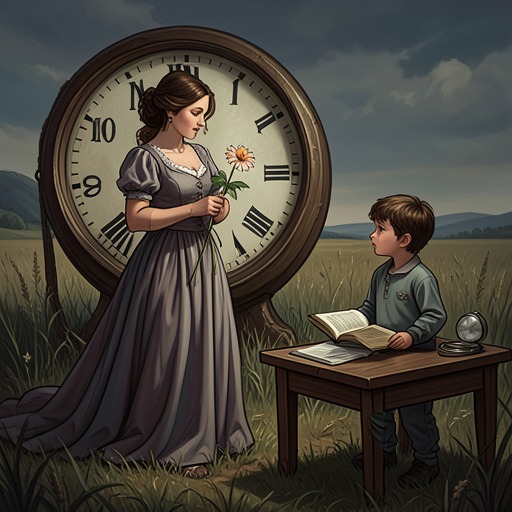
Professor Hora introduces the riddle as a difficult teaser and tells Momo to listen carefully. Momo, who intends to make a note of it and try it on her friends, listens as the poem describes three strange brothers who live in one house. They are unlike, yet resemble one another; one is absent but will arrive, another has departed, and the smallest is present. The verses give the reader a set of contrasts before they supply names, making the puzzle depend on recognizing a pattern rather than identifying three characters from external description.
The clues also insist that the brothers cannot be understood in isolation. The smallest is needed by the other two, while the first turns into the second. The poem then complicates the idea of counting them: perhaps they are one, perhaps two, perhaps none. They rule a kingdom together and are that kingdom as well, while the question of their dwelling place remains open. These apparent contradictions are not distractions from the answer; they are the puzzle’s method. Each clue presses toward a relationship among the brothers, not a simple inventory of them.
Momo can repeat the whole rhyme word for word because of her excellent memory, but exact recall does not immediately give her its meaning. She sighs and says she has no idea where to start. That gap between remembering the poem and understanding it makes the riddle a test of interpretation, not merely attention. Professor Hora’s encouragement keeps the question open while Momo works through what its images might mean.
Momo's Route to the Answer
Momo begins again by asking what Cassiopeia knows. She recalls that Cassiopeia always knows what is going to happen, and this association brings her to the first brother: “The future!” Professor Hora nods. Momo then matches the departed brother to “the past,” receiving another affirmative nod. The sequence is important: she does not guess all three at once, but tests each proposed meaning against the verse and the professor’s response.
The third clue takes more thought. Momo notes that the smallest brother is the only one at home, yet the others cannot manage without him. After a pause, she identifies him as “now — this very moment!” Her reasoning is explicit: the past consists of moments gone by, and the future of moments still to come, so neither can exist without the present. The answer makes the riddle’s image of the brother who is present and indispensable into an account of how the other two are constituted.
Momo then applies the same reasoning to the line about the first brother becoming the second. She takes it to mean that the present exists because the future turns into the past. This realization surprises her: she says she had never looked at it in that way. The riddle has not only asked her to attach labels to its brothers; it has made her reconsider what it means for the present to exist at all.
The Riddle's Account of Time
Momo’s interpretation preserves a tension rather than resolving it away. The present is indispensable to past and future, but it cannot be held still as an object of observation. By the time Momo speaks about a moment, she recognizes, that moment has already passed. The verse’s claim that one cannot stand back and observe the third brother thus becomes a reflection on the instability of “now”: the act of noticing it occurs within time, and the noticed moment slips into the past.
This also explains why Momo considers whether there might be only one brother, only one of the three kinds of time, or none. Each possibility seems plausible if past, present, and future are treated as separate things; each fails if their existence depends on one another. Her conclusion is not that the distinctions disappear, but that no one of them stands alone. The poem’s shifting count—three, one, two, or none—gives formal expression to this interdependence, while the transition from future to past supplies its movement.
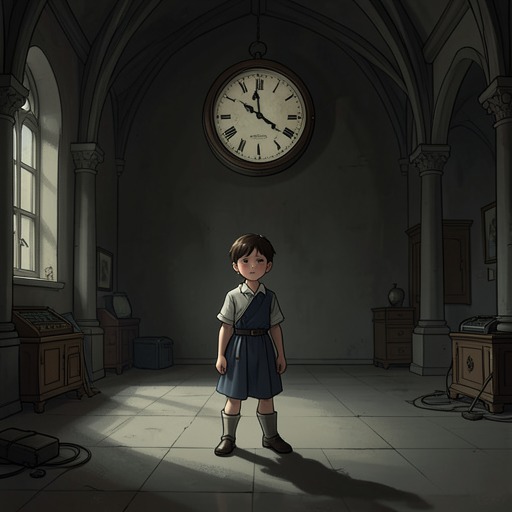
Professor Hora extends the puzzle by asking what kingdom the brothers rule together and what they themselves are. Momo looks around the great hall, where thousands upon thousands of clocks are visible, and suddenly answers “Time!” The clocks furnish the immediate setting for her recognition, but the answer gathers more than the objects in the room: past, present, and future together constitute the kingdom and its rulers. The riddle turns the division of time into a whole that is at once something the brothers govern and something they make up.
The World as Their House
One question remains after Momo names time: where do the brothers live? Asked about their shared house, Momo replies that it is “the world.” This last answer completes the movement from the temporal parts to their encompassing conditions. Time is not presented as a kingdom outside existence; its three aspects dwell together in the world, and the world is the house that gives the riddle’s image a place.
Professor Hora congratulates Momo and says he is delighted by her skill at solving riddles. Momo is pleased too, but secretly wonders why Professor Hora should be quite so pleased that she has solved this one. The scene therefore closes with the puzzle answered but with a small question left between them: Momo understands the riddle’s account of time, while Professor Hora’s particular satisfaction remains unexplained in this moment. The poem’s final answer is complete, yet its place in their exchange still invites curiosity.