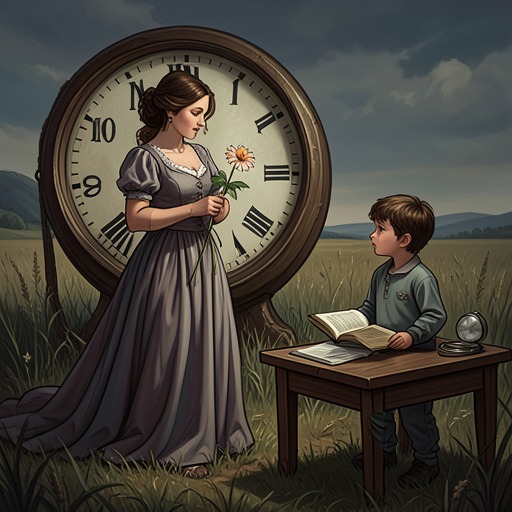
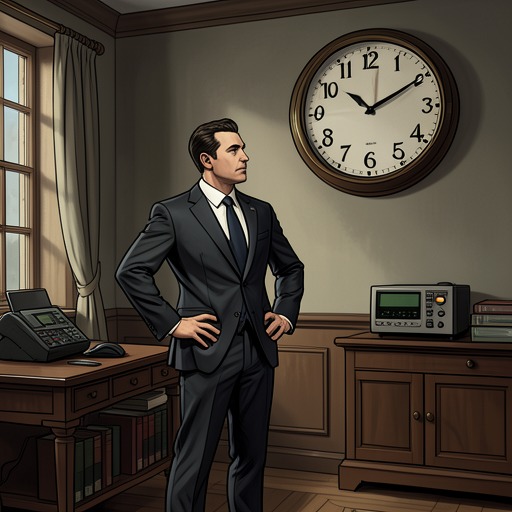
“Time is life itself, and life resides in the human heart.”
Momo“Time is life itself, and life resides in the human heart.” gives the novel’s account of time its governing principle: time is not simply what clocks measure, but the living substance of human experience. The phrase links the felt character of an hour to the quality of a life, and exposes the contradiction at the heart of the Men in Gray’s promise that time can be saved.
Meaning and Formulation
The novel introduces time as a commonplace mystery that people share but seldom consider. Calendars and clocks measure it, yet measurement cannot describe how an hour may seem eternal or pass in a flash according to how it is spent. The expression answers that distinction by locating time in human life and the heart: its value is experienced, not merely counted.
The phrase is repeated after the account of the city’s growing devotion to efficiency. This recurrence makes it more than an introductory reflection. It becomes a standard against which the effects of time-saving can be judged: if time is life, then changing how people spend it changes the texture of their lives.
The Men in Gray’s Counterfeit Expertise
The Men in Gray understand time’s value, but use that knowledge as a means of taking it from others. The narration compares their expertise in time to leeches’ expertise in blood. They install themselves secretly in the city, identify people they can recruit, and wait for the moment when each can be drawn into their plans. Their concealed intervention turns the language of care for one’s time into an instrument of exploitation.
Their advice to Mr Figaro makes the difference between lived time and counted time concrete. The gray agent urges him to work faster, limit customer visits to fifteen minutes instead of half an hour, shorten time with his mother, place her in an inexpensive home, sell his budgerigar, and abandon singing, reading, and conversation with friends. He also recommends an accurate clock so Mr Figaro can time his apprentice to the nearest minute. Each instruction treats a relationship or pleasure as time that can be reclaimed and measured.
The Cost of Saving Time
After the gray visitor has gone, Mr Figaro forgets the man but retains the resolution to save time, believing it to be his own. He begins by serving a customer in twenty minutes rather than the usual thirty, then imposes the same brisk treatment on every customer. He hires two assistants and watches them closely, arranging every move around a precise timetable. The notice on his barbershop wall, “TIME SAVED IS TIME DOUBLED!”, turns the campaign into a public rule of work.
The changes extend beyond the shop. Mr Figaro writes Miss Daria a brief, businesslike note ending their meetings, sells the budgerigar, and visits his mother in the old folks’ home only once a month. Although he follows the gray agent’s recommendations as if they were his own, the results are visible in the life he has given up: he no longer enjoys his work, while his social and family ties are reduced in the name of future time.
Consequence and Significance
The novel’s final restatement of the principle supplies the measure of this loss. People fail to notice that saving time means losing something else; life grows poorer, bleaker, and more monotonous, and children feel the deprivation especially because adults no longer have time for them. Against the bank’s arithmetic, the passage concludes that the more people save, the less they have.
The expression therefore reverses the apparent logic of efficiency. Time cannot be separated from the human activities and attachments that give it substance; when those are cut away, accumulated savings do not amount to a fuller life. The repeated phrase binds the ordinary details of Mr Figaro’s changed routine to the citywide consequence, making the heart—not the clock—the measure of what has been lost.