Sophie
MovingSophie is Fern Woolbright and James Frobisher’s daughter, introduced first as a child in a newspaper cutting and finally as an adult expecting her first baby. Though she grows up outside the novel’s central family conflicts, her life becomes a quiet counterpoint to them: Fern and James’s cherished only child reaches adulthood, and her pregnancy ends the book with two heartbeats on a screen, bringing the family’s history of twins back into view.
Identity and Family Background
Sophie enters the record through an image of family success. A cutting shows James outside Buckingham Palace with his Distinguished Service Order, an eye patch, his beautiful wife and their eighteen-month-old daughter. The photograph fixes Sophie at the beginning of her life within a public portrait of her father’s military bravery and her parents’ marriage. It is an image of a family made visible through James’s achievement, while Sophie herself is still too young to be known beyond her place in it.
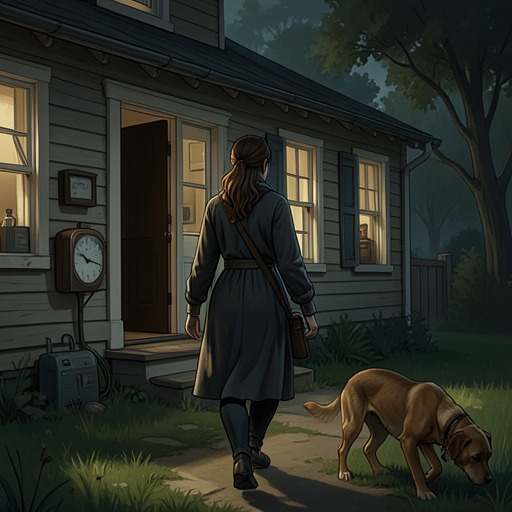
By the time Lucas later imagines what has become of the family, Fern has apparently retired to Wiltshire and devoted herself to James and Sophie. The imagined setting is a large yellow-stone rectory with a black Labrador; the house and dog belong to Lucas’s speculation, not to a confirmed account of their home. He estimates that Sophie must now be a woman in her thirties. This glimpse reaches her through distance and conjecture, before the narrative returns to her directly at the end.
Childhood and Character
Fern remembers Sophie as a particular child rather than as a continuation of the family’s tragedies. She has soft brown hair and blue eyes, laughs quietly at things only she finds funny, and is sociable while sometimes choosing solitude. Dreaminess sits alongside a practical fondness for keeping her doll’s house tidy. She draws with both her right and left hands, a concrete sign of her cleverness that distinguishes her without turning her into a symbol or a problem to be explained.
The account also follows her qualities into adulthood: Sophie grows up kind, funny, patient and popular. The list gives her a rounded presence through small contrasts and accumulated traits. She can enjoy company and still want time alone; she can be dreamy and orderly. The narrative does not describe a dramatic break from childhood, but instead presents a continuous growth from the self-contained girl Fern watched to a woman approaching motherhood.
Fern and James as Parents
Fern is beside Sophie in hospital for the pregnancy examination, having come up from the country and determined not to miss it. When the obstetrician smiles and asks whether she is Grandma, Fern laughs and reaches for her daughter’s hand, recognizing the familiar feel of her slim, cool fingers. The scene places their physical closeness alongside the change in their roles: Fern is now the older woman anxiously sitting by the bed, while Sophie is the patient whose own child is being examined.
James cannot contain his excitement. He had always wanted a larger family, but it did not happen, and he and Fern learned to count their blessings. Fern recalls telling him that it was fate and that they were lucky to have Sophie, whose birth had made their small family wonderful. Her words present Sophie not as a consolation in any diminished sense, but as the child they loved and valued. Fern says she loved her from the moment she was born; as Sophie grew, she watched anxiously for signs that never came. The passage does not specify those signs, but makes clear that Fern’s attention to her daughter carried an unspoken fear as well as affection.
The Twin Pregnancy and Ending
At the hospital, the obstetrician asks whether there is a history of twins in the family. Sophie says she knows of none and turns to Fern for confirmation. The exchange makes the family’s past relevant without making Sophie aware of it: her answer is an honest account of what she knows, while Fern is present at the point where the hidden family pattern returns. On the screen are two separate heartbeats, together. Sophie is expecting twins.
This final discovery gives the book’s close its force. Sophie had been the single child around whom Fern and James built their hopes for a larger family they never had; now she is expecting two children at once. The ending does not supply their future or resolve the family’s history, but places a new beginning beside it. The twins are separate and together, a compact image that echoes Sophie’s own place in the story: loved as an individual, yet connected to a family past she does not fully know. The novel ends not with a retrospective explanation but with the visible fact of two heartbeats, leaving that inheritance alive in the next generation.