Mr Robbins
MovingMr Robbins’s abuse of Charlie at Wyebourne College turns a school’s private misconduct into a family crisis, exposing how personal connections and institutional self-protection can leave a child without support. The novel presents him not as an isolated threat but as someone whose history was known, or suspected, by adults who had the power to act.
Position at Wyebourne
Mr Robbins was a teacher at Wyebourne College and an old schoolfriend of Dickie. That connection made his later abuse of Charlie especially consequential: when Charlie tried to tell Lucas what had happened, Lucas treated the accusation as implausible partly because Mr Robbins sent Christmas cards to his father. A token of respectable social continuity became, in Lucas’s reasoning, evidence that the teacher could not be dangerous.
The school’s response to the scandal reveals a wider pattern of evasion. Charlie reported Mr Robbins, and two other boys came forward with similar accounts. Wyebourne nevertheless tried to hush the matter up; Mr Robbins was placed on gardening leave, while the school employed a new sports master described as heterosexual. The contrast between a discreet personnel change and the seriousness of the boys’ reports makes the institution’s priority appear to be managing appearances rather than openly confronting abuse.
Lucas’s Recollection and Delayed Recognition
Years later, Lucas recalls that Charlie came to him only once for help. After returning from a school service, Lucas found his stepbrother waiting outside his dormitory and, irritated by Charlie’s repeated detentions, accused him of looking for trouble. Charlie then described Mr Robbins’s abuse and asked whom he should tell. Lucas, still a thirteen-year-old unfamiliar with the possibility of abuse by an adult at school, called him a liar. He relied on Mr Robbins’s friendship with Dickie and the Christmas cards the families exchanged as proof that the accusation could not be true.
The memory is sharpened by what Lucas now understands he failed to do: listen to Charlie or help him find an adult who would. Charlie went to the matron instead, and the accounts of two other boys confirmed that his accusation was not isolated. By the time the school broke up for Christmas, both Charlie and Mr Robbins had left Wyebourne. Mr Robbins later died by suicide; the inquest concluded that his balance of mind had been disturbed. The episode leaves Lucas with a belated recognition of his own part in Charlie’s isolation, while showing how a familiar social bond had made an accusation of abuse easier for him to dismiss.
The Arrangement Behind Charlie’s Place
Edwina later understood Charlie’s admission to Wyebourne as part of an arrangement shaped by Dickie’s prior knowledge of Mr Robbins. Dickie had helped secure the place, and when the abuse scandal emerged, Edwina inferred from his reaction that he already knew what Mr Robbins was capable of. In her reconstruction, Wyebourne accepted Charlie because Dickie could otherwise have exposed the danger the school was tolerating. The school place was therefore not simply an educational opportunity: it had been entangled with adult knowledge and institutional self-protection before Charlie arrived.
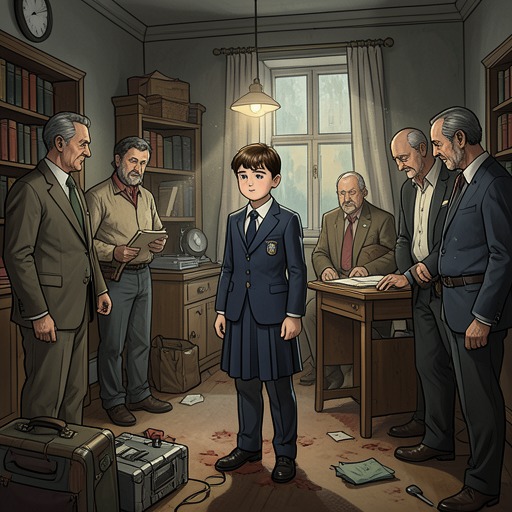
The cost of that arrangement became painfully concrete to Edwina in the expensive uniform, the oversized school trunk, and the equipment Charlie barely used before he had to leave. Her anger at Dickie was sharpened by the belief that he had entrusted their child to a school where Mr Robbins could abuse him, while Dickie’s own assumptions about boarding-school life made him fail to grasp the harm. Charlie, not the adults who had maneuvered around the danger, ultimately exposed Mr Robbins. That reversal defines the scandal’s bitter irony: the child placed inside the institution became the person who broke its silence.
Death and Public Reception
Mr Robbins’s death did not immediately bring public recognition of what had happened at Wyebourne. After he was found hanged in a wood near his mother’s house, the inquest concluded that his balance of mind had been disturbed. There was a brief flurry of news coverage, but the school’s effort to hush up the abuse had already shaped what many people knew; most, Lucas recalls, thought Mr Robbins had finally done the decent thing. His death could therefore be read as a private moral resolution rather than as the end of a scandal involving children and a school’s failure to protect them.
Barbara’s response exposes how readily blame could be redirected toward the boys. She called Mr Robbins’s conduct heinous, yet suggested that the pupils had somehow been responsible, perhaps by flaunting themselves. Her reaction echoes the broader adult failure surrounding the case: even when the abuse was acknowledged, suspicion could be shifted onto the children who had been harmed. Set beside the school’s discretion and the public’s response to Mr Robbins’s death, that victim-blaming makes clear why Charlie’s report mattered—and why his decision to speak did not by itself ensure that adults would understand or respond justly.