Lucas
MovingLucas is Dickie’s son and Edwina’s stepson, first welcomed into the family through a bedroom made especially for him and later remembered as someone Edwina cannot bear to think about. His life is shaped by that uneasy belonging, by Charlie’s death and the guilt that follows it, and by a final effort to tell Edwina the truth about the theft that hurt them all.
Identity and Early Place in the Family
Lucas enters Edwina’s memories as a child whose presence unsettles her from the beginning. The first time she sees him, he is covered in blood, an image she remembers as nightmarish; the incident is later brushed aside, but it remains part of the uneasy beginning of their relationship. Once he becomes a regular guest and an official, if part-time, member of the family, Edwina tries to make him feel welcome rather than treat him as an intruder.
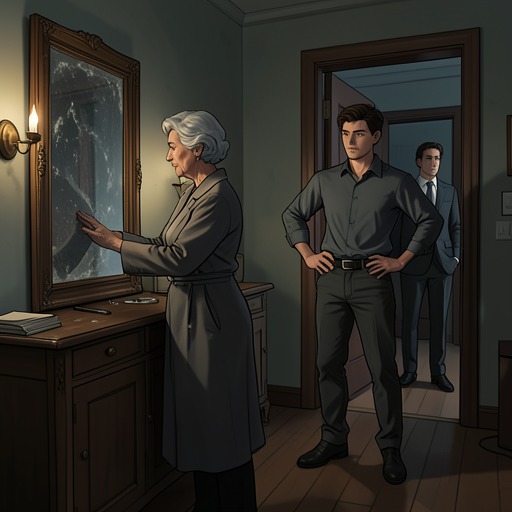
She learns that he is keen on the Apollo space mission and paints a mural for him. A hand-painted tile on the bedroom door marks the room as his, and the room’s later appearance still carries the evidence of that effort. Dickie even hopes Lucas might return for a night, so the room is refurbished for his possible use. Edwina cannot say that she does not want him there, but she is relieved when he returns to Britain and stays with his mother instead. By the time she decides to sell the house, she calls the room the spare room rather than Lucas’s old bedroom; saying his name has become difficult, and she wants not to think of him after what he did.
Lucas’s ties to the household are also bound up with his mother, Barbara, Edwina’s predecessor as Dickie’s wife. Edwina remembers Barbara and Lucas as closely entwined, sharing even their mutual loathing of her. The family connection offers Lucas a place in the house, but it does not produce an easy relationship between him and Edwina. Her memories hold both the care she took to welcome him and the resentment that eventually makes his name almost unsayable.
School and Family Expectations
A buff-coloured folder of Lucas’s school reports gives Edwina another view of him. Academically, he struggles even to reach average performance, while Dickie cannot understand why the school does not rate his efforts more highly. Lucas explains his disappointments through a succession of external causes: favouritism keeps him off sporting teams, bad luck affects his test marks, and what he believes was undiagnosed glandular fever accounts for poor O-level results. The explanations leave his difficulties unresolved rather than clarifying them for his father.
Edwina’s comparison of Lucas with Charlie and Rowena further sketches the family’s different temperaments. She indulges Charlie, while Rowena is hard to sway with praise and faces her own shortcomings without flinching. Lucas, by contrast, seems to need constant reassurance. Dickie believes that his son is less confident than he appears, and Edwina hopes that the conceit she sees may be a façade over a young man unsure of himself. The account does not settle the question; it shows how little the family can confidently read in Lucas beneath his self-presentation.
Charlie’s Death and Lucas’s Guilt
After Charlie dies in Thailand, Dickie shows Lucas a postcard sent from there. Rowena’s neat handwriting describes trips to food markets and Buddhist temples, their beach hut beside the sea, and Charlie’s health and sun-tan; Charlie adds an exuberant scrawl and kisses in the remaining space. The card has been torn in half and mended with tape. Its cheerful report of recovery stands in painful contrast to Dickie’s account of what followed: Rowena returned to Australia, leaving Charlie money for a flight home on the condition that he continue his healthy routine. He kept to it for almost a week, then fell in with other travellers and moved to a rougher part of the resort. Ten days after Rowena left, he was found dead in a backpackers’ hostel, a needle in his arm.
Lucas does not voice the anger that the postcard and Dickie’s story stir in him. He believes Charlie spoiled everything and holds him responsible for Elise’s death, even while acknowledging that Charlie may not have killed her directly. Dickie, too, admits anger and wonders why Charlie was not more grateful for the opportunity to recover. Lucas’s silence keeps his blame private, but it does not free him from it. In the years after Charlie’s death, guilt becomes a force that shapes his life, driving him toward drinking and drugs.
Addiction and the Turn Toward Recovery
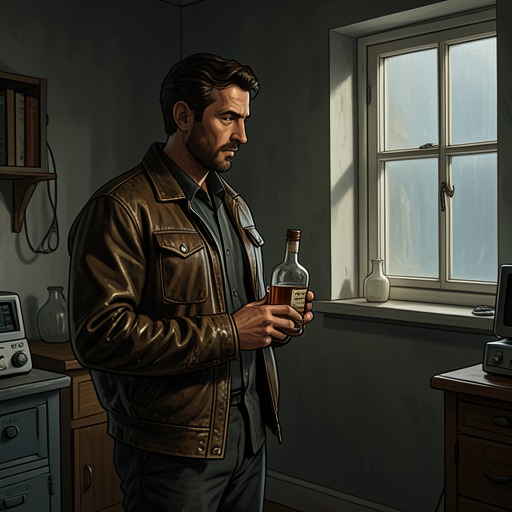
After a night of drinking with Dickie, Lucas wakes to find his father already gone and a note in the kitchen saying he should sleep it off. The whisky bottle is empty; Dickie’s pad Thai is largely untouched. Late for work and feeling ill, Lucas accepts cocaine when it is offered in a toilet cubicle. The drug brings an abrupt sense of confidence and, for the first time in eight years, an absence of guilt. He convinces himself that he was right to stand in court and that his testimony against Charlie was not wrong.
That relief becomes the beginning of years of drinking and drug use, hidden from both parents. In New York he appears to function: he works and even goes to the gym between binges, though he also suffers nosebleeds and periods of drunkenness. At Dickie’s funeral, alcohol and drugs blur the day; Lucas boards his flight back to New York very drunk, his suit stained with egg and smoked-salmon canapés. In the turbulence high above the ground, while violently sick in a tiny toilet cubicle, he reaches a limit. He realizes that trying to kill himself is no longer giving him any pleasure and, more decisively, that he does not want to die.
Back in the United States, Lucas enrolls himself in a twelve-step programme and begins a difficult, uneven movement toward sobriety. The struggle continues: he remembers nearly calling his dealer and nearly buying vodka, while the attacks of September 11, 2001, enter his memory as another event in the years when he is trying to stay clean. His recovery is not presented as an instant cure. Rather, it begins with the recognition that he wants to live and continues through repeated resistance to the habits that once allowed him to avoid guilt.
Confession and the Meaning of His Return
Much later, Lucas decides that he cannot spend the rest of his life agonizing over what he has done. Guilt has shaped him in opposite directions: Charlie’s death drove him toward drink and drugs, while Dickie’s death helped make him stop. The past cannot be repaired wholesale, but Lucas wants to put some small part of the story right. He acts on that intention by telling Edwina what happened to her jewelry box.
With his head in his hands, his voice low but steady, Lucas admits that he arranged the theft while in trouble at school and owing money to someone who would not forget the debt. When that person offered a solution, Lucas handed over the house keys and told them when it would be safe to enter. He received the money and believed no one had been hurt; in retrospect, he recognizes that everyone was. The disclosure turns the long-avoided history between Lucas and Edwina into something spoken plainly, but it does not undo the damage. Edwina trembles, presses her fingers to her mouth, and weeps. Lucas gets up and leaves to attend to other things; the scene offers no easy reconciliation.
His significance lies in the collision between the welcome he once received and the betrayal he concealed, and between the blame he directs toward Charlie and the guilt he carries himself. For years, silence and intoxication keep that guilt at a distance. His confession does not restore the family or make the past reversible, but it marks a change in what he is willing to face: instead of continuing to circle his actions in private, he names his own responsibility to the person he harmed.