Edwina
MovingEdwina’s decision to sell her deteriorating house marks a break with the past that has enclosed her for years, but it does not erase that past: her home holds the history of her children, her dependence on Alicia, and the losses she has struggled to face. As she recovers the keepsakes once hidden in a stolen jewellery box and prepares to join Rowena in Australia, Edwina begins to understand that love and grief have shaped both her estrangements and her return toward family.
Identity and the House
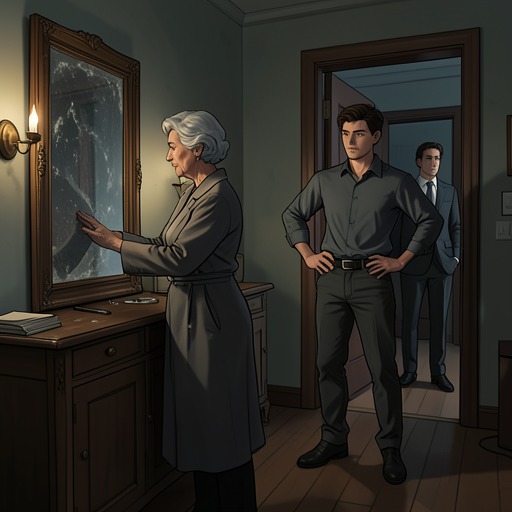
The older Edwina sees herself in a cracked, stained bathtub, holding on to its taps as she hauls herself out. Wiping the steam from the mirror, she laughs at the contrast between the tiny silver-haired woman before her and the young brunette she remembers, with crimson lips and a baby-swollen belly. Her reflection makes age visible, but it does not reduce her to a single present identity: she imagines her former selves nested inside her like Russian dolls, from the lonely boarding-school girl and art student to the young wife, mother, and widow. The image gives her past continuity even as her body and circumstances have changed.
That accumulation has made the house both a home and a burden. Much of it is unused, and she has not entered some rooms for months. Her days have contracted around getting up late, taking a long afternoon nap, and going to bed early; the sheets are grimy, and without Alicia, retired for a decade, she cannot bring herself to manage the stress of hiring new help. Even basic domestic routines remind her of how much has altered. Trays on the stairs seem dangerous, so she now eats in the basement kitchen rather than in the candlelit dining room where silver once glinted.
Edwina has previously considered selling the house, only to dismiss the thought. This time, the decision takes hold because she no longer wants to feel imprisoned by her own past. The choice is not simply a practical response to disrepair or unused rooms; it is a decision to stop living inside a structure whose memories have become difficult to bear. When an agent, Lee, forgets her name and addresses her as an old woman whose house could become a project for buyers, she declines to choose between the surnames Treadaway and Spinner and asks him to call her Edwina. Her name, for the moment, is enough; the house remains hers even as she considers letting it go.
Alicia and the Work of Care
The history of Edwina’s dependence on Alicia begins in exhaustion and practical need. With two small children, no income, and a large house demanding money and attention, Edwina recalls days when she felt she could not go on. She met Alicia on a bench in the grounds of the Imperial War Museum while the twins were crying in their pram. Alicia, then a part-time cleaner with two sons being cared for by their grandmother in Kingston, came to Edwina’s house; Edwina offered her a job soon after they met.
On one of Alicia’s early visits, the twins arrived home wet and uncomfortable. The Aga, installed at Ollie’s insistence, warmed the kitchen, but Edwina did not know how to cook on it and relied on a Baby Belling to heat tinned soup and jarred baby food. She knew the children were not eating properly. Alicia stripped, dried, and changed them, then fetched dry clothes from the pulley above the kitchen table. Toast and honey followed; warm and fed, the twins settled into the playpen. Edwina remembered the scene as a demonstration of the care she could not yet provide by herself.
Alicia stayed after the twins no longer needed a nanny, taking on ironing and cleaning and, in Edwina’s words, becoming her closest ally despite their differences. Her contribution also made Edwina’s working life possible. Edwina illustrated the first-edition Betsy and Tom books, whose appeal lay in the details she painted: Betsy’s red button-up shoes, Tom’s freckles, and the biscuits in his pockets. She made money from the work while Alicia looked after the children in the nursery or kitchen. Their shared lunches—often soup and toast—connected the domestic care happening below to Edwina’s work in her studio. Edwina credits Alicia with giving her the freedom to be a working mother and recognizes that she would have been overwhelmed without her.
Betrayal, Grief, and Blame
The trust between Edwina and Charlie breaks during a theft at the house. Edwina had gone into town to meet her agent about commissions and hoped to have lunch with Charlie and buy him shoes. After waiting until four o’clock, she returned home to find Alicia badly injured at the bottom of the stairs. Charlie had filled a rucksack with valuable, easily sold antiques, including silverware and framed landscapes. Alicia caught him as he was leaving. During the confrontation on the stairs, she was either pushed or fell; the account leaves the exact cause unresolved. What Edwina cannot forgive is that Charlie ran without helping her.
Alicia suffered a smashed hip and collarbone. Edwina changed the locks, and the incident closed off the part of her heart she had kept open to Charlie. She came to believe that Charlie had also stolen her jewellery box years earlier and had lied to her. The loss of trust did not end with his death. After Charlie died in Thailand, Edwina carried his ashes home on a plane as carefully as if the urn were a small child, yet she blamed Rowena for leaving him there. She told herself that Rowena should have known how vulnerable her twin was and that, had she stayed, he would not have died. In holding her daughter responsible, Edwina turned grief into a lasting separation: she ignored Rowena’s letters and refused to speak to her for years.
Edwina’s feelings toward Lucas are also marked by injury and judgment, though the source of one long-standing loss is eventually disclosed. When Lucas returns from America and places the old jewellery box on the table, Edwina recognizes its worn red leather and dulled gold clasp. The compartments are empty, but the lowest drawer still holds her tiny wedding ring, a lock of hair, the children’s baby teeth, and a photograph from the last day. Lucas admits that he arranged the burglary because he was in trouble at school and owed money; he had handed over the keys and told the thieves when the house would be safe. The confession changes the meaning of the box’s absence: it was not simply a loss Edwina could attribute to Charlie, but part of a crisis Lucas concealed.
Recognition and Return
Edwina’s understanding of loss begins to shift before Lucas’s confession. Remembering how Rowena once succeeded where Lucas had failed, she feels an almost overwhelming desire to stroke her daughter’s head and hold her close. She recognizes that she has been wrong and fears she is running out of time to put matters right. Before she can reconsider, she reaches for the blue airmail letters addressed to her and Dickie, which she has never answered. The gesture turns regret into an attempt at contact, though she cannot know whether it is too late.
After Lucas explains the theft, Edwina does not claim to forgive him for what he did in court. She can, however, see more clearly how events came about and how people react when they lose someone they love. That recognition leads her back to her own conduct toward Rowena: she had blamed her daughter for Charlie’s death, punished her through years of silence, and refused even to read her letters. The change is not a declaration that every injury has been repaired. It is a more limited but consequential recognition that her grief made her misjudge the people still alive.
The jewellery box now contains the things Edwina had feared were lost, and she can take them with her to Australia. Rowena’s letter says that she lives near St Kilda beach, that Edwina can paint there, and that the family is waiting; Rowena also wears Edwina’s charm bracelet every day. Edwina has the tickets and checks them nightly alongside her passport. She adds the photograph, teeth, rings, and small matchbox of hair to her travel checklist. These objects make the planned reunion tangible: the past will travel with her, but it need not keep her inside the old house. Returning to painting and joining Rowena remain hopes rather than completed events; Edwina’s decisive change is that she is preparing to go.