Daji
MulanDaji is the White Fox, a long-lived shapeshifter who moves through the story behind beautiful, deceptive, and sometimes monstrous appearances. Her assumed identities let her influence rulers, pursue Mulan and Xiu, and turn a city’s fear of its flooding river against Mulan. Her defeat comes when Mulan, rather than a man, strikes her with the peach-wood sword, overturning Daji’s confident claim that no man can kill her.
Identity and Shapeshifting
The White Fox has used many names and forms, but her favored disguise is that of a beautiful woman. Over centuries, she has refined this appearance into a means of persuasion: her charm leaves few able to resist her. Daji is the name she gives Mulan when presenting herself as a woman who can be called upon for help. That seemingly open offer becomes difficult to trust when Mulan later recalls the honey Daji gave her and recognizes that their encounter has carried a hidden threat.
Her powers extend well beyond a human disguise. The Rabbit explains that the White Fox can take the shape of any beast, bird, or insect, including a spider. This revelation connects Daji’s long pursuit of Xiu to the nine-legged spider that bit her: the attack was not an unrelated danger, but part of the White Fox’s effort to reach Mulan’s sister. Daji’s changes of form therefore serve both concealment and pursuit, allowing her to approach her targets in guises they would not recognize as hers.
The difference between her public beauty and her other forms becomes a recurring source of dramatic reversal. Mulan first encounters the White Fox as a many-tailed predator whose cold stare briefly stills her; Daji later appears as an elegant woman, then as a wrinkled Hag, and ultimately resumes the beautiful face associated with her schemes. These appearances are not separate identities so much as shifting masks. Recognition, rather than appearance, is what allows Mulan to resist her.
Courtly Influence and Self-Indulgence
Daji’s earlier history is bound to the fall of the dynasty before the current one. The Rabbit identifies her as the real cause of its downfall and names its last ruler as Emperor Zhou. Taken by Daji at once, he made her his royal companion and indulged her whims without restraint. The account presents her influence through specific acts of costly excess: horses were driven to exhaustion to bring her fresh fruit from the south, honey was mixed with charcoal fuel to sweeten the scent of her heaters, and rooms were filled with fine silk for her to tear because she enjoyed its sound.
These details show how her charm operates politically. Emperor Zhou’s attachment gives Daji access to the resources of the court, while his willingness to satisfy her makes personal indulgence a matter of rule. The Rabbit says that she caused the dynasty’s fall, placing her influence at the scale of a kingdom; the episodes of fruit, fuel, and silk show the extravagance through which that influence is expressed. The surviving account makes her power clear without depicting her as a ruler in her own name: she works through the ruler’s desire to please her.
The same self-serving quality appears in the Rabbit’s assessment of her conduct. He says that Daji cares for no one beyond herself and that being exposed and thwarted by the Scholar enraged her. He also explains that the Scholar had consumed much of her poison over the years, giving Daji the means to punish him with her most malicious power. The account thus links her retaliation to a particular grievance and to a history of poisoning, rather than presenting her violence as detached from the people she targets.
Deception and the Pursuit of Mulan
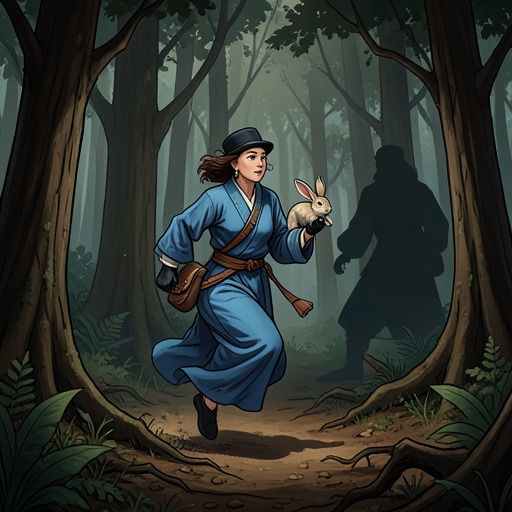
Daji’s approach to Mulan combines apparent assistance with concealed danger. After Mulan has gathered fallen branches for her, Daji offers herself as someone Mulan can summon if she needs help. Mulan asks what to call her, and the woman names herself Daji. Later, hidden among the trees, Mulan remembers the honey Daji put to her lips. The memory makes clear why the earlier offer of help cannot be read simply as generosity: Mulan associates Daji with a sweet substance that has become a source of suspicion and unease.
The pursuit also reaches back to Xiu. When the Rabbit explains the White Fox’s capacity to become a spider, Mulan recognizes the nine-legged creature that bit her sister as Daji. The Rabbit confirms that Daji has been trying to get Xiu for quite some time. This disclosure reframes the danger that began the sisters’ crisis: Xiu’s injury belongs to a sustained pursuit by an enemy who can hide in forms Mulan would not normally connect with the beautiful woman who called herself Daji.
At the City of Rushing Water, Daji adopts another disguise, appearing as an old Hag who directs the crowd’s fear toward Mulan. She declares Mulan to be the River King’s bride and claims that Mulan must be sent to the river to end its flooding. The Magistrate supports the accusation with a supposed prophecy: the chosen bride would arrive on a black horse, and Mulan has ridden into the city on one. Daji’s scheme turns a coincidence into public evidence and makes the threatened river sacrifice appear to be the community’s solution to its distress.
Mulan recognizes the Hag’s smile beneath the changed face. The recognition connects the old woman to the beautiful figure she has seen before, even though the disguise alters Daji’s outward appearance. Mulan objects that the Hag is trying to trick the crowd into removing her. The episode shows Daji’s talent for working through other people: rather than attack Mulan openly, she gives the crowd and the Magistrate a story that makes them instruments of her plan.
Exposure, Defeat, and Narrative Role
Daji’s disguises eventually fail when Mulan deliberately tests what she sees. Holding a teacup, Mulan pieces together her suspicions, then throws the tea at Daji. As Daji moves to shield herself, Mulan glimpses a fox’s tail. She names her as the White Fox, and Daji confirms the identification before turning her anger on Mulan. Mulan rejects Daji’s claim to be an Immortal helping them and tells her to go away. The exposed tail makes physical what the earlier clues had established: beneath the helpful woman and the Hag is the same pursuing fox.
Daji’s response to setbacks reveals a characteristic reliance on schemes, followed by frustration when they fail. After the sea monster has been defeated and the boat has continued onward, she is left watching from above with Xianniang. For once, her usual confidence gives way to visible frustration; she acknowledges that her schemes have failed and shifts her attention to the Garden of Splendors. She plans to prevent Mulan and her companions from picking anything before nightfall and says that, if they find what they seek, she will attack and kill Lu Ting-Pin. Her plan makes Lu the immediate target because she blames him for frustrating her effort to send Mulan to the bottom of the sea.
In the final confrontation, Daji turns back into her beautiful form after Lu Ting-Pin falls to his knees, then boasts that no man can kill her. Her assertion defines the limit she believes protects her, but Mulan is the one who acts. When the White Fox leaps at her, Mulan drives the peach-wood sword into her. Celestial-blue flames burst from the weapon and engulf the White Fox; the shriek that accompanies the blaze falls silent, and the flames go out. Mulan is left holding the sword, having survived the attack and brought Daji’s campaign to its decisive end.
Daji’s narrative function rests on the gap between what a person appears to be and what that appearance conceals. She offers help, assumes the face of a Hag, and turns a black horse into an apparent sign of destiny; each disguise tries to make others accept her version of events. Mulan’s progress against her depends on refusing those appearances as proof and recognizing the pattern connecting them. Daji’s defeat consequently answers both her claim about who can kill her and her repeated confidence that beauty, disguise, and manipulation will keep her beyond reach.