Eight Immortals
MulanThe Eight Immortals are a group of divine beings whose authority in the story is both protective and disciplinary: they are associated with helping others, but they also enforce a strict code among themselves. Their discovery of Lu Ting-Pin’s secret marriage to the mortal Yellow Peony leads to his punishment and lasting separation from her, making the group’s rules a force that reaches beyond its own ranks into mortal lives.
Identity and Place in the Story
The Eight Immortals are described as eight extraordinary beings with divine powers. In the mythic tradition discussed in the book, they dispense justice, alleviate suffering, help others find enlightenment, and can also cause havoc. Their identity therefore combines public service and disruptive power rather than reducing them to a single function. Lu Ting-Pin is often regarded as their leader, and is presented as a characteristic member of the group: kind, powerful, fun-loving, and brash, with a history of adventures.
The group enters the present-day plot through Lu Ting-Pin’s altered status. When the Jade Rabbit explains that Lu Ting-Pin can be found wherever the festivities are, Mulan recognizes him as one of the Eight Immortals. The Jade Rabbit corrects her: Lu Ting-Pin used to belong to their company. That distinction points to a consequential history rather than a temporary absence. Lu’s exclusion follows a judgment by his former companions, and the effects of that judgment remain visible in his abilities and obligations.
The Code and Lu Ting-Pin’s Violation
The Eight Immortals maintain a strict moral code that forbids their members from entering a forbidden relationship with a mortal. Lu Ting-Pin recalls that he fell in love with Yellow Peony and that, although both understood the relationship was wrong, he alone knew that it was forbidden. He nevertheless married her in secret, using his powers to conceal their relationship and deceive those who encountered them. His account makes the group’s standard explicit while locating responsibility for the breach with Lu, who knew the rule and chose to break it.
The concealment took physical form around the couple’s home. Lu conjured a lake with jade-green water and orange fish, but its purpose was not merely decorative: it blocked others from passing and left him as the only one able to fly to Yellow Peony. He says he had tried to keep her hidden from the world, treating her as a treasured possession. The lake thus became both a barrier around their private life and the clue that exposed it. Its sudden appearance could not escape the attention of the Eight Immortals.
Discovery, Judgment, and Consequences
While Lu was away during one of his questionable disappearances, his seven fellow immortals searched for him. Seeing the unfamiliar lake from the air, they investigated and uncovered his deceptions. The discovery transformed private misconduct into a matter for collective judgment: the Eight Immortals were outraged, and their disappointment weighed especially heavily on Lu. They judged him swiftly, using their talismans to hold him aloft while they extracted many of his powers, named his penance, and forbade him from seeing Yellow Peony or interfering in her life again.
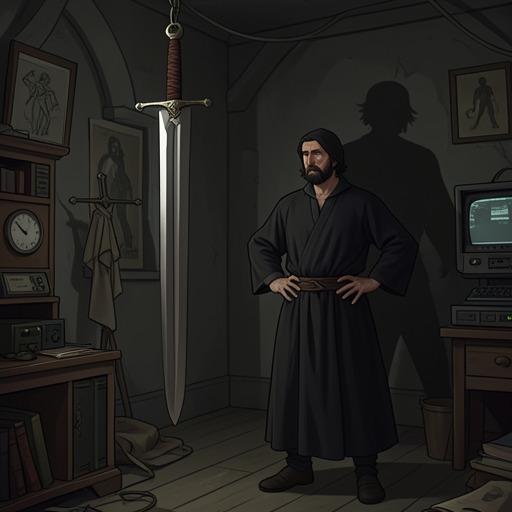
The sentence affected both Lu’s capacities and his conduct. His companions took away his fly whisk, preventing him from flying great distances, and changed his double-edged sword into one made of peach wood. The material had a specific punitive purpose: peach wood could kill noxious beasts and demons, and killing demons became part of his penance. The sword’s demon-killing function therefore records the judgment in an object Lu continues to carry; the group’s decision is not only a past episode but an ongoing condition of his work.
The prohibition on contact also shaped Yellow Peony’s future. Lu says he eventually heard fragments of what happened to her: she had their daughter, and the marriage was dissolved after the child was born. The Eight Immortals arranged for Yellow Peony to move to another town and establish a different identity; she later remarried and began a new family. She could not bear the sight of her eldest daughter, who reminded her of the forbidden marriage and the disgrace surrounding it, and the daughter received the anger that Lu believed should have been directed at him. The group’s intervention changed Yellow Peony’s circumstances, but it did not undo the harm caused by Lu’s actions or prevent that harm from passing to their child.
Mythic Function and Narrative Significance
The Eight Immortals’ judgment gives the group a role beyond identifying Lu Ting-Pin’s former rank. They establish the moral boundary he crossed, impose a punishment that continues to govern his life, and enforce his separation from Yellow Peony. Yet Lu’s own account complicates any simple portrait of discipline as repair: although he accepts that he had no right to control Yellow Peony’s life, the consequences also fell upon her and their daughter. The contrast between the group’s authority and the lasting mortal costs of the affair makes its code consequential without presenting its enforcement as a complete remedy.
The book also places the Eight Immortals within a broader body of Chinese mythic stories. Lu Ting-Pin is associated with the group’s adventures and with a double-edged sword used against evil; the book connects its sea-beast episode to a story in which he is persuaded not to attack a giant octopus. This wider tradition echoes the group’s mixed character as agents of justice and assistance who may also cause havoc. In the plot, that scale contracts to a personal judgment: the same company associated with relieving suffering becomes the authority that disciplines one of its own, while the consequences persist in a wooden sword, a demon-killing penance, and a family divided by secrecy.