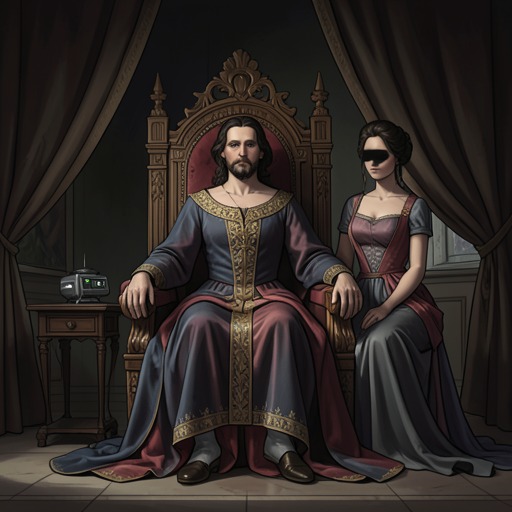
Emperor Zhou
MulanEmperor Zhou is remembered as the last ruler of a dynasty brought down amid his devotion to Daji, the White Fox in the form of a beautiful woman. The Jade Rabbit’s account to Mulan presents a ruler whose lavish attempts to please Daji drained the kingdom and whose willingness to turn war into entertainment helped turn public anger into revolt. His story also reaches Mulan through her family history: Ba had helped end Zhou’s reign, though Mulan had not known the White Fox’s part in his downfall.
Identity and Historical Place
Emperor Zhou ruled the dynasty preceding the one current in Mulan’s time. In her recollections of Ba’s stories, he belongs to the same earlier history as the Rouran invasions: Ba had traveled across the empire as a warrior to help defeat Zhou and fight the Rouran. Mulan admires the honor Ba brought to their ancestors and wishes she could perform a comparable service. Zhou’s reign is therefore more than a distant episode in the Jade Rabbit’s tale; it is part of the family history against which Mulan measures her own hopes.
The later account gives Mulan a new explanation for that history. She knows Zhou as an evil emperor whose reign her father helped end, but she had not understood that Daji had exerted such influence over him. The disclosure shifts the story from a familiar account of a wicked ruler to one in which the White Fox’s manipulation and Zhou’s choices both contribute to political collapse.
Devotion to Daji and Royal Extravagance
According to the Jade Rabbit, Daji’s beauty and charm made her difficult to resist, and Zhou immediately made her his royal companion. He spent the kingdom’s resources on satisfying her preferences. The fastest horses were sent repeatedly across the country to bring her fresh fruit. Charcoal for the heaters was mixed with honey to alter its smell, and fine silk was supplied because she enjoyed hearing it tear.
These recurring extravagances grew into a vast public burden. People from four hundred villages were enslaved to build Daji a palace decorated with jewels and jade, together with a garden and a lake filled with wine. A three-story boat of gold and marble carried her across the lake, where roasted meat was hung from branches for her to take as she passed. When a fallen leaf displeased her, she demanded that it, and other fallen leaves, be replaced by silk leaves. The story makes the excess concrete through these repeated substitutions: ordinary resources and labor were redirected toward increasingly arbitrary wishes, and the kingdom was quickly bankrupted.
Cruelty and the Use of War as Spectacle
The Jade Rabbit distinguishes Zhou’s financial ruin of the state from the cruelty that also weakened his rule. Daji sought new entertainments after tiring of the palace’s diversions. Interested in a belief that a sage’s heart had seven holes, she had the kingdom’s wisest men killed so their hearts could be examined. After observing an ant accidentally cooked in a pan, she persuaded Zhou to devise a similar punishment for his enemies. The account presents these acts as examples of a court in which the ruler’s power served Daji’s curiosity and amusement, rather than the needs of the realm.
Her demand to watch a genuine battle brought that abuse of power into public view. Zhou declared war on a neighboring kingdom to provide the spectacle she wanted. When Daji arrived after combat had begun, he halted the fighting and ordered his soldiers to build a road to a cliffside vantage point. Only after she was seated there, attended and supplied with fruit, did he allow the battle to resume. Once its violence bored her and she wished to go home, Zhou stopped his troops and retreated, despite their advantage. The episode underscores how completely military decisions had become subject to her passing interest.
Revolt, Death, and the Account Given to Mulan
The meaninglessness of the battle’s casualties provoked widespread horror. Days later, when Daji demanded another, larger and bloodier battle, the kingdom revolted. A new emperor was proclaimed, and troops from across the regions turned toward the capital instead of joining another campaign. Commoners gathered at the gates; as the rebels entered the palace, the Imperial Guard joined them. Their shared demand was an end to the reign’s cruelty and extravagance. With no supporters left, Zhou was killed by the new emperor’s son.
Daji appeared to die by hanging with the help of her handmaid, but the apparent end proved false. When her body was retrieved the next day, it had been replaced by a stalk of bamboo. The White Fox had escaped, leaving the dynasty’s collapse behind her and continuing the pattern of destruction and escape described in the account.
Mulan responds to the revelation by connecting Zhou’s downfall to Ba’s service: her father had helped end the reign, but she had not realized that the White Fox had helped cause its corruption. The Jade Rabbit offers a qualified judgment rather than absolving Zhou. He describes the emperor as more foolish than wicked, while acknowledging that Zhou had little goodness; Zhou’s devotion to Daji was so complete that the Rabbit suggests it may help explain why she later seeks revenge. The account thus leaves Zhou responsible for his decisions while showing how Daji’s influence shaped the course of his rule and the rebellion that ended it.