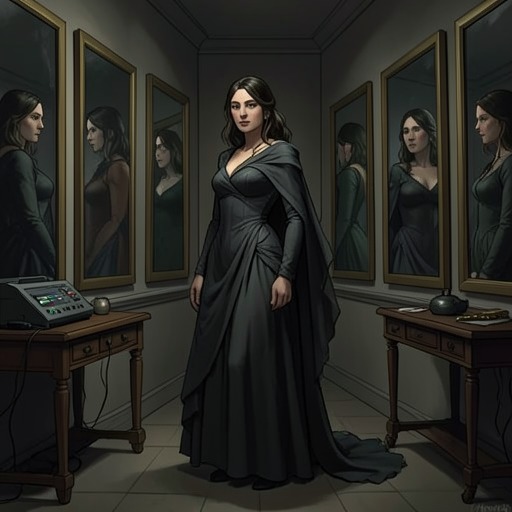
Yellow Peony
MulanYellow Peony is the mortal woman whose secret marriage to Lu Ting-Pin breaks the Eight Immortals’ code and leaves lasting consequences for her and their daughter. Remembered first through Lu’s account and later invoked when Daji takes her face, she is not merely the beloved at the center of his regret: her story reveals how his attempt to possess and protect her helped bring about the family shame and estrangement that shaped their child’s life.
Identity and Relationship with Lu Ting-Pin
Lu describes falling in love with Yellow Peony at a glance. Her beauty drew him, but what held his attention was the light in her eyes, which he associated with innocence and hope. He says that both of them understood their relationship was wrong, while he alone knew that it was forbidden to him as one of the Eight Immortals. Despite that knowledge, he pursued the attachment and married her in secret.
Lu’s recollection names her as a woman with thoughts and a destiny of her own. This recognition is central to his later remorse: he had treated her as something to conceal and keep, rather than as a person entitled to shape her own life. The account therefore distinguishes the intensity of his attachment from the care he owed her. His love did not prevent him from exercising power over the circumstances in which she lived.
Secret Marriage and Separation
To hide the marriage, Lu used his powers to deceive those around him, offering implausible explanations for his absences. He also conjured a lake around the home he had made with Yellow Peony. Its jade-green water and orange fish made it beautiful, but Lu admits that beauty was not his purpose. The lake served as a barrier: he intended that no one could reach the house, and that he alone could fly to her.
The concealment failed when Lu’s seven fellow Immortals noticed the unfamiliar lake during one of his absences and investigated. They exposed his deceptions and judged him swiftly. Their talismans held him helpless in the air while they extracted many of his powers, imposed penance, and forbade him both to see Yellow Peony and to interfere in her life. Lu recalls that their disappointment affected him deeply, but the prohibition also marked a limit he had no right to evade. He later acknowledged that his attempt to keep her apart from the world had injured a destiny that belonged to her, not to him.
Motherhood and the Unwanted Girl
Yellow Peony gave birth to a daughter amid the disgrace surrounding the marriage. After the child’s birth, the Immortals dissolved the marriage and arranged for Yellow Peony to move to another town and establish a different identity. She was able to remarry and begin another family and life. Lu learned these developments only gradually, through fragments of information; the separation meant that he did not direct or witness her subsequent life firsthand.
The daughter, however, remained a painful reminder to Yellow Peony of the relationship, its shame, and the dishonor it had brought her. Lu says Yellow Peony could not bear the sight of her eldest daughter and that her anger and resentment fell on the child, though he believed the blame properly belonged to him. The girl came to be known as the Unwanted Girl. In Lu’s reckoning, this was the most terrible consequence of his actions: not simply that he had been punished or separated from Yellow Peony, but that an innocent child endured the resentment produced by the adults’ choices.
Daji’s Assumed Face and Yellow Peony’s Accusation
The history returns during the confrontation with Daji, when Lu sees that she has taken Yellow Peony’s face. Addressing him as the woman he had called his delicate peony and his love, Daji presents the relationship not as a private romance but as the source of harm: she says that it led to her family disowning her, drove her from her village, and broke her heart. The assumed face makes the past immediate, while the accusations put Yellow Peony’s experience beside Lu’s own account of guilt.
Daji further accuses Lu of abandoning her and their child and says that the shame and resentment of their relationship turned her against her daughter. She describes that resentment as changing her into a bitter woman who no longer sees innocence or hope. Lu’s earlier confession had already acknowledged the daughter’s rejection as a consequence of his conduct; Daji’s words give that consequence the force of a direct accusation. Nearby, the Red Fox watches Daji intently as Mulan asks whether the Unwanted Girl is the same girl who became the Red Fox. The scene connects Yellow Peony’s history to the daughter’s later identity without erasing the harm that passed from one generation to the next.
Narrative Significance
Yellow Peony’s story is conveyed through two partial accounts: Lu’s retrospective confession and Daji’s later, accusing performance in her face. Lu recognizes his responsibility, especially for the daughter’s rejection, but his account also begins with his own powerful love and remorse. Daji’s words shift attention toward what that love cost Yellow Peony: her family ties, her place in her village, and the conditions under which she became a mother. Together, the accounts expose the distance between romantic devotion and respect for another person’s agency.
Her role in the narrative also makes the daughter’s name, the Unwanted Girl, more than a description of childhood. It records the lasting effect of a secret marriage and the resentment it generated. Yellow Peony is thus central to the chain of cause and consequence that links Lu’s forbidden choice, the family’s disgrace, and the child’s rejection, even though the available account follows her later life only in brief reports and the words spoken through Daji’s borrowed face.